Report From Japan
REPORT FROM JAPAN
YUKIO KURODA
SUZUKA 10-HOUR
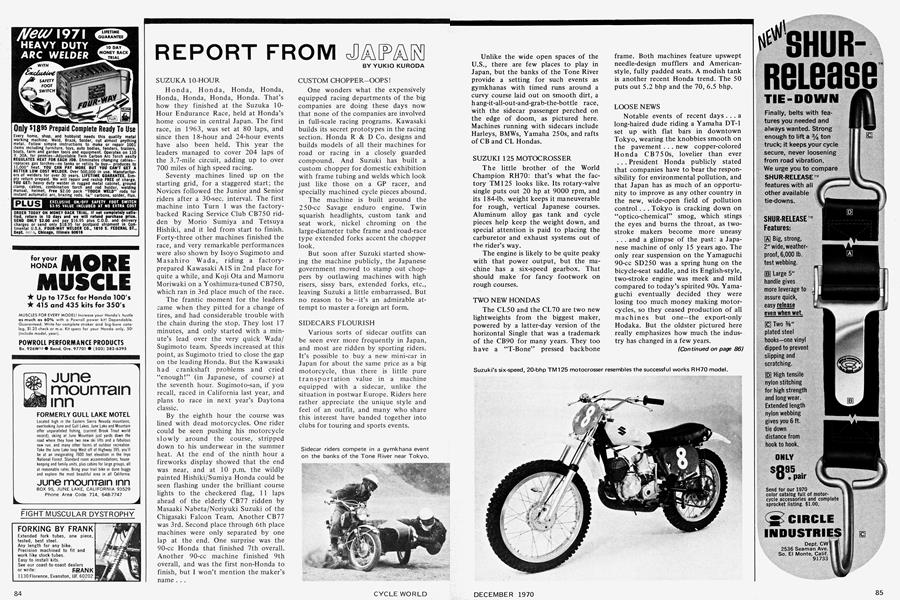
Honda, Honda, Honda, Honda, Honda, Honda, Honda, Honda. That’s how they finished at the Suzuka 10-Hour Endurance Race, held at Honda’s home course in central Japan. The first race, in 1963, was set at 80 laps, and since then 18-hour and 24-hour events have also been held. This year the leaders managed to cover 204 laps of the 3.7-mile circuit, adding up to over 700 miles of high speed racing.
Seventy machines lined up on the starting grid, for a staggered start; the Novices followed the Junior and Senior riders after a 30-sec. interval. The first machine into Turn 1 was the factorybacked Racing Service Club CB750 ridden by Morio Sumiya and Tetsuya Hishiki, and it led from start to finish. Forty-three other machines finished the race, and very remarkable performances were also shown by Isoyo Sugimoto and Masahiro Wada, riding a factoryprepared Kawasaki AIS in 2nd place for quite a while, and Koji Ota and Mamoru Moriwaki on a Yoshimura-tuned CB750, which ran in 3rd place much of the race.
The frantic moment for the leaders came when they pitted for a change of tires, and had considerable trouble with the chain during the stop. They lost 17 minutes, and only started with a minute’s lead over the very quick Wada/ Sugimoto team. Speeds increased at this point, as Sugimoto tried to close the gap on the leading Honda. But the Kawasaki had crankshaft problems and cried “enough!” (in Japanese, of course) at the seventh hour. Sugimoto-san, if you recall, raced in California last year, and plans to race in next year’s Daytona classic.
By the eighth hour the course was lined with dead motorcycles. One rider could be seen pushing his motorcycle slowly around the course, stripped down to his underwear in the summer heat. At the end of the ninth hour a fireworks display showed that the end was near, and at 10 p.m. the wildly painted Hishiki/Sumiya Honda could be seen flashing under the brilliant course lights to the checkered flag, 11 laps ahead of the elderly CB77 ridden by Masaaki Nabeta/Noriyuki Suzuki of the Chigasaki Falcon Team. Another CB77 was 3rd. Second place through 6th place machines were only separated by one lap at the end. One surprise was the 90-cc Honda that finished 7th overall. Another 90-cc machine finished 9th overall, and was the first non-Honda to finish, but I won’t mention the maker’s name . . .
CUSTOM CHOPPER—OOPS!
One wonders what the expensively equipped racing departments of the big companies are doing these days now that none of the companies are involved in full-scale racing programs. Kawasaki builds its secret prototypes in the racing section. Honda R & D Co. designs and builds models of all their machines for road or racing in a closely guarded compound. And Suzuki has built a custom chopper for domestic exhibition with frame tubing and welds which look just like those on a GP racer, and specially machined cycle pieces abound.
The machine is built around the 2 50-cc Savage enduro engine. Twin squarish headlights, custom tank and seat work, nickel chroming on the large-diameter tube frame and road-race type extended forks accent the chopper look.
But soon after Suzuki started showing the machine publicly, the Japanese government moved to stamp out choppers by outlawing machines with high risers, sissy bars, extended forks, etc., leaving Suzuki a little embarrassed. But no reason to be—it’s an admirable attempt to master a foreign art form.
SIDECARS FLOURISH
Various sorts of sidecar outfits can be seen ever more frequently in Japan, and most are ridden by sporting riders. It’s possible to buy a new mini-car in Japan for about the same price as a big motorcycle, thus there is little pure transportation value in a machine equipped with a sidecar, unlike the situation in postwar Europe. Riders here rather appreciate the unique style and feel of an outfit, and many who share this interest have banded together into clubs for touring and sports events.
Unlike the wide open spaces of the U.S., there are few places to play in Japan, but the banks of the Tone River provide a setting for such events as gymkhanas with timed runs around a curvy course laid out on smooth dirt, a hang-it-all-out-and-grab-the-bottle race, with the sidecar passenger perched on the edge of doom, as pictured here. Machines running with sidecars include Harleys, BMWs, Yamaha 250s, and rafts of CB and CL Hondas.
SUZUKI 125 MOTOCROSSER
The little brother of the World Champion RH70: that’s what the factory TM125 looks like. Its rotary-valve single puts out 20 hp at 9000 rpm, and its 184-lb. weight keeps it maneuverable for rough, vertical Japanese courses. Aluminum alloy gas tank and cycle pieces help keep the weight down, and special attention is paid to placing the carburetor and exhaust systems out of the rider’s way.
The engine is likely to be quite peaky with that power output, but the machine has a six-speed gearbox. That should make for fancy footwork on rough courses.
TWO NEW HONDAS
The CL50 and the CL70 are two new lightweights from the biggest maker, powered by a latter-day version of the horizontal Single that was a trademark of the CB90 for many years. They too have a “T-Bone” pressed backbone
frame. Both machines feature upswept needle-design mufflers and Americanstyle, fully padded seats. A modish tank is another recent Honda trend. The 50 puts out 5.2 bhp and the 70, 6.5 bhp.
LOOSE NEWS
Notable events of recent days ... a long-haired dude riding a Yamaha DT-1 set up with flat bars in downtown Tokyo, wearing the knobbies smooth on the pavement . . . new copper-colored Honda CB75 0s, lovelier than ever . . . President Honda publicly stated that companies have to bear the responsibility for environmental pollution, and that Japan has as much of an opportunity to improve as any other country in the new, wide-open field of pollution control. . . Tokyo is cracking down on “optico-chemical” smog, which stings the eyes and burns the throat, as twostroke makers become more uneasy . . . and a glimpse of the past: a Japanese machine of only 15 years ago. The only rear suspension on the Yamaguchi 90-cc SD250 was a spring hung on the bicycle-seat saddle, and its English-style, two-stroke engine was meek and mild compared to today’s spirited 90s. Yamaguchi eventually decided they were losing too much money making motorcycles, so they ceased production of all machines but one—the export-only Hodaka. But the oldster pictured here really emphasizes how much the industry has changed in a few years.
(Continued on page 86)
Continued from page 85
RUMORS ABOUT HONDA 500s
It’s about Motor Show time in Japan. And just about two years ago Honda startled the motorcycling world with the four-cylinder 750. The big Four has been more successful than Honda ever imagined it would be, and people are speculating whether there will be more surprises appearing at the Harumi Fairgrounds show.
One story says a 500-cc version of the four-cylinder machine will appear. It would be a replica of its big brother in most design features, but would be priced down to meet the competition. During development of the new machine, engineers wrestled with the problem of Duuding a 500 that wouldn’t be beaten too badly by the acceleration of the Kawasaki Mach III, the star seller in the 500 class. Since a 750 is only fractionally faster through the quarter and on the top end, it would seem to be difficult for Honda to produce a quicker machine in the 30-in. class.
Another story concerns the rumored Honda motocross machine which I mentioned many months ago. Honda R & D engineers reportedly started with a 350 Single, but didn’t manage to get the torque and the combination they wanted. Then the engine was redesigned as a 500 Single. A pushrod 500. That’s what the man said, all right. Unless Honda can figure out how to build an overhead cam machine that’s lighter and more compact than any previous machine, they’ll probably settle on the pushrod design—and set off a chorus of “I told you so’s” from Great Britain .
The new machines will most likely debut in late winter, if not at the Tokyo Motor Show. But they might not be available in the U.S. for some months, if past Honda practice is an indicator of export plans.
YAMAHA SAID TO HAVE A THREE
The other big news that just leaked is about an 800-cc two-stroke from Yamaha. The company is reportedly contemplating such a machine to get a larger piece of the big-bike market.
They previously thought that bigbore motorcyclists were prejudiced against two-stroke machines (the poor reception of the Suzuki 500 in the late 60’s may have had something to do with this), and that’s where their big Twin 650 ohc machine came in.
But they spent years refining the XS 1-650, and by the time it was announced, Kawasaki was reaping a landslide of sales and praise for their Mach III 500. The continuing success of the Mach III must have convinced Yamaha that there is a good-sized market for a multi-cyíinder two-stroker.
When the first decision to build the XS1-650 was made, the demand for big British Twins was very high in the U.S. But a younger generation of riders that grew up on Yamahas, Kawasakis, and Suzukis has demonstrated different preferences, and these riders are apparently ready and willing to buy a threecylinder two-stroke. Many months ago I reported that Suzuki was contemplating a three-cylinder 650 or 750 two-stroke, but no more news has turned up on that lead. Will Yamaha be the one to challenge the Mach Ill’s leadership on the drag strip? The XS 1-650 won’t do it. But a new multi could. This would do a lot to strengthen Yamaha’s position in the superhot superbike market.