Continental Report
CONTINENTAL REPORT
B. R. NICHOLLS
AS SURELY as summer is followed by fall, so the sporting season draws slowly to its close. And, with the cool winds of late season, there comes a wind of change that strikes at the very foundations of the racing scene. In recent years, both Mobil and Esso have actively supported, then withdrawn from motorcycle activities. Mobil has retained a slight interest in cars and Esso has moved wholeheartedly into the four wheel brigade. Now BP has withdrawn from both car and cycle fields as a direct economy measure, supposedly brought about by the present position in the Middle East. However, it is worth mentioning that the British government has a very large shareholding in the company.
Following the BP action and the present worldwide decline in motorcycle markets, it is difficult to forecast what action may be taken by Shell and Castrol, the two remaining petroleum companies. It could well be that the days of contracts and the payment of large sums to companies and individuals are nearly over.
Allied to the BP move is one made by the Grovewood concern that owns Brands Hatch, Oulton Park, Mallory Park and Snetterton. The firm has announced that next season there will be no start money paid to anyone at national meetings. The money thus saved will be added to present prize money and paid farther down the field. This naturally brought an outcry, but it was a vociferous minority, for at present 80 percent of competitors at a meeting will not make the prize money. The oil companies could adopt a similar procedure — not pay retainers, but give large bonuses for international grand prix wins. There undoubtedly will be a shakedown as a result of the BP action and that of Grovewood, but as in all walks of life, the fittest will survive, and in the long run racing may well be the better for it.
Paul Friedrichs, the quiet spoken, good looking East German, has retained his 500cc world motocross title in devastating fashion with a win at the final round in Switzerland. So, with seven out of 12 scores to count, he has a maximum of 56 points. Runnerup with 35 points was Jeff Smith, who just kept ahead of Dave Bickers who finished with 32. Bickers' chance of beating Smithy disappeared in Switzerland when his bike seized on the way to the start of the first race. Friedrichs had eight wins in all and this underlines his superiority, for Bickers won two of the remaining four and Smith and Gunnar Draugs one each. Fourth place in the championship went to the very popular Czech, Vlastimil Valek. Belgian Roger De Coster sneaked fifth place from Draugs by (Continued on page 102) taking runnerup spot in Switzerland, there by gaining 15 of his total 19 in the last three meetings. Final standings are:
In the 250cc class, Joel Robert's crash in practice for the Swedish meeting put paid to his title hopes,for he was still suf fering from its effects the following week in Finland, where he was forced to retire in the first race. Olle Pettersson, however, showed Torsten Hallman the way `round and was the winner on time;each had won one race. The following week, in Russia, Haliman made no mistake, winning both legs. Robert finished second in the first race, but retired in the second. Thus Hallman gained the crown for the second year running. Pettersson, second in Russia, stood a chance of finishing runnerup, if Robert failed to score at the last meeting and Pettersson won. Robert won, however, and so took runnerup position. Though the Swede had a greater total of championship points, his best seven rides put him six down on the Belgian. Hallman and Robert each won five of the twelve meetings, Pet tersson took one and the luckless Russian Victor Arbekov won the first round in Spain to carry the jinx that has gone with winning that round since the champion ship started. Final standings were:
With the finish of the championship events come the two international team contests, the first of which is the Trophee des Nations for 250cc machines. Sweden started favorites and fully justified the choice as three riders in the first six of the individual world title were Swedes. The meeting was held in Czechoslovakia. With 14 teams entered it was necessary to hold two qualifying heats. This ended Russia's chances when Arbekov crashed in his heat. In the race that decided the destination of the Trophy, Hallman rode as befits the champion and finished in first place with Robert second, Shinkarenko third and Polas fourth. Thus, four different countries were represented in the first four finishers. With riders scoring points on par with their finishing positions, Sweden won with a total of 13. Next came Czechoslovakia with 19, then Russia with 24, Great Britain with 38, Belgium with 42 and East Germany with 71.
On the home front Alan Clough has clinched the British 250 motocross championship and lies joint fourth in the 500 class with Chris Horsfield. With one round to go, Smith leads by four points over Vic Eastwood and Dave Bickers, so the final round next month should be a real cracker.
So, to road racing and a couple of true cliff hangers. The 250 and 500cc class title fights are in doubt, and in the 500cc class Mike Hailwood must win the two re-
maining rounds to regain the title he lost last year to Agostini. One win would again make Ago champ.
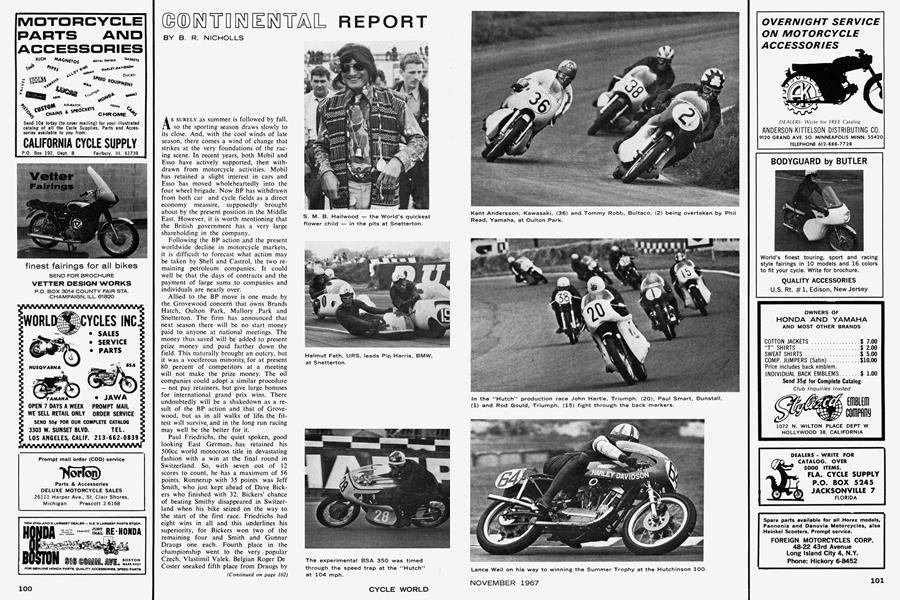
With three rounds to go for the .250 it is even closer. Though the main contenders obviously are Read and Hailwood, Ivy has a good chance and Bryans still is an outsider. One must believe the speed of Yamaha fours has caught Honda by surprise and that the latter will counter soon with a much improved six or even a new design altogether, which could only be an eight-cylinder design. A few years ago this would have seemed ludicrous and impossible, but such is the ingenuity of Honda technicians. An eight is the logical step, though the joining of two five-cylinder 125cc engines may even have crossed some Honda minds. There seems little doubt the 500cc Guzzi V-8 soon will lose its title of the world's most sophisticated motorcycle. It is not that the present Honda six is slow, it is that Yamaha is getting great speed from two-strokes. Even the elderly aircooled twin that Read uses for British short circuit meets is fast enough to push Hailwood on this year's grand prix model. Proof of this came during the August holiday weekend at Oulton Park when Read and Hailwood engaged in a superb dice in the 250 race. To escape from Read, Hailwood lapped once at 97.07 mph to create an absolute record and break by over 5 mph the one set by Derek Minier on a 500cc Gilera four years ago. Mike had done a similar thing the day before at Snetterton when he set the absolute record at 94.35. That was where the crowd looked forward to seeing the big Harley, ridden by Lance Weil, up against the aces. But, rushing into the first corner after a mediocre start, the big twin bucked and slid down the road. The very vulnerable Tillotson carburetor was knocked off. A cylinder was damaged and the gearbox was broken. Lance suffered a badly bruised ankle and now anxiously awaits spares from Milwaukee, Wis., to enable him to put the machine on the line for the Race of the Year at Mallory.
This year Scarborough joined Snetterton and Oulton in holding international meetings, and it proved to be a success story for Helmut Fath. Riding his four-cylinder URS, which he built, Fath set a new sidecar lap record, then watched John Blanchard on a solo version set fastest lap in the 500 race. Blanchard won his heat, but slid off in the final. The Seeley framed machine was expected to race at Snetterton and Oulton, but squabbling between Seeley and Blanchard led to its withdrawal from both meetings. Cause of the trouble was the fitting at Scarborough of a Lockheed disc brake to the front wheel without consulting Seeley. It now appears that it will not be seen again this season in solo form. Perhaps a long cold winter will help to settle the matter, but it may mean that Fath must have a go at building a frame of his own. Fath went on to win at Snetterton after a terrific dice with Pip Harris' BMW. The most impressive Scarborough winner was Swedish rider Kent Andersson, who, riding a Kawasaki bought only a week earlier, won the 250 race though he hadn't ridden the circuit before. John Cooper, on a Seeley Matchless, won the 500 race. Dan Shorey won the 350 and followed it the next day at Snetterton by winning the Race of the Aces, as well as the 500 class. Kelvin Carruthers, on his very fast Aermacchi, won the 350 class after Mike Hailwood had blown up the 350 Honda four in passing him. No fluke this win for the Australian, as he won the same class the following day at Oulton Park. Bill Ivy, with only a 125 Yamaha at his disposal, won at both Snetterton and Oulton. Cooper won both the Les Graham Memorial Trophy and 500cc race at Oulton, where the sidecar scrap between the two Germans, Schauzu and Enders, decided over two races, went to Schauzu on time.
A couple of weeks before the holiday weekend was the Hutchinson Hundred meeting, staged at Brands Hatch with racing held counter-clockwise to prevent the regulars having an advantage. Practice for the meeting was on Saturday. During the 500 class session, relations between Colin Seeley and John Blanchard, riding the Seeley framed URS, took a knock when Blanchard, riding in close company with Ray Pickrell on the big Dunstall Dominator, grounded the exhausts and slid off. Fortunately the damage was not serious and it is to Seeley's credit that he worked most of the night to have it ready to race the following day. The race of the meeting was the production event with four riders up front going hammer and tongs at each other. Those concerned were Paul Smart and Ray Pickrell on Dunstall Dominators, and Rod Gould and John Hartle on 650 Triumphs. Pickrell was forced to fight his way through the field to join the leaders after 10 laps. From then to the end it was cut and thrust with the wily veteran, Hartle, making his effort at just the right moment to win from Gould, with Pickrell third and Smart fourth. Hartle's win also gained him the coveted Mellano trophy awarded to the rider whose race speed comes nearest to, or exceeds by the greatest margin, the existing lap record. The lap record was 82.10 mph. Hartle's race record speed was 83.87. He also set a record lap at 85.64 mph. Bill Ivy set a lap record when winning the 125 race on his Yamaha at 83.25 mph. Helmut Fath broke the 750cc sidecar lap record on his 500cc URS when winning the sidecar race. He also won the 1300cc three-wheeler event from Owen Greenwood and the 1071-cc Mini, which set a class lap record at 81.82 compared with Fath's 80.30 for the 750 class. Dan Shorey, on a Norton, was the 350 winner. Hailwood won both 250 events and also the big race of the day for which . he rode his 297cc Honda six.
In the summer scratch race, Lance Weil gained an easy win on the Harley. Not so the previous week at Lydden when he gained his first win in dramatic fashion. As he left the paddock for the big race final,his clutch cable broke and he was a very bad last away as he required help to push start the monster without the clutch after the remainder of the field had left the line. It took 10 of the 12 laps for Lance to fight his way through the field, but he did,to score a great win and give the crowd a memorable race. At the same meeting Frank Scurria had a second in the 250 race and a fourth in the 350, mounted on his Kawasakis. Lance has had problems stopping the Harley. As can be seen from the accompanying photograph, he has fitted a disc brake to the front. g