Belgian Grand Prix
BELGIAN GRAND PRIX
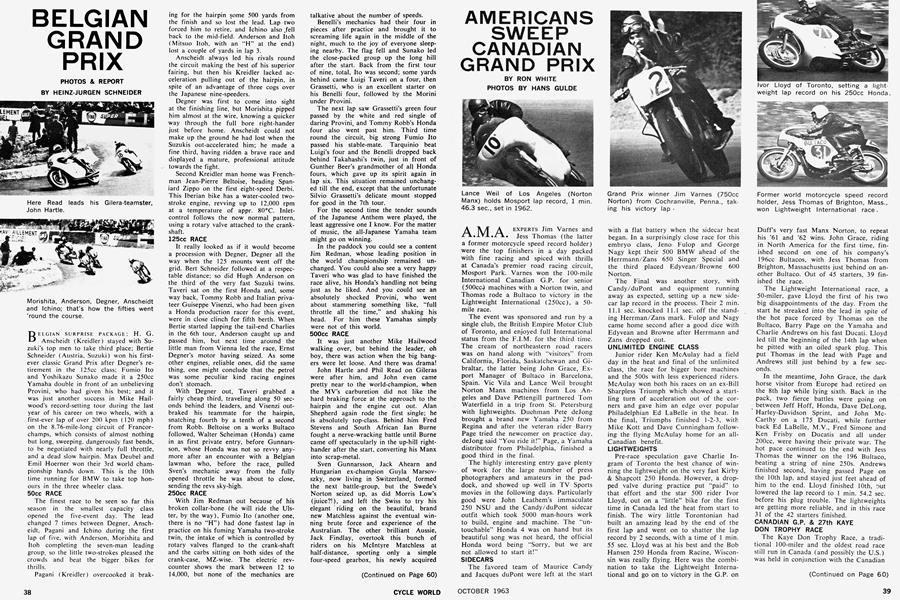
BELGIAN SURPRISE PACKAGE: H. G. Anscheidt (Kreidler) stayed with Suzuki’s top men to take third place; Bertie Schneider (Austria, Suzuki) won his firstever classic Grand Prix after Degner’s retirement in the 125cc class; Fumio Ito and Yoshikazu Sunako made it a 250cc Yamaha double in front of an unbelieving Provini, who had given his best; and it was just another success in Mike Hailwood’s record-setting tour during the last year of his career on two wheels, with a first-ever lap of over 200 kpm (120 mph) on the 8.76-mile-long circuit of Francorchamps, which consists of almost nothing but long, sweeping, dangerously fast bends, to be negotiated with nearly full throttle, and a dead slow hairpin. Max Deubel and Emil Hoerner won their 3rd world championship hands down. This is the 10th time running for BMW to take top honours in the three wheeler class.
50cc RACE
The finest race to be seen so far this season in the smallest capacity class opened the five-event day. The lead changed 7 times between Degner, Anscheidt, Pagani and Ichino during the first lap of five, with Anderson, Morishita and Itoh completing the seven-man leading group, so the little two-strokes pleased the crowds and beat the bigger bikes for thrills.
Pagani (Kreidler) overcooked it brak-
ing for the hairpin some 500 yards from the finish and so lost the lead. Lap two forced him to retire, and Ichino also .fell back to the mid-field. Anderson and Itoh (Mitsuo Itoh, with an “H” at the end) lost a couple of yards in lap 3.
Anscheidt always led his rivals round the circuit making the best of his superior fairing, but then his Kreidler lacked acceleration pulling out of the hairpin, in spite of an advantage of three cogs over the Japanese nine-speeders.
Degner was first to come into sight at the finishing line, but Morishita pipped him almost at the wire, knowing a quicker way through the full bore right-hander just before home. Anscheidt could not make up the ground he had lost when the Suzukis out-accelerated him; he made a fine third, having ridden a brave race and displayed a mature, professional attitude towards the fight.
Second Kreidler man home was Frenchman Jean-Pierre Beltoise, heading Spaniard Zippo on the first eight-speed Derbi. This Iberian bike has a water-cooled twostroke engine, revving up to 12,000 rpm at a temperature of appr. 80°C. Inletcontrol follows the now normal pattern, using a rotary valve attached to the crankshaft.
125cc RACE
It really looked as if it would become a procession with Degner, Degner all the way when the 125 mounts went off the grid. Bert Schneider followed at a respectable distance; so did Hugh Anderson on the third of the very fast Suzuki twins. Taveri sat on the first Honda and, some way back, Tommy Robb and Italian privateer Guiseppe Visenzi, who had been given a Honda production racer for this event, were in close clinch for fifth berth. When Bertie started lapping the tail-end Charlies in the 6th tour, Anderson caught up and passed him, but next time around the little man from Vienna led the race, Ernst Degner’s motor having seized. As some other engines, reliable ones, did the same thing, one might conclude that the petrol was some peculiar kind racing engines don’t stomach.
With Degner out, Taveri grabbed a fairly cheap third, traveling along 50 seconds behind the leaders, and Visenzi outbraked his teammate for the hairpin, snatching fourth by a tenth of a second from Robb. Beltoise on a works Bultaco followed, Walter Scheiman (Honda) came in as first private entry, before Gunnarsson, whose Honda was not so revvy anymore after an encounter with a Belgian lawman who, before the race, pulled Sven’s mechanic away from the fully opened throttle he was about to close, sending the revs sky-high.
250cc RACE
With Jim Redman out because of his broken collar-bone (he will ride the Ulster, by the way), Fumio Ito (another one, there is no “H”) had done fastest lap in practice on his fuming Yamaha two-stroke twin, the intake of which is controlled by rotary valves flanged to the crank-shaft and the carbs sitting on both sides of the crank-case, MZ-wise. The electric revcounter shows the mark between 12 to 14,000, but none of the mechanics are
talkative about the number of speeds.
Benelli’s mechanics had their four in pieces after practice and brought it to screaming life again in the middle of the night, much to the joy of everyone sleeping nearby. The flag fell and Sunako led the close-packed group up the long hill after the start. Back from the first tour of nine, total, Ito was second; some yards behind came Luigi Taveri on a four, then Grassetti, who is an excellent starter on his Benelli four, followed by the Morini under Provini.
The next lap saw Grassetti’s green four passed by the white and red single of daring Provini, and Tommy Robb’s Honda four also went past him. Third time round the circuit, big strong Fumio Ito passed his stable-mate. Tarquinio beat Luigi’s four and the Benelli dropped back behind Takahashi’s twin, just in front of Gunther Beer’s grandmother of all Honda fours, which gave up its spirit again in lap six. This situation remained unchanged till the end, except that the unfortunate Silvio Grassetti’s delicate mount stopped for good in the 7th tour.
For the second time the tender sounds of the Japanese Anthem were played, the least aggressive one I know. For the matter of music, the all-Japanese Yamaha team might go on winning.
In the paddock you could see a content Jim Redman, whose leading position in the world championship remained unchanged. You could also see a very happy Taveri who was glad to have finished the race alive, his Honda’s handling not being just as he liked. And you could see an absolutely shocked Provini, who went about stammering something like, “full throttle all the time,” and shaking his head. For him these Yamahas simply were not of this world.
500cc RACE
It was just another Mike Hailwood walking over, but behind the leader, oh boy, there was action when the big bangers were let loose. And there was drama!
John Hartle and Phil Read on Güeras were after him, and John even came pretty near to the world-champion, when the MV’s carburetion did not like the hard braking force at the approach to the hairpin and the engine cut out. Alan Shepherd again rode the first single; he is absolutely top-class. Behind him Fred Stevens and South African Ian Burne fought a nerve-wracking battle until Burne came off spectacularly in the up-hill righthander after the start, converting his Manx into scrap-metal.
Sven Gunnarsson, Jack Ahearn and Hungarian ex-champion Guyla Marsovszky, now living in Switzerland, formed the next battle-group, but the Swede’s Norton seized up, as did Morris Low’s (juice?!), and left the Swiss to try his elegant riding on the beautiful, brand new Matchless against the eventual winning brute force and experience of the Australian. The other brilliant Aussie, Jack Findlay, overtook this bunch of riders on his McIntyre Matchless at half-distance, sporting only a simple four-speed gearbox, his newly acquired Schaftleitner-six having given trouble in practice and caused an enormous amount of work the whole paddock took interest in. Unfortunately, a completely disorganized last lap stop for refueling pushed him off the leader board.
(Continued on Page 60)
Fighting with Roy Ingram, Englishman Bill Mizen went round, his Norton bearing a number which originally belonged to William Sharp’s BSA, the Delaware moto-cross rider now stationed in Paris during his army-time, being kept from qualifying by a faulty magneto. Geoff Duke pulled a face when, three laps from the end, his number one did not turn up again. A murmured “broken” was Hartle’s sole comment when he pushed his faithless four over the line to qualify as a finisher, m company with Juri Randla, on the last of CKB’s who did the same. The other Russians did not show up in the front groups, nor did they finish, in spite of Sevostianov’s eighth fastest time in practice, done in a frightening style which was nearer to attempted manslaughter than to ordinary dangerous riding. SIDECARS
Tension was in the air, and a bit of fear that something might go wrong, when the three-wheelers lined up for the start of a race which would bring the decision between Florian Camathias and Max Deubel. Both of them had done in their engines during practice. Flori had done the welding of his lifetime, repairing the aluminum cylinderhead with a normal welding apparatus without Argon cover.
Scheidegger, Camathias and Deubel shared the front row. The German made best start, then Camathias in fifth position, a nightmare for anyone who knows his way of overtaking, and Fritz Scheidegger was way back in 15th place among the tail-enders. But when they reappeared after the first 8.76 miles, the beautiful silver fairing of Camathias showed up first, then the red one of Scheidegger and then, in an already hopeless-looking position, the white-blue BMW with the emblems of “Max und Moritz,” the terrible children created by one of Germany’s greatest humorists, Wilhelm Busch, painted on the left hand side.
Lap two gave the same position, Camathias still further ahead, but the next time the silver outfit was missing. Old Flori had given away the chance of his lifetime to become world champion. In a situation in which he could have taxied round the circuit just in front of Deubel and collected the points, he had lost his nerves and wrecked the BMW engine. Anyway, that kept him from losing his head later in the race.
Managed by once-famous Swiss sidecar-driver Hans Haldemann (on the track of Europe until the mid-fifties), Scheidegger took his kneeler to his only classic win this season, and Deubel/Hoerner, now fully recovered from their TT crash, even had time to stop and look over their frighteningly shaking outfit, when their rival was out. They carried on easily and collected enough points to make sure of the title for the third time running. •