M IS FOR Magic
There’s a ton of untapped potential in the M 1000 RR and it may take a sorcerer to unleash it
There’s a ton of untapped potential in the M 1000 RR and it may take a sorcerer to unleash it
M IS FOR Magic
There’s a ton of untapped potential in the M 1000 RR and it may take a sorcerer to unleash it
MICHAEL GILBERT
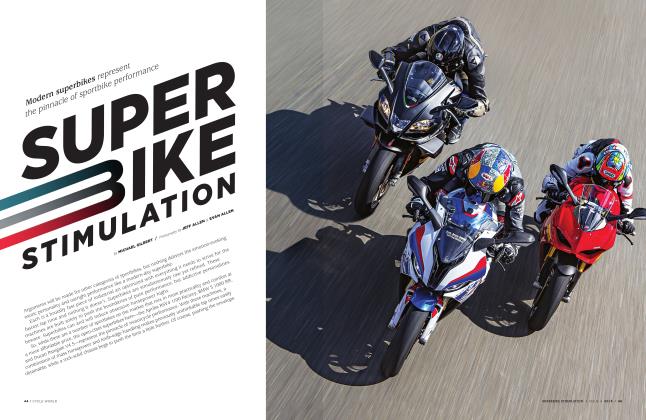
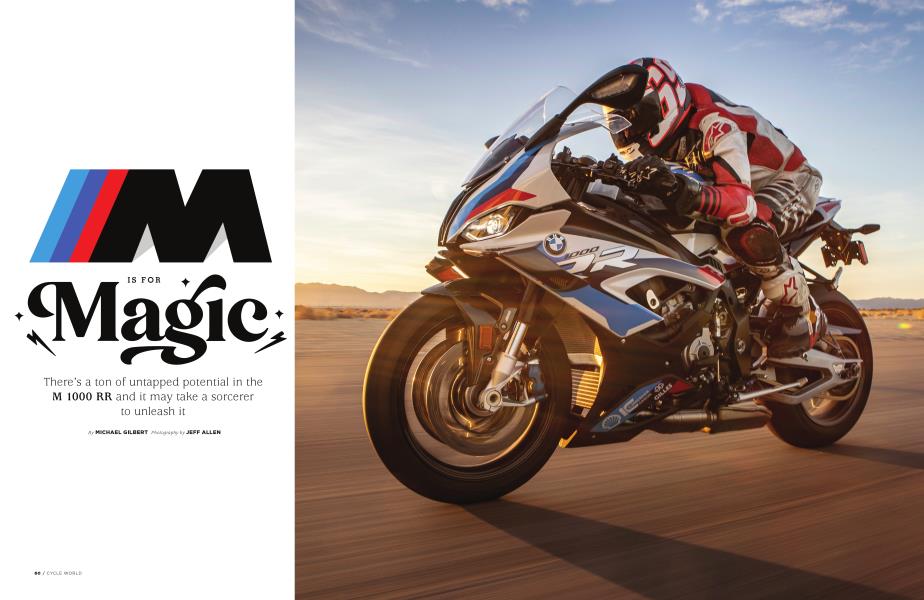
The curbs lining Chuckwalla Valley Raceway’s intricate 2.68-mile layout are like bogeys for the 2021 BMW M 1000 RR’s fighter-jet-like precision. The locked-on attitude of the Bavarian-built literbike is a showcase of the company’s years of racing endeavors and technical expertise while the bike also serves a platform for developing future model improvements.
Of course, M 1000 RR is also a homologation special, every bit of the bike’s design and performance focused on gaining advantage within the scope of World Superbike technical regulations. The street-spec equipment is there merely to meet DOT requirements and ensure it qualifies as a for-sale streetbike in accordance with the rules of production-based racing. Sure, the $37,490 M is there for well-heeled trackday connoisseurs or even club racers, but its number one role is to give BMW Motorrad and its supported racing efforts a machine on which to work their magic in search for the ideal lap time.
What you get is a motorcycle that Motorrad touts as the first two-wheel model to join BMW’s iconic M-series and a competition-minded offspring of the S 1000 RR, which has established itself as a long-standing contender in the open-class production literbike category from its introductory year of 2009. Except the M 1000 RR is sharper and more exotic so that the racing elite can race toward glory.
As with the already-ripping S 1000 RR, the M RR utilizes the same basic 998cc inline-four with BMW’s ShiftCam Technology. It’s a spectacular engine in S form, but a number of internal components are altered with racing in mind. A set of lightweight titanium Pankl connecting rods that are 2mm longer than before move new, lower-friction two-ring forged Mahle pistons. These lighter components kick redline to 1 5,100 rpm (500 rpm higher than the S model). Compression ratio is bumped to 13.5:1 via a new combustion chamber profile while valve-actuating finger followers have been redesigned for reduced weight. Even the titanium Akrapovic exhaust shaves 8 pounds in comparison to the exhaust system on the S 1000 RR.
The result of the revisions is a powerplant that BMW Motorrad says produces, undramatically, 205 hp at 13,000 rpm in US trim—the same as that of the S 1000 RR in stock configuration. The lighter parts and higher redline are simply waiting for racer mods so the bike can make competitive power at the track. Our test unit was flashed with the dealer-installed “torque map,” which we tested on the in-house Cycle World Dynojet 250i dynamometer. The M RR produced a peak 161.30 hp at 11,230 rpm and 77.07 pound-feet of torque at 9,250. Analyzing the curves, the optional flash eliminates the frustrating dip between 6,000 and 8,000 rpm familiar on the S model, but power quickly signs off just after 11,000 rpm, leaving 4,100 rpm of over-rev waiting to be uncorked with those race-spec tuning changes.
That bumped midrange torque makes the M 1000 RR a missile on corner exits. The ripping initial acceleration is aided by the superb grip of the Dunlop KR448 and KR451 racing slicks we mounted to our testbike for our trackday test session, giving us extra confidence clicking gears after the apex, aided by seamless action of the standard bidirectional quickshifter. Even with the extra midrange, superb grip, and on-point quickshifter, BMW’s overly complex electronic rider-aid package and a numb throttle connection lessen the synergy of man and machine. Rideby-wire throttle inputs just don’t precisely match expected results most of the time, and the four basic levels of traction control in Ride Pro modes—Rain, Road, Dynamic, Race—each feature 15 further settings of adjustability (+ 7 being the greatest level of intrusion and -7 being the least). That’s 60 selectable options! Maybe with many, many hours of seat time and tuning experience this makes sense, but it is a lot to absorb.
Even with all the benefits brought to the M 1000 RR through lightweight materials, engine changes, and chassis tuning, the real potential is still locked within.
After working with all these options in the time allowed by our one-day track test, I found the most visceral riding experience came with dialing the TC to a less intrusive setting, my preference being -4, and reducing wheelie control to level 1. Here, the M RR makes the most of its linear power delivery and low-end grunt, exhibiting strong corner-exit acceleration while perfectly maintaining a low-trajectory MotoGP-style power wheelie like you’d see in a slow-motion replay. Awesome.
It’s fair to say that M RR’s racing-influenced chassis accepts hammering corner exits with little drama and superb drive grip. But the real star of the handling show here is the spectacular smooth action and great damping control of the Marzocchi fork, no doubt aided by the pair of downforce-producing winglets. Changes that result in this performance include a slightly steeper steering head angle of 23.6 degrees (versus 24.2 on the S) with the trail measurement increased by 5.9mm to 99.8mm.
Fork offset is also reduced by 3mm. The result is a confidence-bolstering front-end feel unrivaled by any previous BMW superbike we’ve tested.
The front end is so good that the pair of M-branded brake calipers co-developed with Nissin are a mild letdown after aggressive initial bite as lever feel isn’t great while you trail-brake to the apex. Outright power is superb, I just wish for more communication and sensitivity when pushing the limit. Three-level selectable electronic engine-braking function can be tuned to suit your style.
But among the standout qualities of the M 1000 RR none is greater than its wicked agility and uncanny ease snapping through side-to-side transitions. Certainly chassis geometry and a lot of lightweight materials help here but the key is its carbon-fiber wheelset. Sure, composite rims aren’t legal in world-level competition, but our muscles warmly welcome the nimbleness they provide. Nothing makes a bike feel lighter and steer more quickly than a reduction in wheel weight and I found myself running over inside curbing in my early laps! Simply stated, the BMW M 1000 RR is one of the most nimble motorcycles I have ridden. The only comparable machine in handling terms is the no-holds-barred Ducati Superleggera V4.
Even with all the benefits brought to the M 1000 RR through lightweight materials, engine changes, and chassis tuning, the real potential is still locked within. That is the fate of most homologation specials. Think back to Honda’s exotic 1994 RC45 and its US-market sub-100-hp output on the CW dyno. Sure, the BMW has a lot more bark than that Honda, but the spirit remains the same: You are buying something that takes racing modifications to fully realize. So, yes, the M 1000 RR is stronger on a racetrack in stock form, and equipped with a bunch of carbon composite and trick features, like launch control, a pit-lane speed limiter, and an adjustable swingarm pivot, but still possesses the same basic soul and personality as the S 1000 RR, including its flaws in the numb throttle and overwrought electronics suite. Think of the M RR as a motorcycle like the Kawasaki ZX-10RR. It’s got trick componentry and neat bells and whistles, but showroom-spec performance is within range of the “base” model.
Whether the price premium of the M 1000 RR versus the S model is worth it is, as always, up to you. If you’re a club racer or serious trackday enthusiast with budget, the M brings trick components (and those spectacularly light C-F wheels!), plus all the potential BMW is seeking to tap on the World Superbike stage. Admittedly, firstyear results in 2021 for the M weren’t spectacular, with a single victory and only four podium finishes to back it up. The 2022 season so far also shows that even BMW could use some wizardry to find the potential of the M.
But the base S 1000 RR is $ 16,995, and it’s easy to get past $20,000 with a few choice options. The $37,490 sticker on our testbike comes from a combination of exotic materials and a list of trick components, some of which are visible: carbon fiber bodywork, CNC-machined levers and titanium Akrapovic exhaust system. BMW’s carbon fiber wheelset is included as part of a $4,500 add-on package on the S model, but standard on the M 1000 RR. Also consider the unpublished but presumably extensive cost of engine development, including the titanium connecting rods and other trick internal pieces.
So the M 1000 RR is a huge jump in price for some admittedly great parts. But for the street rider and typical trackday warrior, the S 1000 RR will provide just about as much entertainment, while saving a many dollars for extra sticky tires and entry fees. The M RR’s details, adjustability, and OE-fitted parts are what make it enticing to the racer, raising the ceiling of its outright capability.
If you have the resources—both financial and technical—the M’s magic is worth it, particularly for the chassis changes and carbon wheels. For most of us mortals, a lower-spec S will do the trick. But don’t we all want a little more magic in our lives?
2021 BMW M 1000 RR
$37,490
Type
Displacement
Bore x Stroke
Compression Ratio
Transmission/Final Drive
Fuel System
Clutch
Engine Management/Ignition
Frame
Front Suspension
Rear Suspension
Front Brake
Rear Brake
Wheels, Front/Rear
Tires, Front/Rear
Rake/Trail
Wheelbase
Ground Clearance
Seat Height
Fuel Capacity
Cycle World Measured Wet Weight
Horsepower
Torque
Quarter Mile
0-30 mph
0-60 mph
0-100 mph
40-60 Top-Gear Roll-On
60-80 Top-Gear Roll-On
Braking, 60-0
Braking, 30-0
Price
DOHC, LIQUID-COOLED INLINE-FOUR; 16 VALVES
999CC
80.0 X 49.7MM
13.5:1
6-SPEED/CHAIN
ELECTRONIC FUEL INJECTION W/48MM THROTTLE BODIES
WET, MULTI-DISC SLIPPER; CABLE OPERATION
RIDE-BY-WIRE/TCI
TWIN-SPAR ALUMINUM CHASSIS
45MM MARZOCCHI INVERTED FORK, FULLY ADJUSTABLE; 4.7 IN. TRAVEL
MARZOCCHI SHOCK, FULLY ADJUSTABLE; 4.6 IN. TRAVEL
4-PISTON MONOBLOCK CALIPERS, DUAL 320MM DISCS W/ ABS
2-PISTON SLIDE-PIN CALIPER, 220MM DISC W/ ABS
M CARBON; 17 X 3.50 IN. / 17 X 6.00 IN.
120/70ZR-17 / 200/55ZR-17
23.6°/3.9 IN.
57.4 IN.
4.7 IN.
32.8 IN.
4.4 GAL.
434 LB.
161.30 HP @ 11,230 RPM
77.07 LB.-FT. @ 9,250 RPM
10.43 SEC @ 147.12 MPH
1.76 SEC.
3.28 SEC.
5.49 SEC.
2.41 SEC.
2.19 SEC.
132.95 FT.
31.33 FT.
$37,490 (AS TESTED)