The Legacy of J. Armand Bombardier
THE LEGACY OF J. ARMAND BOMBARDIER
This Canadian man built things that go like no other things go.
Peter Jones
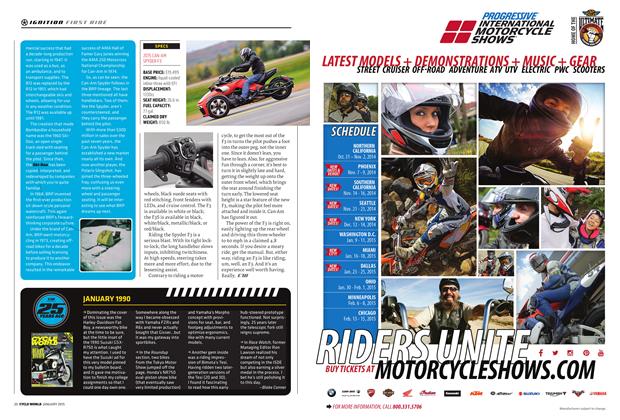
There’s been significant consternation over what the Can-Am Spyders are and why a company would build this answer to a question no consumer has ever asked. But if one takes a moment to consider what Bombardier Recreational Vehicles (BRP) is, the Spyder makes complete historical sense. In fact, the Spyder’s creation harks all the way back to the heart and soul of its founder, a creator of unique vehicles for new markets.
j. Armand Bombardier was a Canadian who, beginning in his teens, applied himself to solving alternative needs of transportation. As just a 15-year-old, he applied himself to creating a
vehicle that could “float on snow.” He invented a dog-less sled to provide wintertransportation where snow all but halted travel and commerce.
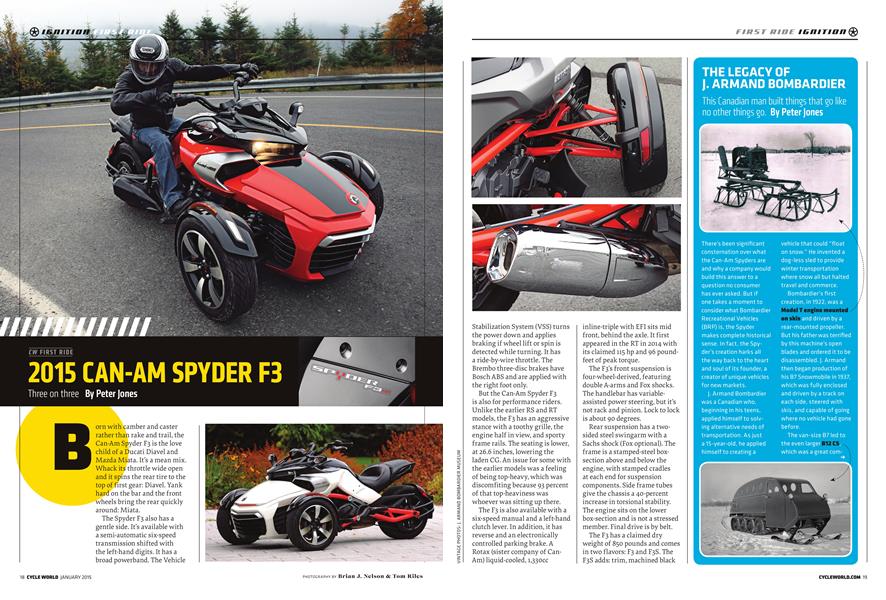
Bombardier’s first creation, in 1922, was a
Model T engine mounted on _____________
ear-mounted propeller. But his father was terrified by this machine’s open blades and ordered it to be disassembled, j. Armand then began production of his B7 Snowmobile in 1937, which was fully enclosed and driven by a track on each side, steered with skis, and capable of going where no vehicle had gone before.
The van-size B7 led to the even larger^^^^^H which was a great commercial success that had a decade-long production run, starting in 1947. It was used as a bus, as an ambulance, and to transport supplies. The B12 was replaced by the R12 in 1951, which had interchangeable skis and wheels, allowing for use in any weather condition. The R12 was available up until 1981.
The creation that made Bombardiera household name was the 1960 SkiDoo, an open singletrack sled with seating for a passenger behind the pilot. Since then, thj-irra-r has been copied, interpreted, and redeveloped by companies with which you’re quite familiar.
In 1968, BRP invented the first-ever production sit-down-style personal watercraft. This again reinforced BRP’s forwardthinking corporate culture.
Under the brand of CanAm, BRP went motorcycling in 1973, creating offroad bikes for a decade before selling licensing to produce it to another company. This endeavor resulted in the remarkable success of AMA Hall of Famer Gary Jones winning the AMA 250 Motocross National Championship for Can-Am in 1974.
So, as can be seen, the Can-Am Spyderfollows in the BRP lineage. The last three mentioned all have handlebars. Two of them, like the Spyder, aren’t countersteered, and they carry the passenger behind the pilot.
With more than $300 million in sales overthe past seven years, the Can-Am Spyder has established a new market nearly all its own. And now another player, the Polaris Slingshot, has joined the three-wheeled fray, confusing us even more with a steering wheel and passenger seating. It will be interesting to see what BRP dreams up next.