Service
SERVICE
PAUL DEAN
Compression made easy
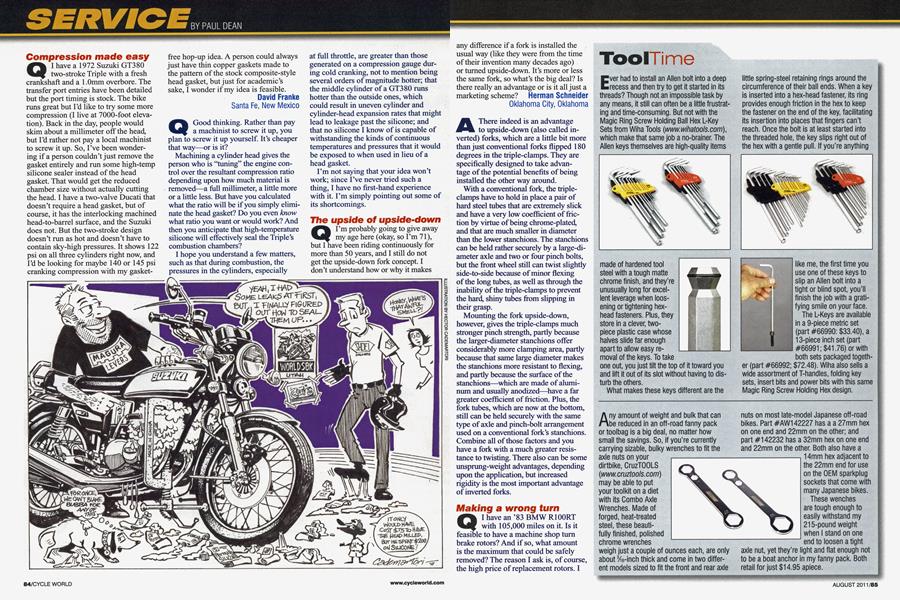
Q I have a 1972 Suzuki GT380 two-stroke Triple with a fresh crankshaft and a 1.0mm overbore. The transfer port entries have been detailed but the port timing is stock. The bike runs great but I’d like to try some more compression (I live at 7000-foot elevation). Back in the day, people would skim about a millimeter off the head, but I’d rather not pay a local machinist to screw it up. So, I’ve been wondering if a person couldn’t just remove the gasket entirely and run some high-temp silicone sealer instead of the head gasket. That would get the reduced chamber size without actually cutting the head. I have a two-valve Ducati that doesn’t require a head gasket, but of course, it has the interlocking machined head-to-barrel surface, and the Suzuki does not. But the two-stroke design doesn’t run as hot and doesn’t have to contain sky-high pressures. It shows 122 psi on all three cylinders right now, and I’d be looking for maybe 140 or 145 psi cranking compression with my gasketfree hop-up idea. A person could always just have thin copper gaskets made to the pattern of the stock composite-style head gasket, but just for academic’s sake, I wonder if my idea is feasible.
David Franke Santa Fe, New Mexico
Q Good a machinist thinking. to screw Rather it up, than you pay plan to screw it up yourself. It’s cheaper that way—or is it?
Machining a cylinder head gives the person who is “tuning” the engine control over the resultant compression ratio depending upon how much material is removed—a full millimeter, a little more or a little less. But have you calculated what the ratio will be if you simply eliminate the head gasket? Do you even know what ratio you want or would work? And then you anticipate that high-temperature silicone will effectively seal the Triple’s combustion chambers?
I hope you understand a few matters, such as that during combustion, the pressures in the cylinders, especially at full throttle, are greater than those generated on a compression gauge during cold cranking, not to mention being several orders of magnitude hotter; that the middle cylinder of a GT380 runs hotter than the outside ones, which could result in uneven cylinder and cylinder-head expansion rates that might lead to leakage past the silicone; and that no silicone I know of is capable of withstanding the kinds of continuous temperatures and pressures that it would be exposed to when used in lieu of a head gasket.
I’m not saying that your idea won’t work; since I’ve never tried such a thing, I have no first-hand experience with it. I’m simply pointing out some of its shortcomings.
The upside of upside-down
Q l’m probably going to give away my age here (okay, so I’m 71), but I have been riding continuously for more than 50 years, and I still do not get the upside-down fork concept. I don’t understand how or why it makes any difference if a fork is installed the usual way (like they were from the time of their invention many decades ago) or turned upside-down. It’s more or less the same fork, so what’s the big deal? Is there really an advantage or is it all just a marketing scheme? Herman Schneider Oklahoma City, Oklahoma
A There indeed is an advantage to upside-down (also called inverted) forks, which are a little bit more than just conventional forks flipped 180 degrees in the triple-clamps. They are specifically designed to take advantage of the potential benefits of being installed the other way around.
With a conventional fork, the tripleclamps have to hold in place a pair of hard steel tubes that are extremely slick and have a very low coefficient of friction by virtue of being chrome-plated, and that are much smaller in diameter than the lower stanchions. The stanchions can be held rather securely by a large-diameter axle and two or four pinch bolts, but the front wheel still can twist slightly side-to-side because of minor flexing of the long tubes, as well as through the inability of the triple-clamps to prevent the hard, shiny tubes from slipping in their grasp.
Mounting the fork upside-down, however, gives the triple-clamps much stronger pinch strength, partly because the larger-diameter stanchions offer considerably more clamping area, partly because that same large diameter makes the stanchions more resistant to flexing, and partly because the surface of the stanchions—which are made of aluminum and usually anodized—have a far greater coefficient of friction. Plus, the fork tubes, which are now at the bottom, still can be held securely with the same type of axle and pinch-bolt arrangement used on a conventional fork’s stanchions. Combine all of those factors and you have a fork with a much greater resistance to twisting. There also can be some unsprung-weight advantages, depending upon the application, but increased rigidity is the most important advantage of inverted forks.
Making a wrong turn
el with have 105,000 an ’83 BMW miles on R100RT it. Is it le to have a machine shop turn brake rotors? And if so, what amount is the maximum that could be safely removed? The reason I ask is, of course, the high price of replacement rotors. I have never read anything on this subject, and neither have I talked to anyone who has had it done. I haven’t had any braking problems with my bike, but having just noticed the wear showing on the rotors, I was wondering if this is ever done. Don Welch Submitted via America Online
A Absolutely not. On most passenger cars and trucks, where unsprung weight is not as critical as it can be on motorcycles, the brake rotors are large, vented and thick enough to allow at least one remachining before they have to be replaced.
But not on motorcycles. Besides not being vented, bike rotors are made as light and thin as the bike’s designers thought was reasonable to provide consistent, fade-free braking under all normal riding conditions. If the rotors were turned down, they would be too thin, potentially restricting their ability to dissipate the heat of braking and, in all likelihood, quickly warp. In some cases, too-thin rotors might even permit the caliper pistons to move too far outward during the last stages of brake-pad wear, causing them to jam in their bores. Every rotor has a minimum allowable thickness stamped into it somewhere, and if it can be resurfaced without becoming narrower than that spec, it probably would work acceptably. The problem is that most rotors already are barely wider than that spec when new, so rarely can any imprefections be removed without machining the rotor beyond that thickness limit.
I know several mechanics and riders who have turned the rotors on their bikes, and in every case, they regretted having done so. The rotors warped, braking efficiency was reduced and they all ended up buying new rotors.
Bottom line: Don’t do it.
Assault on a battery
QI that have recently an ’84 let Honda me down VFR700F for the first time when I turned the key on and got no lights, no starter, nothing. I got a jump start and rode home, and when I turned the key off and back on, the problem recurred. If I waited a few minutes and turned it back on, the headlight and all the warning lights would come on normally, but as soon as I would hit the starter button, I’d get a click and all the lights would go out. I removed the battery and hooked up another bike battery with jumpers, and the engine started and ran fine.
I assume the battery failed, but in the past (riding since 1963), a battery always got progressively weaker and warned of impending failure. Not this time. When I departed, it worked like a champ until I parked at my destination.
When I came back out and turned on r the key, all was fine until I touched the starter; then it was click and lights out. The battery is an AGM type, the first I of these I have had. Is that the way they fail or is there another problem? All connections are clean and tight around I the battery and under the seat. When I tested the battery off the bike, it showed I 14 volts, and also had 14 volts on the bike with the key off, but 0 volts with the key on. James McMullen Submitted via America Online
A Given the symptoms and the steps you have taken to isolate the problem, I believe that your battery has a faulty internal connection. The behavior you describe is exactly what happens when one of the battery cables has a poor connection, but you have eliminated that possibility by trying another battery and using jumper cables. That points to an internal problem, most likely a broken connection between two of the cells, which could be the result of a manufacturing defect or perhaps caused by vibration.
As with a loose external battery cable, a faulty internal connection can allow enough amperage to illuminate the headlight, taillight and instrument warning lights; but as soon as you attempt to engage the starter motor, which draws far more current than anything else, that poor connection cannot handle the amperage, so the circuit opens entirely. Obviously, the only solution is to replace the battery.
There is nothing about AGM (absorbed glass mat) batteries that makes them more susceptible to this kind of failure than traditional “flooded leadacid” batteries. Matter of fact, their mat design is less prone to internal breakage and vibration damage because they use a “sandwich”-style construction that, among other benefits, eliminates the need for the cells to support their own weight. But any manufactured product can fail, including AGM batteries, and you just may, by the luck of the draw, have ended up with one of them.
Tappet woes
My 1992 Harley-Davidson Softail that now has 27,000 miles on it began developing a clicking or rattling noise about 5000 miles back. The bike has a BDL enclosed primary belt drive with a dry clutch that makes some noise, so I thought that was the source. I finally opened up the cam case and saw that the innermost roller tappet had self-destructed and turned in the lifter block, breaking the housing.
I found metal shavings and pieces of broken needle bearings from the tappet roller in the bottom of the gear housing.
I have totally taken apart the motor and will check the lower end to see if any debris got into the main beaings. My question is, what do you think caused this to happen? The oil was changed regularly, and the bike has never been ridden hard or abused. I will install a new set of tappets when I reassemble the motor, but any advice would be greatly appreciated. I’ve included a picture of the damaged tappet block and roller. Dan Oehlert Submitted via America Online
Hydraulic tappet failure is not an uncommon occurrence with H-D Evolution engines. It usually happens when the needle bearing on the roller starts to fail, allowing the roller to gradually develop freeplay that lets it shift up-and-down and rock side-to-side on its axle. At first, any noise or performance drop-off resulting from this freeplay might not be noticeable because the automatic adjustment action of the hydraulic tappet takes up the slack. But as the failure grows worse, the tappet can no longer compensate, so the noise becomes apparent as the roller starts to wallow more dramatically, even trying to twist out of the alignment slot in the tappet block. If the engine continues to operate in this condition, the roller can eventually succeed in jumping out of its slot and turning sideways, often breaking the cast aluminum tappet block.
On Evo engines, the tappets are fed high-pressure oil that comes directly from the pump. That oil does not first pass through the oil filter, so it can contain tiny amounts of contamination that, over time, could cause problems with the tappets. To help prevent such occurrences, the engine is equipped with a removable screen in the oil galley between pump and tappets that traps most contamination. If the screen is not periodically cleaned, it can block the flow of oil to the tappets enough to reduce their ability to maintain zero valve lash and also cause the roller’s needle bearings to fail.
So, when you reassemble the engine, be sure to remove and clean the tappet screen. It’s located under a big slotted screw next to the right-rear comer of the rear tappet block. You also need to thoroughly clean the oil pump, oil tank and all of the oil lines to remove any debris that might have gotten into them.
Pilot error
QI (urban recently assault purchased machine?) as a novelty a 1981 Yamaha SR250 Exciter, a single-cylinder, carbureted four-stroke with a stock trunk. The bike was rusty but showed only 3426 miles on the odometer when I bought it. I have since cleaned it up and gotten it running fairly well except for the carburetion. To date, the local Yamaha dealer has cleaned the carburetor twice and replaced the main jet. Even still, the bike stalls at idle and exhibits “herky-jerky” cruising. I added STABIL to the gas and have tried using Sea Foam additive, but neither have solved the problem. Any and all solutions to help me get the bike to run better would be appreciated. My wife has just started riding the bike because she intends to get her motorcycle license. Bob Torres Cocoa Beach, Florida
Recall Roster
NHTSA Recall No. 11V282000
Manufacturer: Zero Motorcycles Inc.
Models: 2009-10 DS and S
Number of units affected: 160
Problem: On certain of these motorcycles built between July, 2009, and March, 2011. the front-brake caliper bracket may experience permanent deformation when subjected to high braking loads. This condition could cause misalignment of the front-brake pads with the rotor, and that, in turn, may result in reduced front braking performance that could lead to a possible crash. Remedy: Dealers will replace the frontbrake caliper bracket with a redesigned component, and replace the front brake pads if the existing pads exhibit abnormal wear. Also, the front brake fluid will be inspected, and if it shows signs of overheating, the system will be flushed and the fluid replaced. Owners not receiving this free remedy can contact Zero at 888/7869376, extension 45.
NHTSA Recall No. 11V277000
Manufacturer: Triumph Motorcycles America Ltd.
Model: 2010 Thunderbird Number of units affected: 1955 Problem: On certain of these motorcycles manufactured between September. 2009, and August, 2010, an incompatible threadlocker/screw combination was used at the front fender mounting. This could allow the screws to work loose and contact the sidewall of the front tire, leading to tire deflation and the possible risk of a crash.
Remedy: Dealers will install new screws with the proper thread-locker/ screw combination. Owners not receiving this free remedy can contact Triumph at 678/539-8782.
I suspect that the dealer—or perhaps just the mechanic who worked on your bike—incorrectly diagnosed the problem. When a carbureted bike stalls at idle, the cause is not the main jet, which has no effect on engine performance until the throttle is more than three-quarters open. Instead, the culprit when that condition exists is the pilot/idle jet, which has the tiniest orifice of all the fuel-metering devices. Since the dealer evidently did not know that the pilot jet was the problem, he likely failed to clean it. That jet also is the primary fuel-metering device when the throttle is only barely cracked open during easy cruising. So, rather than you attempting to clean the pilot jet—whose #47 orifice is so small that it’s difficult to get completely clean—my advice is just to replace it. A new one costs less than $15 and will assure that your SR50’s pilot jetting is correct.
World record break-in
QIn the March issue, you mentioned a story about the first-generation Honda VFR750F that broke Cycle World's 24-hour world speed record back in 1986. You said that you were able to tear down the engine and examine it after the run and that everything was still within prescribed assembly tolerances in spite of having run at or near redline for 24 hours. I’m curious if you know whether or not the engine was broken in before the speed record attempt, and if so, what technique was used to break it in. Ken Heiret Bothell, Washington
JKk I know that the engines in all of jHL the bikes that made the attempt (There were three of them: two 750s and a 700. The 700 broke the existing record, but one of the 750s was faster yet; the other 750 blew up) had been broken in, but I have no idea how it was done. I also don’t know if the engines were straight off the assembly line or had been disassembled and carefully reassembled with hand-matched components. If Honda had done such things in preparation for the record attempt, I don’t think they would have told me about it. I do know, however, that when I took the winning 750’s engine apart, I found no signs of it having been hotrodded or modified in any way.
Smoke alarm
QI have an ’05 CBR1000RR Honda with 8500 miles on it. I don’t stunt it and usually just ride it around to work and for play, but when I hammer the throttle, a nice puff of blue smoke comes out the exhaust. And when I let off the throttle on the freeway and am slowing in gear, smoke billows from the exhaust. I suspect the valve-guide seals, but the dealer here in Colorado Springs says rings and wants $3000 to fix it. Trust me, I am hoping for valve seals. Any ideas? The only mods are removal of the exhaust valve, a Micron slip-on and a disabled intake flapper. Phil Barker Colorado Springs, Colorado
A Sorry to tell you this, Phil, but I think your dealer is correct in his analysis. When valve seals leak, the primary symptom usually is smoking upon initial startup, especially if the bike has been sitting for a while after being run at full temperature. That allows time for the hot, thin oil in the cam box (or rocker box in an ohv engine) to seep past the seals and run down the valve stems into the combustion chamber where it is burned when the engine is
started.
But the symptoms you describe are typical for an engine with worn piston rings. When you nail the throttle, there is a sudden and dramatic pressure increase in the cylinders during the combustion cycle, and some of that pressure blows past the worn rings into the crankcase. That creates high-
pressure pulsations in the crankcase that force oil mist upward past the worn rings of each cylinder when it’s in a lowpressure state during its intake stroke. This back-and-forth process between all of the cylinders is repeated during hard acceleration, resulting in oil smoke being emitted through the exhaust.
When you let off the throttle at higher rpm, the pistons are rapidly trying to suck large quantities of air into the cylinders, but the butterflies in the throttle bodies or carburetors are closed; so, instead, the substantial suction in the cylinders draws oil up past the worn rings and into the combustion chambers, again resulting in smoking.
In my opinion, your dealer’s estimate of $3000 for a top-end rebuild seems a little high, but his diagnosis is right on the, uh, money. □
Got a mechanical or technical problem with your beloved ride? Can’t seem to find workable solutions in your area? Or are you eager to learn about a certain aspect of motorcycle design and technology? Maybe we can help.
If you think we can, either: 1) Mail a written inquiry, along with your full name, address and phone number, to Cycle World Service, 1499 Monrovia Ave., Newport Beach, CA 92663; 2) fax it to Paul Dean at 949/631 -0651; 3) e-mail it to CW1Dean@aol.com\ or 4) log onto www.cycleworld.com, click on the “Contact Us” button, select “CW Service” and enter your question. Don’t write a 10page essay, but if you’re looking for help in solving a problem, do include enough information to permit a reasonable diagnosis. And please understand that due to the enormous volume of inquiries we receive, we cannot guarantee a reply to every question.