2011 Triumph Sprint Gt
RIDING IMPRESSION
2011 TRIUMPHSPRINT GT
Hinckley tweaks its recipe for sport-touring
PAUL DEAN
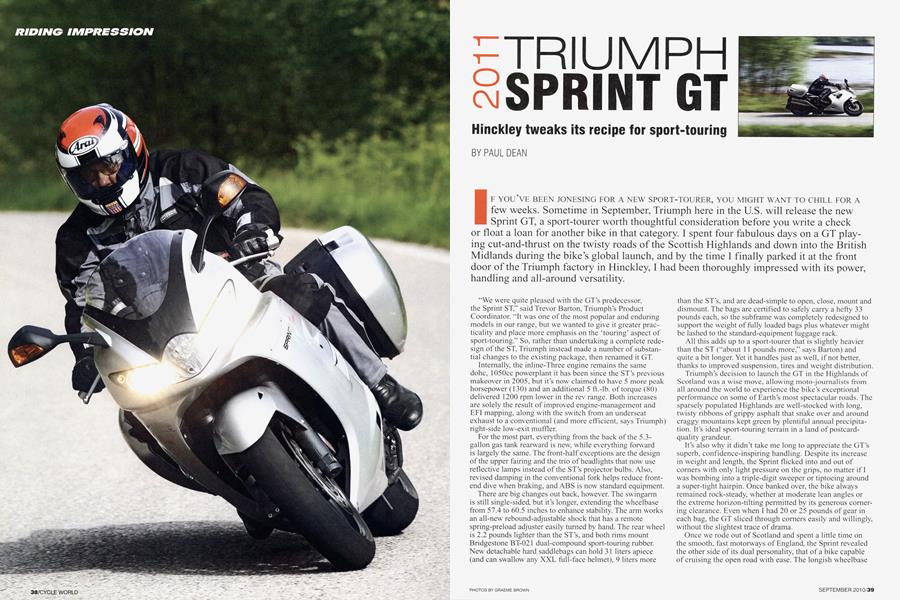
IF YOU'VE BEEN JONESING FOR A NEW SPORT-TOURER, YOU MIGHT WANT TO CHILL FOR A few weeks. Sometime in September, Triumph here in the U.S. will release the new Sprint GT, a sport-tourer worth thoughtful consideration before you write a check or float a loan for another bike in that category. I spent four fabulous days on a GT play ing cut-and-thrust on the twisty roads of the Scottish Highlands and down into the British Midlands during the bike's global launch, and by the time I finally parked it at the front door of the Triumph factory in Hinckley, I had been thoroughly impressed with its power, handling and all-around versatility.
“We were quite pleased with the GT’s predecessor, the Sprint ST,” said Trevor Barton, Triumph’s Product Coordinator. “It was one of the most popular and enduring models in our range, but we wanted to give it greater practicality and place more emphasis on the ‘touring’ aspect of sport-touring.” So, rather than undertaking a complete redesign of the ST, Triumph instead made a number of substantial changes to the existing package, then renamed it GT.
Internally, the inline-Three engine remains the same dohc, 1050cc powerplant it has been since the ST’s previous makeover in 2005, but it’s now claimed to have 5 more peak horsepower (130) and an additional 5 ft.-lb. of torque (80) delivered 1200 rpm lower in the rev range. Both increases are solely the result of improved engine-management and EFI mapping, along with the switch from an underseat exhaust to a conventional (and more efficient, says Triumph) right-side low-exit muffler.
For the most part, everything from the back of the 5.3gallon gas tank rearward is new, while everything forward is largely the same. The front-half exceptions are the design of the upper fairing and the trio of headlights that now use reflective lamps instead of the ST’s projector bulbs. Also, revised damping in the conventional fork helps reduce frontend dive when braking, and ABS is now standard equipment.
There are big changes out back, however. The swingarm is still single-sided, but it’s longer, extending the wheelbase from 57.4 to 60.5 inches to enhance stability. The arm works an all-new rebound-adjustable shock that has a remote spring-preload adjuster easily turned by hand. The rear wheel is 2.2 pounds lighter than the ST’s, and both rims mount Bridgestone BT-021 dual-compound sport-touring rubber. New detachable hard saddlebags can hold 31 liters apiece (and can swallow any XXL full-face helmet), 9 liters more than the ST’s, and are dead-simple to open, close, mount and dismount. The bags are certified to safely carry a hefty 33 pounds each, so the subframe was completely redesigned to support the weight of fully loaded bags plus whatever might be lashed to the standard-equipment luggage rack.
All this adds up to a sport-tourer that is slightly heavier than the ST (“about 11 pounds more,” says Barton) and quite a bit longer. Yet it handles just as well, if not better, thanks to improved suspension, tires and weight distribution.
Triumph's decision to launch the GT in the Highlands of Scotland was a wise move, allowing moto-journalists from all around the world to experience the bike’s exceptional performance on some of Earth’s most spectacular roads. The sparsely populated Highlands are well-stocked with long, twisty ribbons of grippy asphalt that snake over and around craggy mountains kept green by plentiful annual precipitation. It’s ideal sport-touring terrain in a land of postcardquality grandeur.
It’s also why it didn’t take me long to appreciate the GT’s superb, confidence-inspiring handling. Despite its increase in weight and length, the Sprint flicked into and out of corners with only light pressure on the grips, no matter if I was bombing into a triple-digit sweeper or tiptoeing around a super-tight hairpin. Once banked over, the bike always remained rock-steady, whether at moderate lean angles or the extreme horizon-tilting permitted by its generous cornering clearance. Even when I had 20 or 25 pounds of gear in each bag, the GT sliced through corners easily and willingly, without the slightest trace of drama.
Once we rode out of Scotland and spent a little time on the smooth, fast motorways of England, the Sprint revealed the other side of its dual personality, that of a bike capable of cruising the open road with ease. The longish wheelbase kept the GT pointed straight ahead without my constant intervention; and although the bike’s sporty suspension rates are a little on the taut side, its redesigned seat helped make the ride just cushy enough that I never developed a case of monkey-butt during our four-day trek.
I did, however, wish that the windscreen was either adjustable, as they are on some other sport-tourers, or at least a little taller. The screen is only slightly higher than those on most repli-racers, so the wind would hit me right below my neck—fine on a warm, dry day but not very protective in the cold and wet. The shield is intelligently shaped, so at least I felt not the slightest bit of turbulence. And although I personally did not mind the ergonomics—which, like the windscreen, still tend to favor the sport side of the equation— some riders may find them just a skosh racy for their tastes.
But without question, they’ll love the smooth, high-spirited three-cylinder engine. Its torque output is impressive, delivering seamless, linear acceleration that pulls hard from as low as 2000 rpm all the way to the 10-grand redline. As a result, I didn’t have to keep the Triple bouncing off its rev limiter to maintain a really fast pace on the Scottish backroads. Instead, I could use full throttle out of practically any corner at only around 4000 or 4500 rpm, and the Triumph would bolt out of the turn like it meant business, often painting black stripes on the pavement as it departed the scene. Attacking corners at higher revs would produce more noise but not quite an equivalent increase in acceleration.
That stout midrange torque isn’t just useful on backroads;
it also makes for decent top-gear acceleration anywhere, even though the GT’s sixth gear is an overdrive, its ratio seven percent taller than its counterpart on the ST. Nevertheless, as with just about any motorcycle outside of a VMax or the GT’s ginormous big brother, the Rocket III Roadster, a downshift or two is still required for really quick passes.
So, on one hand, Triumph’s attempt to move the Sprint closer to the touring side of the sport-touring spectrum would seem to have been successful: The GT is more stable, more comfortable and can carry more “stuff.” But the British interpretation of sport-touring apparently is a few degrees off from the one we apply here in the Interstate-infested, fourlane-highway-plentiful U.S. of A.; because by our standard, the GT has only moved the mark a fraction of an inch closer to “touring.” Despite not having an inverted fork or radialmount brakes, it still is a comparatively sporty sport-tourer.
That’s a very good thing for riders who live for long rides on curvy roads. And if a fairly long list of available options— including a taller windscreen, heated grips, a gel seat and a 55-liter top trunk with a built-in 12-volt power outlet— doesn’t help mitigate the concerns of most other interested riders, the GT’s MSRP should. It’s just $13,199—more than two grand below that of the next lowest-priced competitor.
So, no matter whose sport-touring yardstick you use, the new Sprint GT promises to be a serious contender. □
2011 TRIUMPH SPRINT GT