2008 Kawasaki Klr650
CYCLE WORLD TEST
2008 KAWASAKI KLR650
NEW BIKES 2008
Born-again adventure-bike
MATTHEW MILES
AT A TIME WHEN THE SHELF life for new-from-the-axles-up racer-replicas is just two years and motocrossers get annual re-thinks, Kawasaki hadn’t given the KLR650 a full-blown makeover in more than two decades. And for good reason.
Make that reasons. Nearly 7000 of ’em.
That’s the number of KLRs sold stateside annually. Translated, the big Single is the top-retailing dual-purpose bike in the U.S., outdistancing the second-place Suzuki DRZ400S two-to-one and making it one of Kawasaki’s most popular and profitable models. In other words, if it ain’t broke, don’t fix it.
Exceptional versatility has long been the key to the KLR’s success. So when Kawasaki decided that it was indeed high time for an overhaul, higher-ups mandated that the new model had to be even more adept at cutting up canyons, crossing deserts, climbing mountains and overcoming the challenges of the urban jungle, all while keeping its original character intact. It had to be priced right, too.
And, it is. On all counts.
Updates were further aimed at turning the KLR into a more “tour-ready” D-P bike. More tour-ready? Yes. The experts who lose sleep over these things say the long-haul segment is growing and will continue to do so through the next decade, fueled in great part by aging Baby Boomers.
Some country-crossing elements were already in place.
The wide, crossbar-equipped steel handlebar and 6.1-gallon gas tank, for instance. The one-piece dual seat was treated to firmer foam for-you guessed it-greater comfort over longer distances. Also back for another go-round: the double-cradle steel frame, detachable subframe and semi-knobbed, bias-ply Dunlop K750s.
Everything else is either altered or totally new, though
none of it is state-of-the-art.
For example, the 41mm fork is as simple as they come, a basic damper-rod design with no external adjustments. That said, the sliders are 3mm larger in diameter than before, springs are stiffer, damping is improved and there’s less axle underhang.
The stanchions are bigger, too,
52mm versus 50. The recalibrated shock features five-way springpreload and four-way rebounddamping adjustments, and it acts through a redesigned linkage on
a more-rigid, half-inch-shorter, D-shaped aluminum swingarm. Travel was cut at both ends, from 9.1 inches to 7.9 up front and from 8.1 inches to 7.3 at the rear. Steering geometry-28.0 degrees of rake and 4.4 inches of trail-is the same as before.
No aspect of the previous bike screamed old age and lack of continued development more than the woefully underpowered brakes. Now, 280mm front and 240mm rear petalstyle discs are squeezed by two-piston, sliding-pin calipers. Again, not the latest technology, but they are a dramatic improvement. Anything bigger or more powerful, Kawasaki says, would have been too much off-road. The 21-inch front and 17-inch rear wheels are the same diameters and
widths as in past years, but they now benefit from beefier spokes (4mm vs. 3.5).
The dual-counterbalancerequipped, liquid-cooled, dohc, four-valve, 651cc Single got in on the game, too. It boasts revised cam timing, new intake porting, a digital ignition, thinner piston rings, a slimmer radiator with additional cooling area, and a one-piece stainless-steel header pipe with smoother, flow-enhancing bends. Fuel is still delivered to the combustion chamber via
carburetor, a 40mm Keihin fitted with a handlebar-mounted choke. The matte-black muffler has a U.S. Forestry Serviceapproved spark arrestor.
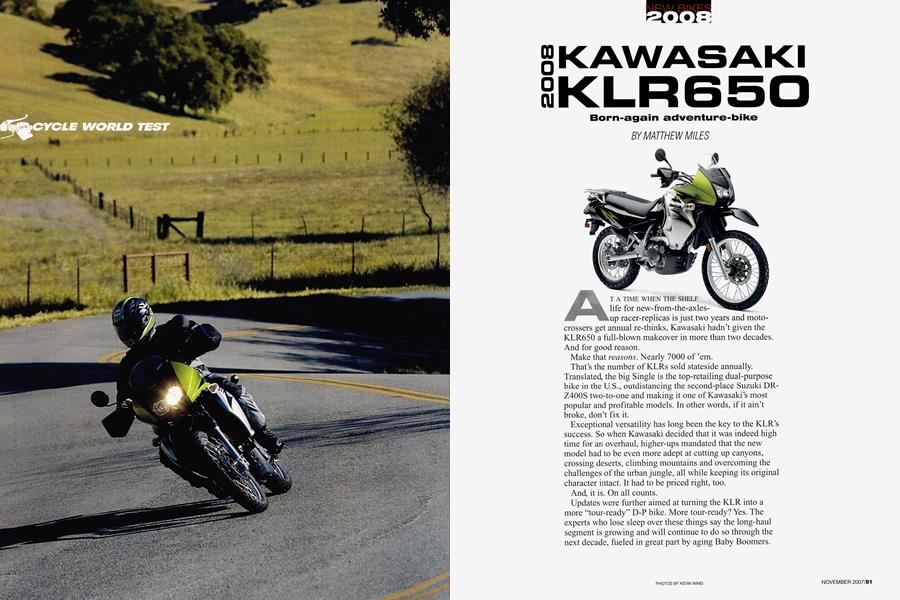
Capping all these changes is a fresh look. All-new plastic-handguards, fenders, sidepanels, engine guard and a halffairing with dual headlights-and redrawn graphics ensure no one will confuse the latest model with the previous one. A tachometer and a water-temperature gauge flank the central analog speedometer, below which reside indicator lights for high beam, neutral and turnsignals. The ignition switch has been incorporated into the top triple-clamp. Now longer and wider, the rear rack incorporates passenger grab handles, a narrow slot for the toolkit and a helmet lock.
Price? $5349, just $150 more than the 2007 model.
Downside to all this goodness is a weight gain over the previous model. Tipping our scales at 404 pounds without fuel, it’s 35 pounds heavier than the last KLR we tested. Still light for a streetbike, and you’ll be hard-pressed to feel the added girth on the road, but it might be another matter trying to extricate the bike from knee-deep mud in the jungles of South America.
On the CW dyno, the KLR produced 37 horsepower at 6200 rpm and 33 foot-pounds of torque at 5050 rpm, down ever so slightly from our 2002 tester’s 38 hp and 35 ft.-lb. Neat thing is, near-peak torque is available over a 4000-rpmwide band between 2500 and 6500 rpm. While get-up-andgo won’t impress anyone who has swung a leg over a modern-day Open-class sportbike, from stoplight to stoplight, the KLR is quicker than all but the priciest, most-exotic four-wheelers. Top speed is 93 mph, down 4 mph.
Engine vibration is fairly well muted, and the KLR will
cruise at an indicated 75 mph in relative peace. Initially, however, the gearbox on our testbike left a lot to be desired. Shifts from second to third in particular were often an exercise in futility, especially when hurried, and the transmission occasionally popped out of fifth (top) gear. Turns out the problem was a loose anchor pin for the shift-return spring, which we easily fixed. Downshifts never presented any problems, and finding neutral was a piece of cake, whether rolling or at a stop.
On-road handling is excellent, much of the credit going to the firmed-up suspension and better binders. That said, a hard pull on the front brake lever will cause the fork to
dive demonstrably, though not as much as on the previous model. Quick stops require a firm two-finger pull and practiced command of the easily locked rear brake. The bias-ply tires provide exceptional traction, especially on loose, potholed roads, and allow for high corner speeds and ridiculously deep lean angles. Stability is top-notch.
Wind protection from the bigger fairing and handguards is good, though 6footers are subject to some buffeting. Comfort is also good, though you’ll be ready for a break by the time you’ve emptied that big tank (a difficult task, as it’s tough to tap the last remaining half-gallon without tipping the bike onto its side).
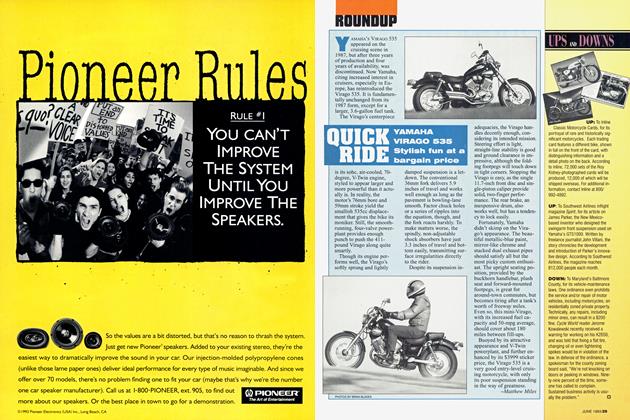
Off-road, it’s a different story. There’s no getting around the fact that the KLR is a big, softly suspended motorcycle. In its favor, much of the fuel sits low, near the center of the bike, so it’s easy to get over the tank when standing, making rough going easier. If you take your time and avoid the really nasty stuff, you can go most anywhere.
And that, of course, is the KLR’s appeal. This born-again
adventure-bike is just comfortable enough, just powerful enough, just smooth enough, handles and stops just well enough, and goes just far enough between fill-ups to give it the broad-ranging versatility that is admired and enjoyed by so many people.
Good enough, then, for another 20 years? Kawasaki is banking on it. E
KAWASAKI KLR650