Pirelli Diablo Corsa III
Pirelli Diablo Corsa III
CW EVALUATION
Soft shoulder to lean on
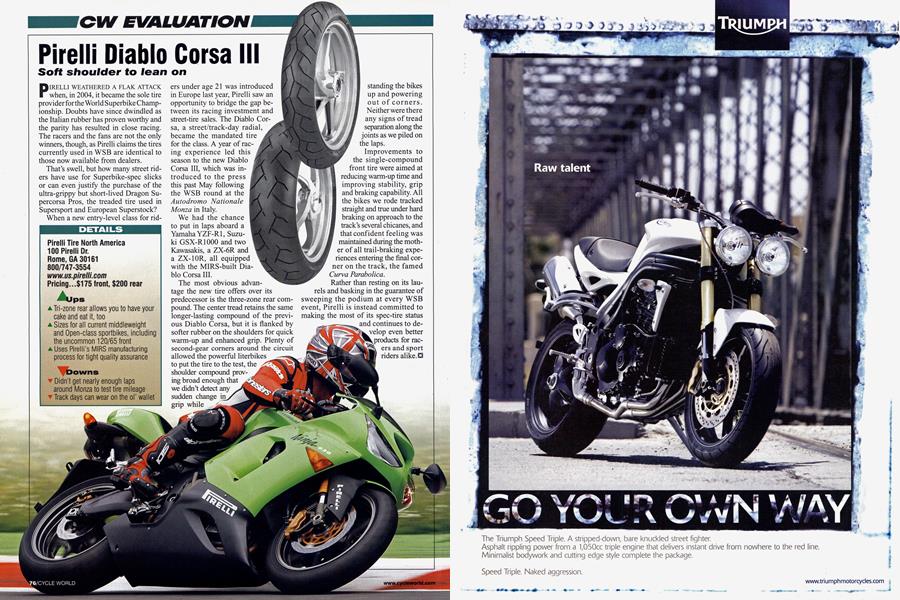
PIRELLI WEATHERED A FLAK ATTACK when, in 2004, it became the sole tire provider for the World Superbike Championship. Doubts have since dwindled as the Italian rubber has proven worthy and the parity has resulted in close racing. The racers and the fans are not the only winners, though, as Pirelli claims the tires currently used in WSB are identical to those now available from dealers.
That’s swell, but how many street riders have use for Superbike-spec slicks or can even justify the purchase of the ultra-grippy but short-lived Dragon Supercorsa Pros, the treaded tire used in Supersport and European Superstock? When a new entry-level class for rid-
DETAILS
Pirelli Tire North America 100 Pirelli Dr. Rome, GA 30161 800/747-3554 www.us.pirelli.com Pricing...$175 front, $200 rear
A Tn-zone rear allows you to have your cake and eat it, too A Sizes for all current middleweight and Open-class sportbikes, including the uncommon 120/65 front A Uses Pirelli's MIRS manufacturing process for tight quality assurance owns v Didn't get nearly enough laps around Monza to test tire mileage v Track days can wear on the 01' wallet
ers under age 21 was introduced in Europe last year, Pirelli saw an opportunity to bridge the gap between its racing investment and street-tire sales. The Diablo Corsa, a street/track-day radial, became the mandated tire for the class. A year of racing experience led this season to the new Diablo Corsa III, which was introduced to the press this past May following the WSB round at the Autódromo Nationale Monza in Italy.
We had the chance to put in laps aboard a Yamaha YZF-R1, Suzuki GSX-R1000 and two Kawasakis, a ZX-6R and a ZX-10R, all equipped with the MIRS-built Diablo Corsa III.
The most obvious advantage the new tire offers over its predecessor is the three-zone rear compound. The center tread retains the same longer-lasting compound of the previous Diablo Corsa, but it is flanked by softer rubber on the shoulders for quick warm-up and enhanced grip. Plenty of second-gear comers around the circuit allowed the powerful literbikes to put the tire to the test, the shoulder compound proving broad enough that we didn’t detect any sudden change in
standing the bikes up and powering out of corners. Neither were there any signs of tread separation along the joints as we piled on the laps.
Improvements to the single-compound front tire were aimed at reducing warm-up time and improving stability, grip and braking capability. All the bikes we rode tracked straight and true under hard braking on approach to the track’s several chicanes, and that confident feeling was maintained during the mother of all trail-braking experiences entering the final corner on the track, the famed Curva Parabólica.
Rather than resting on its laurels and basking in the guarantee of sweeping the podium at every WSB event, Pirelli is instead committed to making the most of its spec-tire status and continues to develop even better for racers and sport riders alike.