The Mysterious Mr. Deeley
The mysterious Mr. Deeley
UP FRONT
David Edwards
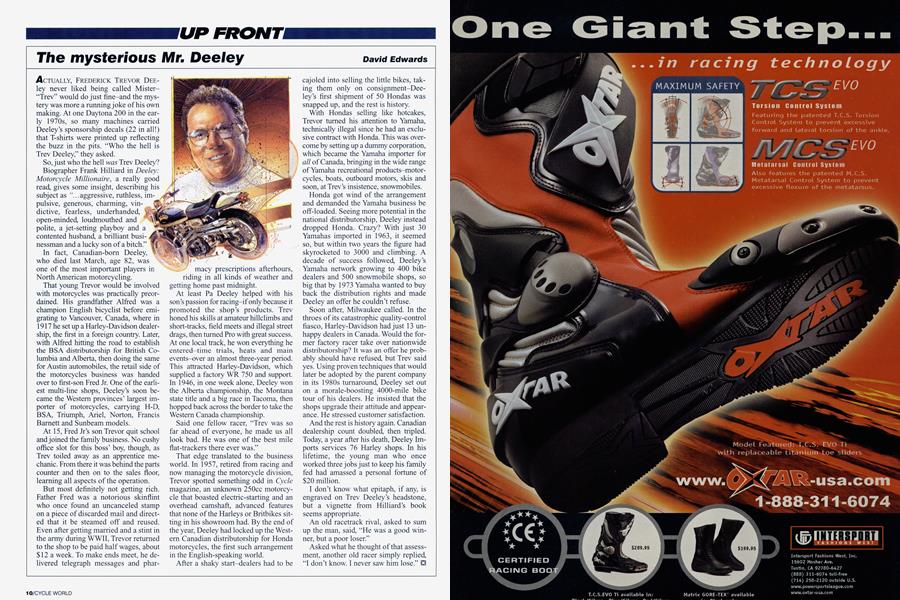
ACTUALLY, FREDERICK TREVOR DEEley never liked being called Mister—“Trev” would do just fine—and the mystery was more a running joke of his own making. At one Daytona 200 in the early 1970s, so many machines carried Deeley’s sponsorship decals (22 in all!) that T-shirts were printed up reflecting the buzz in the pits. “Who the hell is Trev Deeley,” they asked.
So, just who the hell was Trev Deeley? Biographer Frank Hilliard in Deeley: Motorcycle Millionaire, a really good read, gives some insight, describing his subject as “...aggressive, ruthless, im pulsive, generous, charming, vindictive, fearless, underhanded, open-minded, loudmouthed and polite, a jet-setting playboy and a contented husband, a brilliant businessman and a lucky son of a bitch.”
In fact, Canadian-born Deeley, who died last March, age 82, was one of the most important players in North American motorcycling.
That young Trevor would be involved with motorcycles was practically preordained. His grandfather Alfred was a champion English bicyclist before emigrating to Vancouver, Canada, where in 1917 he set up a Harley-Davidson dealership, the first in a foreign country. Later, with Alfred hitting the road to establish the BSA distributorship for British Columbia and Alberta, then doing the same for Austin automobiles, the retail side of the motorcycles business was handed over to first-son Fred Jr. One of the earliest multi-line shops, Deeley’s soon became the Western provinces’ largest importer of motorcycles, carrying H-D, BSA, Triumph, Ariel, Norton, Francis Barnett and Sunbeam models.
At 15, Fred Jr’s son Trevor quit school and joined the family business. No cushy office slot for this boss’ boy, though, as Trev toiled away as an apprentice mechanic. From there it was behind the parts counter and then on to the sales floor, learning all aspects of the operation.
But most definitely not getting rich. Father Fred was a notorious skinflint who once found an uncanceled stamp on a piece of discarded mail and directed that it be steamed off and reused. Even after getting married and a stint in the army during WWII, Trevor returned to the shop to be paid half wages, about $12 a week. To make ends meet, he delivered telegraph messages and pharmacy prescriptions afterhours, riding in all kinds of weather and getting home past midnight.
At least Pa Deeley helped with his son’s passion for racing-if only because it promoted the shop’s products. Trev honed his skills at amateur hillclimbs and short-tracks, field meets and illegal street drags, then turned Pro with great success. At one local track, he won everything he entered-time trials, heats and main events-over an almost three-year period. This attracted Harley-Davidson, which supplied a factory WR 750 and support. In 1946, in one week alone, Deeley won the Alberta championship, the Montana state title and a big race in Tacoma, then hopped back across the border to take the Western Canada championship.
Said one fellow racer, “Trev was so far ahead of everyone, he made us all look bad. He was one of the best mile flat-trackers there ever was.”
That edge translated to the business world. In 1957, retired from racing and now managing the motorcycle division, Trevor spotted something odd in Cycle magazine, an unknown 250cc motorcycle that boasted electric-starting and an overhead camshaft, advanced features that none of the Harleys or Britbikes sitting in his showroom had. By the end of the year, Deeley had locked up the Western Canadian distributorship for Honda motorcycles, the first such arrangement in the English-speaking world.
After a shaky start-dealers had to be cajoled into selling the little bikes, taking them only on consignment-Deeley’s first shipment of 50 Hondas was snapped up, and the rest is history.
With Hondas selling like hotcakes, Trevor turned his attention to Yamaha, technically illegal since he had an exclusive contract with Honda. This was overcome by setting up a dummy corporation, which became the Yamaha importer for all of Canada, bringing in the wide range of Yamaha recreational products-motorcycles, boats, outboard motors, skis and soon, at Trev’s insistence, snowmobiles.
Honda got wind of the arrangement and demanded the Yamaha business be off-loaded. Seeing more potential in the national distributorship, Deeley instead dropped Honda. Crazy? With just 30 Yamahas imported in 1963, it seemed so, but within two years the figure had skyrocketed to 3000 and climbing. A decade of success followed, Deeley’s Yamaha network growing to 400 bike dealers and 500 snowmobile shops, so big that by 1973 Yamaha wanted to buy back the distribution rights and made Deeley an offer he couldn’t refuse.
Soon after, Milwaukee called. In the throes of its catastrophic quality-control fiasco, Harley-Davidson had just 13 unhappy dealers in Canada. Would the former factory racer take over nationwide distributorship? It was an offer he probably should have refused, but Trev said yes. Using proven techniques that would later be adopted by the parent company in its 1980s turnaround, Deeley set out on a morale-boosting 4000-mile bike tour of his dealers. He insisted that the shops upgrade their attitude and appearance. He stressed customer satisfaction.
And the rest is history again. Canadian dealership count doubled, then tripled. Today, a year after his death, Deeley Imports services 76 Harley shops. In his lifetime, the young man who once worked three jobs just to keep his family fed had amassed a personal fortune of $20 million.
I don’t know what epitaph, if any, is engraved on Trev Deeley’s headstone, but a vignette from Hilliard’s book seems appropriate.
An old racetrack rival, asked to sum up the man, said, “He was a good winner, but a poor loser.”
Asked what he thought of that assessment, another old racer simply replied, “I don’t know. I never saw him lose.”