Gsx-R750
GSX-R750
SPORTBIKES SUZUKI '98
Damn the carburetors, full speed ahead!
NICK IENATSCH
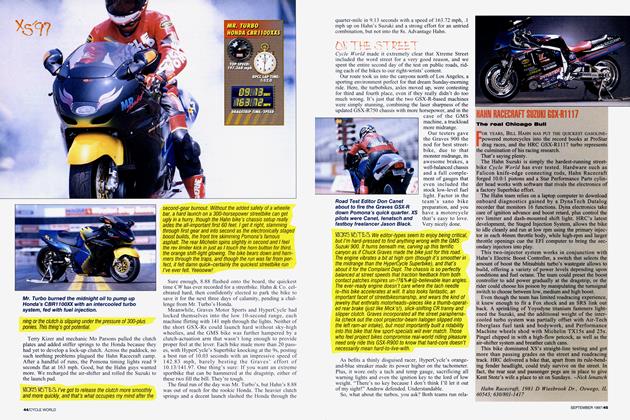
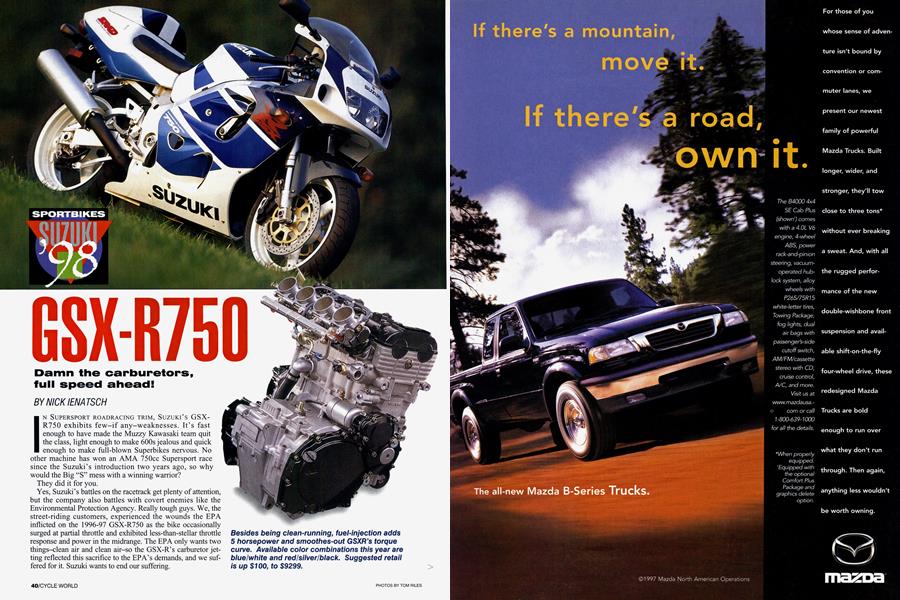
IN SUPERSPORT ROADRACING TRIM, SUZUKI'S GSXR750 exhibits few—if any—weaknesses. It's fast enough to have made the Muzzy Kawasaki team quit the class, light enough to make 600s jealous and quick enough to make full-blown Superbikes nervous. No other machine has won an AMA 750cc Supersport race since the Suzuki's introduction two years ago, so why would the Big "S" mess with a winning warrior? They did it for you.
Yes, Suzuki's battles on the racetrack get plenty of attention, but the company also battles with covert enemies like the Environmental Protection Agency. Really tough guys. We, the street-riding customers, experienced the wounds the EPA inflicted on the 1996-97 GSX-R750 as the bike occasionally surged at partial throttle and exhibited less-than-stellar throttle response and power in the midrange. The EPA only wants two things-clean air and clean air-so the GSX-R's carburetor jet ting reflected this sacrifice to the EPA's demands, and we suf fered for it. Suzuki wants to end our suffering.
"We're at a point on high-performance models where we've basically reached a limit with carburetors and emis sions requirements," explained Suzuki's Press Relations Manager Mark Reese during the 1998 GSX-R750's press introduction at Georgia's Road Atlanta Raceway.
The company's solution was to fuel-inject the `98 Gixxer, equipping it with basically the same Mikuni injectors, Denso engine-control module (ECM) and sensors as the TL1000S, with a single injector per cylinder and 46mm throttle bodies replacing the 39mm carburetors from last year's model. Asked about horsepower and torque gains, Reese replied that he had few hard numbers due to the newness of the bike, but that the factory aimed for a 5-horsepower gain, plus a smoother torque curve with a higher peak.
We'll find out if the factory accomplished its goals once we get the opportunity to strap a testbike to the CW dynamometer sometime down the road. But meanwhile, our seat-of-the-pants dyno yielded positive results. We logged 320 miles during the press intro, riding the bike in a variety of styles, including complete laps in top gear, stopping and starting on the back straight, laboring up hills at 2000 rpm and sailing into the Gravity Cavity at redline.
Clearly, Suzuki's switch to EFI has done nothing to detract from the bike's thrill factor; in fact, the engine zings happily to the 14,000-rpm rev-limiter with more verve than last year's carbureted model. It would be wonderful to report a bulging midrange, but the GSX-R still ain't no ZX-7R. The bike's lightness and the exactness of its EFI system endow it with impressive acceleration from any point on the tach, but once you've sampled the oomph above 9000 rpm, everything below that feels lethargic. We found none of the off-idle surging evident with the previous model's too-lean carbure tors, and could detect no valleys in the acceleration curve. Certainly, the dyno will reflect improved torque figures, but the high-revving nature of the original is unchanged.
There's still a lever on the left bar, but it's no longer a choke; it's simply a fast-idle lever that, if needed, works in conjunction with a camshaft-positioning sensor during coldengine startup. The Denso black box has two modes: one for low to midrange rpm and light loads, and one for heavy loads and high rpm. The low-rpm mode reads intake mani fold pressure and engine rpm to determine injector duration, while the high-rpm mode gets a bit more complicated, deter mining injector duration from throttle position and engine rpm, plus sensors reading coolant temperature, intake air temperature and atmospheric pressure. Ignition timing, injection timing and fuel-pump operation are determined by a crankshaft-position sensor. Lots of stuff, but the cheapest bucket of bolts you could rent from Avis had these goodies 10 years ago.
What about bolting on an aftermarket exhaust system? "There should be enough latitude in the injection system to deal with a free-flowing exhaust," Reese said, "but each pipe-maker is going to have to test specifically with the injected bike, rather than just sell last year's pipe." The sealed ECM carries a diagnostic function with a fail ure alert built into the LCD on the dashboard. Since you can't bolt in your favorite jet kit, expect aftermarket black boxes to start popping up (as they have for the TL), com plete with adjustable fuel metering to match different levels of engine modification. The jet kit of the future might cost a bit more and plug in under the seat, but don't be scared: If car guys can do it, we certainly can.
As you might have guessed, Suzuki didn't just glue on a fuel-injection system and send the bike out the door. Engine changes include longer-duration intake and exhaust cams, plus .2mm more lift on the intake cam. Two additional changes aimed at improving midrange are slightly shorter, slightly smaller-diameter header pipes and a larger airbox complete with electronically controlled flapper valve to help keep intake air velocity up at low rpm.
Other minor changes take aim at reducing weight, with a 1mm reduction in primary drive gear width, the replacement of yesterday's #530 chain with a narrower #525, and "nar row-waist" crankcase bolts like those of the GSX-R600. The final gram-carver was the elimination of coils as we know them; an individual coil is now built into each sparkplug cap in a system called "digital direct." This DC-CDI not only saves 400 grams of weight, but fires a hotter spark without the usual high coil temperatures of a conventional system. Finally, Suzuki's use of thin rare-earth magnets allowed a substantial increase in charging output, needed to run the EFI system and more powerful headlights.
Of course, few of these technical details clouded our minds at Road Atlanta. The agile wickedness of the GSX R750 remains wonderfully intact, and it now wears an envi ronmentally friendly fuel-delivery system that guarantees this type of performance into the next millennium. The "Injixxer" has landed.