Atk 250lq
ATK 250LQ
CYCLE WORLD TEST
FUN, FAST AND FLAWED
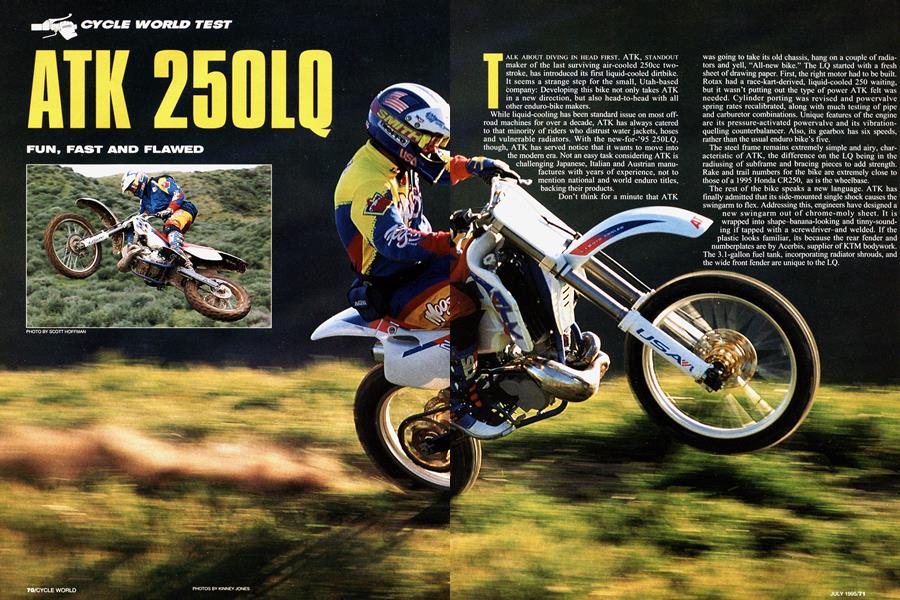
TALK ABOUT DIVING IN HEAD FIRST. ATK, STANDOUT maker of the last surviving air-cooled 250cc twos-troke, has introduced its first liquid-cooled dirtbike. It seems a strange step for the small, Utah-based company: Developing this bike not only takes ATK in a new direction, but also head-to-head with all other enduro-bike makers.
While liquid-cooling has been standard issue on most offroad machines for over a decade, ATK has always catered to that minority of riders who distrust water jackets, hoses and vulnerable radiators. With the new-for-’95 250LQ, though, ATK has served notice that it wants to move into the modem era. Not an easy task considering ATK is I challenging Japanese, Italian and Austrian manufactures with years of experience, not to mention national and world enduro titles, backing their products.
Don’t think for a minute that ATK
was going to take its old chassis, hang on a couple of radiators and yell, “All-new bike.” The LQ started with a fresh sheet of drawing paper. First, the right motor had to be built. Rotax had a race-kart-derived, liquid-cooled 250 waiting, but it wasn’t putting out the type of power ATK felt was needed. Cylinder porting was revised and powcrvalvc spring rates recalibrated, along with much testing of pipe and carburetor combinations. Unique features of the engine are its pressure-activated powervalve and its vibrationquelling counterbalancer. Also, its gearbox has six speeds, rather than the usual enduro bike’s five.
The steel frame remains extremely simple and airy, characteristic of ATK, the difference on the LQ being in the radiusing of subframe and bracing pieces to add strength. Rake and trail numbers for the bike are extremely close to those of a 1995 Honda CR250, as is the wheelbase.
The rest of the bike speaks a new language. ATK has finally admitted that its side-mounted single shock causes the swingarm to flex. Addressing this, engineers have designed a new swingarm out of chrome-moly sheet. It is wrapped into shape-banana-looking and tinny-soundy ing if tapped with a scrcwdriver-and welded. If the plastic looks familiar, its because the rear fender and numberplates are by Acerbis, supplier of KTM bodywork. The 3.1-gallon fuel tank, incorporating radiator shrouds, and the wide front fender are unique to the LQ.
Even when cold, the ATK fires quickly, though the tiny, left-side kick-starter is a bit awkward. Ours hung up on the footpeg sometimes. The reach for the clutch lever is a true reach, though the pull is light. Drop the bike in gear and it wants to creep, especially when cold. The ball-ramp clutch activation is smooth, though its pull is ferociously long and is doesn't completely disengage the clutch-getting the bike back into neutral with the engine running is impossible.
Initially, the motor feels weak. It has no hits in the power spread, building rpm controllably and quickly. Turns out there is abundant power; it’s just not delivered in a flashy, arm-yanking manner. Riding where there is plenty of traction (sand or loam), LQ riders will find themselves wanting more snap from the motor. But if traction is less abundant, the easily controlled ATK is perfect. Throw in slippery hard pack or greasy mud, and hooking up is what the Rotax motor is all about. Contrary to its lack of flywheel feel, this engine resists bogging down as well as any dirtbike we’ve ridden recently. The biggest surprise came in roll-ons and drag races against a Yamaha WR250 and a Suzuki RMX 250: The ATK was dead-even in drag races and pulled even the potent WR in roll-ons. Plus, slotted into sixth gear, it would pull away on top speed.
On a jetting note, the Mikuni TMS carburetor proved a bit on the finicky side. It is a “jet-less” carb, adjustments being made through needle and slide changes only. Our testbike came with a 4.5 slide and needed a 4.0 to riehen the low end. We compensated by closing the air screw and raising the clip on the needle.
The ATK’s broad power spread is good, because the shifting definitely isn’t-in fact, it’s horrible. The transmission has undercut gear dogs for long life. The bike will probably never pop out of gear; unfortunately shifting will probably never be a silky smooth experience, either. We tried different oils and additives with no luck. At least the gear spacing is spot-on. A low first makes the LQ a tractor in the ultraslow going, second through fifth are ideally situated, and sixth allows unfrenzied high-speed work. Very nice.
For the most part, the ATK is slim and extremely light. The lightness-227 pounds without gas-is right in there with current 250cc motocross bikes. The bike is very thin through its midsection, but the fuel tank, with its integrated radiator shrouds, bulges in front. When sliding forward for turns or on steep hillclimbs, the bike feels a bit wide. Racers and knee-brace wearers were the complainants here. Footpeg location (though about an inch farther apart than any other dirtbike), handlebar location, brake and shift levers all proved comfortable.
In use, the brakes feel a bit on the weak side. Originally, a larger front rotor was specified, but according to ATK, supply problems prevented it from being fitted. On the plus side for maintenance, both front and rear calipers are identical, so the same pads will work, front or rear.
Overall, handling is a bit different on the LQ. It has a slightly higher rear-weight bias than other dirtbikes, and for Expert-level riders the front end never quite felt planted. It doesn't unduly deflect off things and it doesn’t headshake, but the fork feels very light, leaving the unfamiliar rider without much confidence. Switching the Michelin front tire to a Dunlop K490 caused the loose feeling in turns to disappear, but the front end still felt feathery. It will carve a tight turn, no problem, just remember that a rider’s weight over the front end aids the ATK more that most bikes.
The ATK’s suspension comprises the best set up WP units we have ever experienced. Without a linkage, the rear shock lacks the initial softness and the extreme stiffening that can be designed into a rising-rate linkage, but ATK has compensated for this through shock valving. The initial travel, as well as the slow-speed valving, are righton. Indeed, the LQ exhibits a plushness that usually goes along with severely undersprung bikes, but it resists botsprung toming better than most off-the-showroom enduro bikes. The fork has a new valving setup designed to allow both highand low-speed valving variation. The right-side leg controls slow-speed setting via a standard shim stack; the left leg has the valve stack removed and only effects the last 3 inches of stroke, resisting bottoming. Fork action is supple and plush through the entire stroke, a good complement to the shock.
One good point about the ATK is that it comes with a lot of quality components standard-Pro-Taper handlebar, O-ring chain, excellent sprockets, strong and wide footpegs, a real kickstand meant to hold the bike up and not fall off in the first 10 miles, a sturdy chain guide and wear pads, and stainlesssteel spokes (optional is a skidplate, spark arrestor and enduro-lighting kit). Plan on spending some cash to replace exhaust pipes, however. Ours seemed made of tin foil and dented within a couple of hours on the bike. We put sizable notches in it (most from rocks thrown up by the front wheel) every time we rode the bike, until it was practically closed shut. ATK says it’s going to thicker-gauge stamping. None too soon. Another nuisance was the mount for the rear-brake master cylinder bending in from being pressed on by testers’ ankles and then flexing to stay in line with the pedal.
Despite its problems, the ATK 250LQ is, surprisingly, right in the hunt. It has a lighter feel than even a Kawasaki KDX200, plus a lot more power. It will go 65 miles on a tank of gas, and proved durable during our testing. The nastier and snottier the terrain, the better the LQ showed. Even through intensely abusive situations, the clutch never faded or squawked, and the oversized radiators kept their coolant.
With the 250LQ, ATK has a lot to be proud of. This bike has the potential to be an enduro champion and all-time trailbike-at a competitive price. Unfortunately, the company also has a lot to answer for. As it sits, the LQ is a work-in-progress. Fix the shifting, hang a real exhaust pipe on the motor, fit slightly stronger brakes, take care of the loose ends, ATK, and you won’t be able to make enough of these.
Right now, though, the 250LQ is a promise unfulfilled.
ATK
250LQ
$5145