Yamaha Sr500
YAMAHA SR500
CYCLE WORLD TEST
SIMPLE IS AS SIMPLE DOES
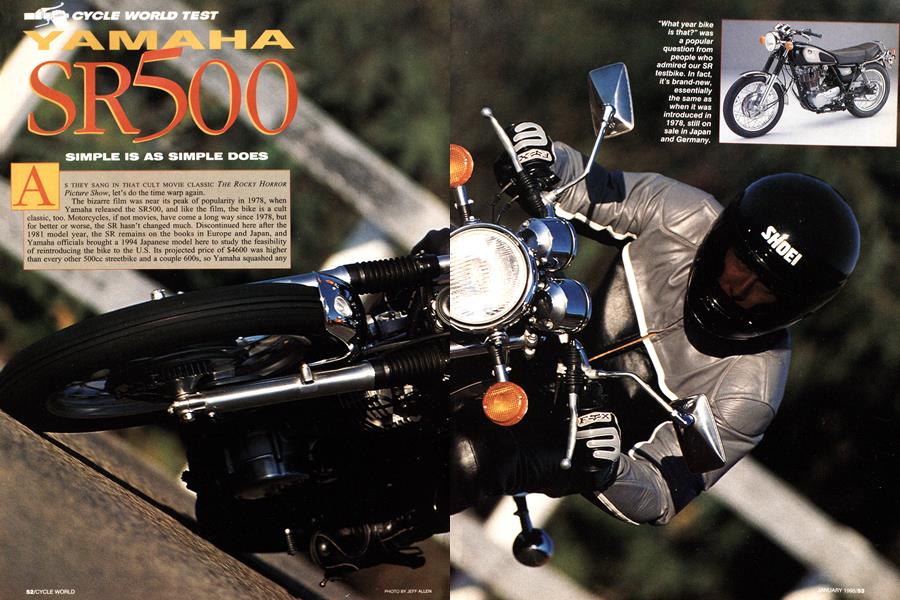
AS THEY SANG IN THAT CULT MOVIE CLASSIC THE ROCKY HORROR Picture Show, let’s do the time warp again. The bizarre film was near its peak of popularity in 1978, when Yamaha released the SR500, and like the film, the bike is a cult
classic, too. Motorcycles, if not movies, have come a long way since 1978, but for better or worse, the SR hasn’t changed much. Discontinued here after the 1981 model year, the SR remains on the books in Europe and Japan, and Yamaha officials brought a 1994 Japanese model here to study the feasibility of reintroducing the bike to the U.S. Its projected price of $4600 was higher than every other 500cc streetbike and a couple 600s, so Yamaha squashed any notions of bringing the SR Stateside, but offered Cycle World a chance to sample this brand-new classic, 16 years after its debut.
It was and is a basic motorcycle, with shortcomings that frustrate some, fervently attract others. Logging miles on the bike really is like traveling back in time; there are precious few motorcycles out there that are largely the same as they were in the late 1970s. “Thank God,” you might be thinking. Not if you’re Jack Robinson.
Robinson is the director of the Four Stroke Single National Owners Club (P.O. Box 1804, Hutchinson, K.S 67504-1804) and the owner of three SR500s. “It’s a strange thing,” he says. “The fact that it is flawed and imperfect makes it endearing to a certain type of individual. The SR500 does stand for a simpler way of life.”
Those looking for a simple motorcycle wouldn’t be disappointed with the SR. Forget about a start button, there’s only a kickstarter. The bike’s level of sophistication has actually been downgraded since 1978, when it had cast wheels and single disc brakes, front and rear. To boost the SR’s retro appeal, Yamaha has replaced those components with spoked wheels and drum brakes, the front stopper looking suspiciously like it was lifted from a 1970 XS650 Twin.
By contemporary standards, there’s not much to get excited about here, and as the data panel will bear out, the SR500 is by no means a hair-raising performer. But Robinson says that may not necessarily be a drawback. “I think people are intimidated by today’s complexities,” he says. “They stick their heads in the sand. The SR is more reassuring.” Owners looking to modify their bikes find it easy to do so. Many an SR engine has been punched out, some to more than 700cc; larger brakes are added; suspension components get upgraded; seats, tanks and handlebars get changed, with owners going for all sorts of different looks and uses. Robinson says he knows of people who have converted SR500s into dragbikes, hillclimbers, added sidecars and even hooked up nitrous-oxide systems.
In Europe and Japan, parts are available to convert SRs into everything from roadracers to Brit-bike rip-offs. The Japanese, in particular, have taken the retro theme to heart; they can get gold-pinstriped fuel tanks, hump-backed seats and enough tasty alloy bits, along with bodywork and badges, to make their SRs look as English as the Queen Mum. A German company, PaMi, makes a 235-pound SR Sound of Singles racer with inverted forks, a beam frame, full bodywork and an engine producing about 65 horsepower.
Some performance-enhancing parts would not be considered overkill, as the stock, two-valve engine makes just 25 rear-wheel horsepower and the bike takes a car-like 7.1 seconds to go from 0-60 mph. Top-speed is 87 mph-no more-but roll-on results reflect the Single’s torque and light weight: At 5.7 seconds going from 40 to 60 mph, the SR500 is half a second quicker than the Harley-Davidson Bad Boy tested in October's issue.
Another 6-8 horsepower can be had through a simple, $400 investment in a new carb and pipe, says Denny Berg, the owner of Time Machine, a Huntington Beach, California, restoration shop that does a good business in the SR aftermarket.
“It’s like any old bike,” says Berg. “You make a few changes and really feel the horsepower. Then you add a decent pair of shocks, good brake pads and lines, and you’ve got an instant canyon bike.”
For nipping around town, the stock power is adequate and the torque is handy. Vibration is noticeable, but not annoying. As Robinson says, “At 60 or so, there’s a sweet spot. The motorcycle dictates to you what speed you ride.”
Riding faster than 60 mph proves Robinson correct. Engine vibration is substantial at 65 mph. But maybe we're jaded. Sixteen years ago, CWs editors were more impressed: “What comes through when riding the SR500 is a great pulsing beast, a flood tide of torque, muffled throb and a willingness to pull.”
to pull.” Well, the engine does display a willingness to start. To fire up the Single, pull a compression-release lever on the left side of the handlebar, fold the right footpeg out of the way and prod the kickstarter until you can see shiny metal through a small portal in the cylinder head, indicating that the piston is at top dead center. The SR fires up easily for a 500cc Single and firstkick starts are not out of the question, even when the engine is stone cold.
The motor's simplicity helps make the motorcycle light and narrow, so maneuvering around town is a breeze. For go-fast riding, however, there simply isn't enough suspension. The forks are a little soft, and limited damping means some cornering competence is sacrificed for a ride that is admittedly very plush around town.
Back when the SR debuted, we were impressed enough to describe the SR500's handling as flawless. “Imagine the unlikely mixture of the jack rabbit agility of a Yamaha RD or Ducati GT and the locomotive stability of the Laverda Jota or Kawasaki KZ1000,” we gushed. “Or, at the risk of salting an emotional scar, the feel of, yes, the classic English roadster. By Gad Sirs, it works.”
Some styling elements also recall the classic bikes, notably the spoked wheels, chromed fenders and seat, which has a brown top and black sides. As good as the seat looks, though, it begins to inflict some discomfort after about 30 minutes. The padding appears thick and comfortable, but it is rather stiff, and its outer edges cut into a rider’s thighs.
In a sense, the seat is a microcosm of the entire motorcycle. It looks terrific, but comes up a little short in operational quality. The SR500, would make a great around-towner; its size and 354-pound weight mean that the bike feels like a Schwinn after riding almost any other motorcycle. The SR500 is an unusually attractive machine, too; passers-by paid more compliments to the SR than are doled out to most CW testbikes.
For all its charms, the SR’s limitations and its projected price are such that a mid-1990s version undoubtedly wouldn’t be a big seller here. There’s always the used-bike market, though. Berg says good-condition SRs can be had for around $1000. often coming with aftermarket goodies. At that price, you’re getting a unique, enjoyable motorcycle, one that’s got its quirks. In that regard, the SR500 is a big winner, for what good is life without a few unusual elements? O
EDITORS' NOTES
I DON'T GET T. MAYBE I'M A LITTLE young to appreciate the classic Single concept that spawned this motorcycle. If that concept includes motorcycles like the SR500, a gutless bike that vibrates like crazy, it doesn't hold tremendous allure for me. There's plenty of form, but not nearly enough function.
The smallish size and retro style are nice enough, but the lack of perfor mance means the SR is miserable on the freeway. Beyond that, $4600 (what the SR would cost here) for a bike like thk i~ 111t1ic~rAII!~
What's more appealing is all the things SR500 owners have done to their machines, and the fact that decent used SRs can be had for cheap. Track down the right bike, along with a few performance-oriented engine and suspension parts, do the work yourself, and you have the best virtues of the SR-light weight, small size and ease of maintenance-in a powerful, corner-devouring package that would cost about $2000. That's a concept almost anyone can appreciate, and a reality I could enjoy. -Robert Hough, News Editor
FOR MANY, THE SR500 OFFERS A RIDE down memory lane. For me, the SR is another reminder of just how far bikes have come since the good `ol days.
I was weaned on electric-start streetbikes, so I wasn't very happy when the SR refused to start after several stiff kicks. Witness to my anguish was Off Road Editor Lewis, who pointed out the ki~k
indicator" window. Smart kid. With the piston in its sweet spot just past TDC, Yamaha's blast from the past often fires on the first or second kick. Maybe with a little more training I'll be ready to tackle a Velocette Thruxton.
trnougn i tounci tne SK iaeai ror runmng erranas aoout town, venturing onto L.A.'s freeways had the engine screaming near redline to keep pace in the 75-mph com muter lane. Rain grooves in the road also had the SR squirming in a big way.
Still, there's a lot to like here; I've had a good time aboard the SR. It's an experience I won't soon forget. -Don canet, Road Test Editor
IN 1978, A CHECK SCRIBBLED OUT FOR $1489 was all it took to make an SR500 yours. My friends at the library resource desk tell me that a 1978 dollar would be worth about a buck-fifty-four today. That works out to an inflation-corrected figure of approximately $2300 for the Yama-Thumper in 1994 money, assum ing I punched the right buttons on my solar-powered Casio calculator ($4.95 today, $3.22 in `78, except it wasn't invented yet).
That's considerably less than the $4600 Yamaha says it would have to charge to bring an SR into the country. I'll leave it to the legume-counters at Yamaha to explain the discrepancy, but it doesn't really matter. Not a lot of people have started letter-writing campaigns championing the cause of `70s-era, no-frills, non-electric-start Singles.
in many ways that's too bad, because a ride on the SR is almost revelatory, reminding that narrowness and light weight can combine for supreme nimbleness, something most modem bikes lost years ago.-David Edwards; Editor-in-Chief
YAMAHA
SR500
$4590
SPECIFICATIONS