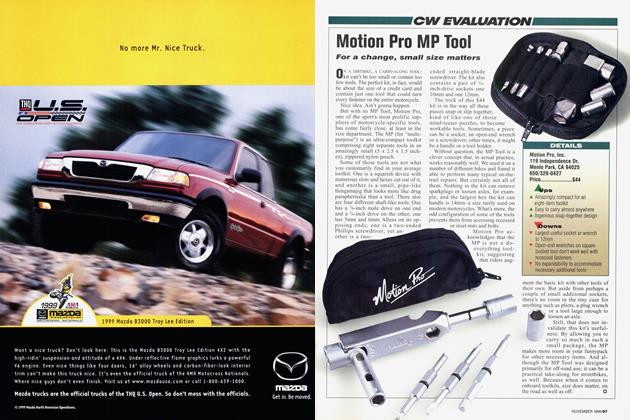
Penske 8900 Series Shock
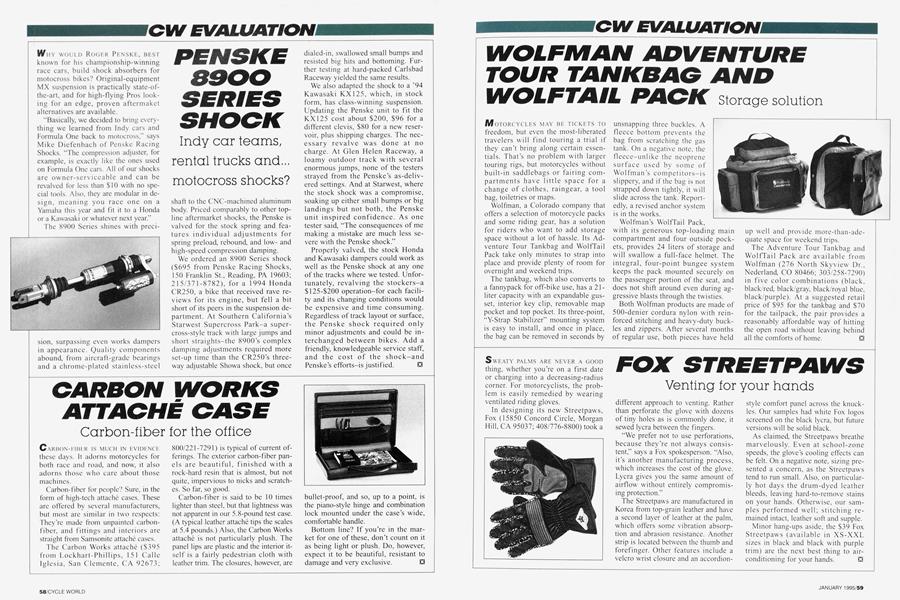
PENSKE 8900 SERIES SHOCK
CW EVALUATION
Indy car teams, rental trucks and... motocross shocks?
WHY WOULD ROGER PENSKE, BEST known for his championship-winning race cars, build shock absorbers for motocross bikes? Original-equipment MX suspension is practically state-of the-art, and for high-flying Pros looking for an edge, proven aftermaket alternatives are available.
"Basically, we decided to bring every thing we learned from Indy cars and Formula One back to motocross," says Mike Diefenbach of Peiiske Racing Shocks. "The compression adjuster, for example. is exactly like the ones used on Formula One cars. All of our shocks are owner-serviceable and can be revalved for less than SlO with no spe cial tools. Also, they are modular in de sign, meaning you race one on a Yamaha this year and fit it to a Honda or a Ka~vasaki or whatever next year."
The 8900 Series shines with preci Sk)fl, surpassing even works dampers in appearance. Quality components abound, from aircraft-grade bearings and a chrome-plated stainless-steel
shaft to the CNC-machined aluminum body. Priced comparably to other topline aftermarket shocks, the Penske is valved for the stock spring and fea tures individual adjustments for spring preload, rebound, and lowand high-speed compression damping.
We ordered an 8900 Series shock ($695 from Penske Racing Shocks, 150 Franklin St.. Reading. PA 19603; 215/371-8782). for a 1994 Honda (R250, a bike that received rave re views for its engine, but fell a bit short of its peers in the suspension de partment. At Southern (`alifornia's Starwest Supercross Park-a super cross-style track with large jumps and short straights-the 8900's complex damping adjustments required more set-up time than the (`R250's three way adjustable Showa shock, but once dialed-in, swallowed small bumps and resisted big hits and bottoming. Fur ther testing at hard-packed Carlsbad Raceway yielded the same results.
We also adapted the shock to a 94 Kawasaki KX125. which, in stock form, has class-winning suspension. Updating the Penske unit to fit the KX125 cost about S200, 96 for a different clevis, S~() for a new reser voir, plus shipping charges. The nec essary revalve was done at no charge. At Glen Helen Raceway, a loamy outdoor track with several enormous jumps, none of the testers strayed from the Penske's as-deliv ered settings. And at Starwest, where the stock shock was a compromise, soaking up either small bumps or big landings but not both, the Penske unit inspired confidence. As one tester said, "The consequences of me making a mistake are much less se vere with the Penske shock."
Properly valved, the stock Honda and Kawasaki dampers could work as well as the Penske shock at any one of the tracks where we tested. Unfor tunately, revalving the stockers-a S125-$200 operation-for each facili ty and its changing conditions would be expensive and time consuming. Regardless of track layout or surface, the Penske shock required only minor adjustments and could be in terchanged between bikes. Add a friendly, knowledgeable service staff, and the cost of the shock-and Penske's efforts-is justified.