Adventures In Africa
RACE WATCH
ADVENTURES IN AFRICA
American Danny LaPorte goes rally racing
IT WAS NOT AN ESPECIALLY IMPRESsive start to a rally career. American Danny LaPorte, the 1982
250cc World Motocross Champion, crashed heavily early in the running of last year’s Paris-to-Dakar Rally, and had to be airlifted back to France with heart and lung contusions.
But this year, LaPorte, 36, returned as a member of the Lucky Explorer Cagiva team to contest the inaugural Paris-to-Capetown Rally, and was in contention for the win until a bad batch of fuel cost him 24 minutes. He went on to finish second to Frenchman Stephane Peterhansel, the world’s best rallyist, who was riding a TDM850-based Sonauto Yamaha YZE750 Twin.
While Paris-Dakar was an awesome undertaking by anyone’s standards, Paris-Capetown is even more so. The event lasts 25 days and covers nearly 8000 miles, traveling through 10 notalways-friendly African nations.
SU KEMPER
The journey from Paris is an adventure that encompasses just about every type of terrain imaginable. In North Africa, sand predominates. “The sand is what makes this race so incredible,” LaPorte says. “It’s difficult to describe what it’s like to navigate through 300 miles of solid dunes. There is no sand in the U.S. or Baja that compares to this. I know it’s hard to comprehend sand dunes as large as Southern California, but there are lots of them in Libya and Niger.”
Navigating through the sand is always difficult. But this year, for the first time in a rally event, competitors were allowed to use Global Positioning System, a type of satellite navigation, in addition to the usual daily road book of course instructions.
“It is so important to have GPS now,” remarks LaPorte. “Unlike Baja racing, the course is completely secret. With the proper coordinates, GPS can tell you if you are off your line by 3 feet or a mile.”
One problem with GPS, however, is that it cannot display topographic information. This means that while you now might know where you are going, you don’t know if there is a steep cliff or a canyon between you and your destination.
But even though the great sand deserts of the north reached all the way to southern Chad, LaPorte preferred the dunes to the dense terrain of central Africa. “The worst part of the course was in the Central African Republic, where overtaking was just about impossible because the tracks were narrow and dusty, and there was either savanna or jungle on both sides of the road,” he says.
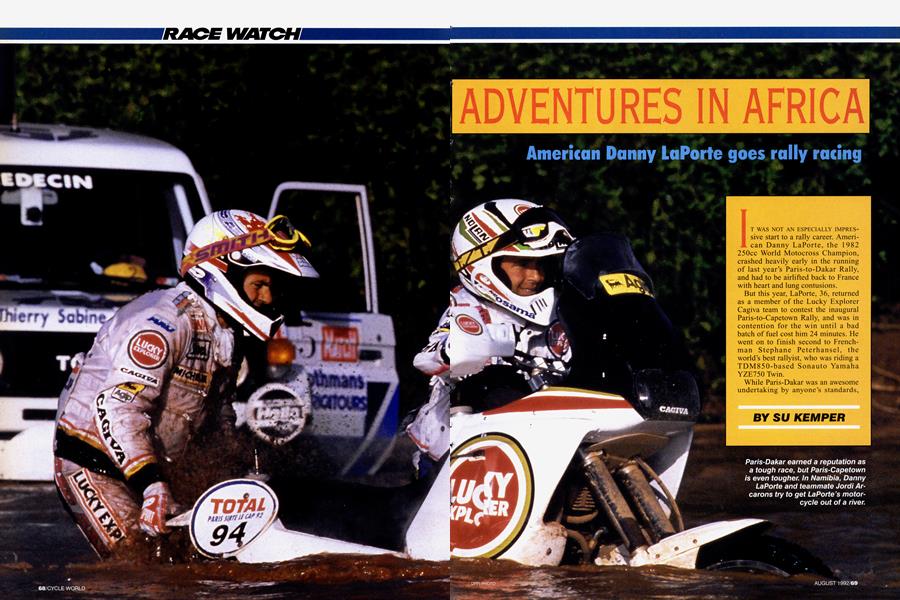
In Namibia, LaPorte and Peterhansel risked life and limb to cross a swollen stream, only to reach the other side and be told the section had
been scrubbed. Both had to be airlifted, via helicopter, back to the other side. “It was really a sandwash, 150 feet wide, just like in Baja, only the water was running really fast and rising by the minute. I was in it up to my chest at times,” explains LaPorte. “The front-running cars wanted to cross, but the officials wouldn’t let them. The major problem was that the medical trucks couldn’t cross, and because of that, it made sense to cancel the section.”
Asked if the stream was alligatorinfested, as some European magazines had reported, LaPorte replied, “There were no alligators; it was too far south into the Namib Desert. The Central African Republic was full of crocs, but fortunately there were bridges.”
It was in this same area that LaPorte recalled a warning, written in French, in his road book. “I didn’t pay any attention to it, but later was aware that I’d been riding through some really weird plants for what seemed like a couple hundred miles. Later, I was told they were meateaters! They were big-3 to 4 feet across, 1 to 2 feet high-and they sat on the ground like a flower with a mouth on the bottom. People who knew about them said they only ate small animals.”
In addition to LaPorte, the Lucky Explorer Cagiva Team had two other riders: Italian Edi Orioli, the 1989 Paris-Dakar winner, and Spaniard Jordi Arcarons. All rode hand-built, $70,000 works Cagivas, liberally sprinkled with carbon fiber, Kevlar and titanium, and powered by oilcooled, 904cc Ducati V-Twins.
“These bikes are very special, having evolved over the past 13 years for running specifically in Africa,” says LaPorte. “The suspension is similar to that on a regular motocross bike, only much more heavy-duty, to take greater weight.”
Putting together a team and then caring for it properly in an event of this magnitude can cost in the millions. Cagiva had a total of five bikes running-three team bikes and two others manned by “assistant riders,” whose job it was to keep the main riders going. “If I broke a wheel, he would give me his. Simple,” says LaPorte. “But if I broke a gearbox, I would have to wait for our Land Rover that was two to three hours behind me. This vehicle was equipped with engines, wheels, suspensions, electrics, etc. The next vehicle was our Mercedes-Benz 6x6, fully equipped with generators, spare parts and mechanics; that would be three to four hours back. Further back were three Mercedes-Benz Unimog 4x4s. And there were eight people who flew daily in our airplanes: the team manager, doctor, secretary and five mechanics.”
Even with all this support, ParisCapetown was not easy. “Each night, we would bivouac, usually at an airport. You’d try to sleep in your tent,
with earplugs firmly implanted, but sometimes it was impossible. The noise outside was incredible-generators running, tools pounding, mechanics testing engines all night. It’s very difficult to sleep,” says LaPorte.
During the event, LaPorte carried with him a selection of emergency supplies such as masterlinks, sparkplugs, coils, ignition parts, inner tubes, safety wire, duct tape and epoxy. He also had a survival kit that included flares, strobe lights, a space blanket and two liters of water.
Another emergency device was a lithium radio beacon for use only in dire circumstances, because once competitors turned it on, they were disqualified. “You only used this if you were hurt or lost or broken down, and it could save your life. Once it was activated, all of the event organizer’s airplanes and helicopters picked up the signal, and they could actually have someone to you within minutes,” says LaPorte.
Now living in Monte Carlo with his wife, Georgia, and their two young children, LaPorte is under contract to Cagiva for the next two years. Given his lack of experience in these offroad marathons, his Capetown runner-up finish is remarkable. Especially when you consider that, after nearly a month’s racing across an entire continent, the margin between first and second places was just 24 minutes, 8 seconds. In African rallies, that’s as close as it gets. □