Bmw K75s
RIDING IMPRESSION: BMW K75S
Does a sporting BMW ever stop being a touring bike?
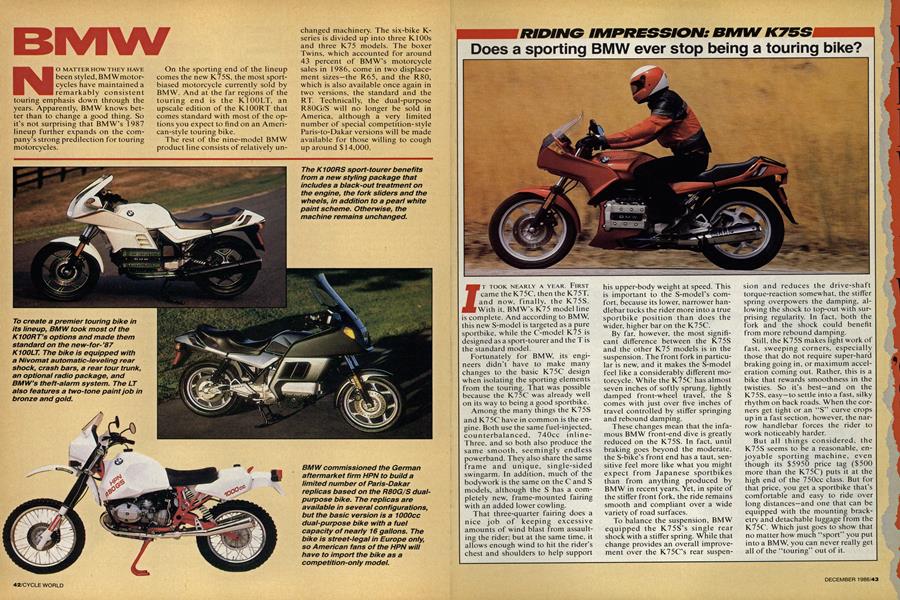
IT TOOK NEARLY A YEAR. FIRST came the K75C, then the K75T, and now, finally, the K75S. With it, BMW's K75 model line is complete. And according to BMW, this new S-model is targeted as a pure sportbike, while the C-model K75 is designed as a sport-tourer and the T is the standard model.
Fortunately for BMW, its engineers didn’t have to make many changes to the basic K75C design when isolating the sporting elements from the touring. That was possible because the K75C was already well on its way to being a good sportbike.
Among the many things the K75S and K75C have in common is the engine. Both use the same fuel-injected, counterbalanced, 740cc inlineThree, and so both also produce the same smooth, seemingly endless powerband. They also share the same frame and unique, single-sided swingarm. In addition, much of the bodywork is the same on the C and S models, although the S has a completely new, frame-mounted fairing with an added lower cowling.
That three-quarter fairing does a nice job of keeping excessive amounts of wind blast from assaulting the rider; but at the same time, it allows enough wind to hit the rider’s chest and shoulders to help support
his upper-body weight at speed. This is important to the S-model’s comfort, because its lower, narrower handlebar tucks the rider more into a true sportbike position than does the wider, higher bar on the K75C.
By far, however, the most significant difference between the K75S and the other K75 models is in the suspension. The front fork in particular is new, and it makes the S-model feel like a considerably different motorcycle. While the K75C has almost seven inches of softly sprung, lightly damped front-wheel travel, the S comes with just over five inches of travel controlled by stiffer springing and rebound damping.
These changes mean that the infamous BMW front-end dive is greatly reduced on the K75S. In fact, until braking goes beyond the moderate, the S-bike’s front end has a taut, sensitive feel more like what you might expect from Japanese sportbikes than from anything produced by BMW in recent years. Yet, in spite of the stiffer front fork, the ride remains smooth and compliant over a wide variety of road surfaces.
To balance the suspension, BMW equipped the K75S’s single rear shock with a stiffer spring. While that change provides an overall improvement over the K75C’s rear suspen-
sion and reduces the drive-shaft torque-reaction somewhat, the stiffer spring overpowers the damping, allowing the shock to top-out with surprising regularity. In fact, both the fork and the shock could benefit from more rebound damping.
Still, the K75S makes light work of fast, sweeping corners, especially those that do not require super-hard braking going in, or maximum acceleration coming out. Rather, this is a bike that rewards smoothness in the twisties. So it’s best—and on the K75S, easy—to settle into a fast, silky rhythm on back roads. When the corners get tight or an “S” curve crops up in a fast section, however, the narrow handlebar forces the rider to work noticeably harder.
But all things considered, the K75S seems to be a reasonable, enjoyable sporting machine, even though its $5950 price tag ($500 more than the K75C) puts it at the high end of the 750cc class. But for that price, you get a sportbike that’s comfortable and easy to ride over long distances—and one that can be equipped with the mounting bracketry and detachable luggage from the K75C. Which just goes to show that no matter how much “sport” you put into a BMW, you can never really get all of the “touring” out of it.