Triumph Bonneville
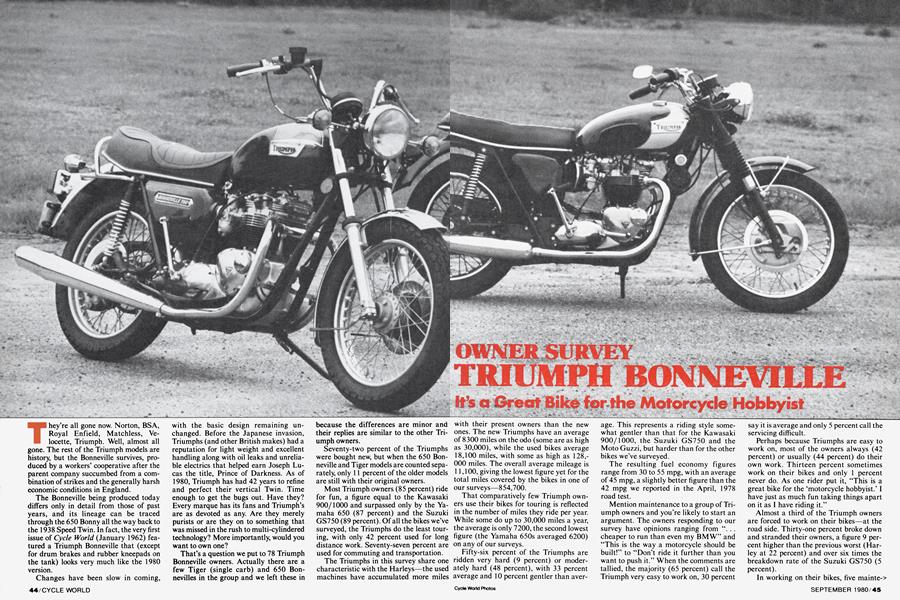
They're all gone now. Norton, BSA, Royal Enfield, Matchless, Velocette, Triumph. Well, almost all gone. The rest of the Triumph models are history, but the Bonneville survives, produced by a workers’ cooperative after the parent company succumbed from a combination of strikes and the generally harsh economic conditions in England.
The Bonneville being produced today differs only in detail from those of past years, and its lineage can be traced through the 650 Bonny all the way back to the 1938 Speed Twin. In fact, the very first issue of Cycle World (January 1962) featured a Triumph Bonneville that (except for drum brakes and rubber kneepads on the tank) looks very much like the 1980 version.
Changes have been slow in coming,
with the basic design remaining unchanged. Before the Japanese invasion, Triumphs (and other British makes) had a reputation for light weight and excellent handling along with oil leaks and unreliable electrics that helped earn Joseph Lucas the title, Prince of Darkness. As of 1980, Triumph has had 42 years to refine and perfect their vertical Twin. Time enough to get the bugs out. Have they? Every marque has its fans and Triumph’s are as devoted as any. Are they merely purists or are they on to something that was missed in the rush to multi-cylindered technology? More importantly, would you want to own one?
That’s a question we put to 78 Triumph Bonneville owners. Actually there are a few Tiger (single carb) and 650 Bonnevilles in the group and we left these in
because the differences are minor and their replies are similar to the other Triumph owners.
Seventy-two percent of the Triumphs were bought new, but when the 650 Bonneville and Tiger models are counted separately, only 11 percent of the older models are still with their original owners.
Most Triumph owners (85 percent) ride for fun, a figure equal to the Kawasaki 900/1000 and surpassed only by the Yamaha 650 (87 percent) and the Suzuki GS750 (89 percent). Of all the bikes we’ve surveyed, the Triumphs do the least touring, with only 42 percent used for long distance work. Seventy-seven percent are used for commuting and transportation.
The Triumphs in this survey share one characteristic with the Harleys—the used machines have accumulated more miles with their present owners than the new ones. The new Triumphs have an average of 8300 mils on the odo (some are as high as 30,000), while the used bikes average 18,100 miles, with some as high as 128,000 miles. The overall average mileage is 11,100, giving the lowest figure yet for the total miles covered by the bikes in one of our surveys—854,700.
TRIUMPH BONNEVILLE
It's a Great Bike for the Motorcycle Hobbyist
OWNER SURVEY
That comparatively few Triumph owners use their bikes for touring is reflected in the number of miles they ride per year. While some do up to 30,000 miles a year, the average is only 7200, the second lowest figure (the Yamaha 650s averaged 6200) on any of our surveys.
Fifty-six percent of the Triumphs are ridden very hard (9 percent) or moderately hard (48 percent), with 33 percent average and 10 percent gentler than aver-
age. This represents a riding style somewhat gentler than that for the Kawasaki 900/1000, the Suzuki GS750 and the Moto Guzzi, but harder than for the other bikes we’ve surveyed.
The resulting fuel economy figures range from 30 to 55 mpg, with an average of 45 mpg, a slightly better figure than the 42 mpg we reported in the April, 1978 road test.
Mention maintenance to a group of Triumph owners and you’re likely to start an argument. The owners responding to our survey have opinions ranging from “. . . cheaper to run than even my BMW” and “This is the way a motorcycle should be built!” to “Don’t ride it further than you want to push it.” When the comments are tallied, the majority (65 percent) call the Triumph very easy to work on, 30 percent
say it is average and only 5 percent call the servicing difficult.
Perhaps because Triumphs are easy to work on, most of the owners always (42 percent) or usually (44 percent) do their own work. Thirteen percent sometimes work on their bikes and only 1 percent never do. As one rider put it, “This is a great bike for the ‘motorcycle hobbyist.’ I have just as much fun taking things apart on it as I have riding it.”
Almost a third of the Triumph owners are forced to work on their bikes—at the road side. Thirty-one percent broke down and stranded their owners, a figure 9 percent higher than the previous worst (Harley at 22 percent) and over six times the breakdown rate of the Suzuki GS750 (5 percent).
In working on their bikes, five mainte-> nance problem areas were found by 5 percent or more of the owners. Electrical problems lead the list at 10 percent, followed by frequent maintenance (9 percent), fork seals (6 percent), headlight bulbs (6 percent) and carburetor problems (5 percent). Forty-two percent had no maintenance problems with their Triumphs.
Electrical problems are the Triumph’s weakness. Eighteen percent of the Triumph owners had problems with the electrical system, mostly with shorts in the wiring harness. The same number (18 percent) replaced the fork seals and 12 percent replaced miscellaneous other seals and gaskets. Eight percent had to have the engine rebuilt (at mileages of 9000, 10,000, 19,000, 25,000, two at 40,000 and
one at 82,000), 7 percent had to replace headlight or instrument light bulbs and 6 percent each had to replace wheel bearings, the oil pressure switch or the clutch cable. Five percent each had to repair the transmission, rebuild the top end or replace the speedometer and 4 percent needed oil pump repairs. Fourteen percent said their Triumphs needed no repairs.
Despite shops that used to deal with British bikes going out of business or switching to Japanese products, most of the owners don’t have much difficulty finding parts. Thirty-eight percent can always get the parts, 42 percent say they are mostly available, 16 percent sometimes have difficulty finding them and only 4 percent say parts are always hard to find.
Compared to the other bikes we’ve sur-
veyed, few Triumphs are idle while waiting for parts and when they are, the wait is a short one. Only six percent of the Triumph owners have had to wait for parts, equaling the BMW in that regard, and the average wait was only 19 days, versus 26 for the BMWs. Only the Honda Gold Wings and the Harleys had a shorter wait (18 days).
On the basis of owner ratings, Triumph dealers do fairly well. Thirty-two percent are rated very good, 38 percent are good, 10 percent got a fair rating, 14 percent are called poor, and 6 percent rate a rude gesture and a very poor rating.
Most of the modifications listed by the owners were chosen to make the Triumph into even more of a sporting machine. Thirty-three percent modified the exhaust system or added headers and nearly as many (27 percent) changed the handlebars. Half of those specified that they went to low handlebars or clip-ons. Twelve percent of the owners put in a quartzhalogen headlight, 10 percent modified the electrics, 8 percent hopped up the engine, 6 percent modified or replaced the carburetors and 5 percent each modified the turn signal mounts or removed them altogether, modified the fenders or changed the gearing.
Accessories chosen by the Triumph owners also reflect their riding preferences with relatively few adding touring accessories. Backrests and sissybars are the most popular add-ons at 19 percent, followed by fairings and windshields (14 percent), luggage racks (13 percent), saddlebags (10 percent), oil coolers (9 percent), highway pegs (8 percent), seats and cruise controls (6 percent each) and 4 percent each added extra instruments, tank bags, crash bars and aftermarket shocks. Twenty-six percent added nothing.
Of those accessories, only Dunstall mufflers were praised by more than two riders, getting a good rating from four riders. However, they were also listed as unsatisfactory by two riders, as were Appliance headers.
TRIUMPH BONNEVILLE OWNER SURVEY
When it comes to best features, Triumph owners agree—it handles! Eightyfive percent of the owners call the handling a best feature. One rider asked, “Am I a coward or is it impossible to scrape the footpegs?” Apparently it isn’t, because another rider said he’s “. . . gone through about a dozen footpeg rubbers—Damn non-folding pegs!”
Triumph’s traditional styling and appearance is a favorite feature for 38 percent of the owners, while 37 percent applaud the light weight. Twenty-seven percent like the torque, 24 percent appreciate its ease of maintenance and simplicity, 15 percent like the fuel economy and 13 percent list “class” or uniqueness as a best feature. Other favorite aspects include the sound, the brakes and the reliability (10 percent each), the ease of starting, the power and the narrowness (9 percent each), “feel” or ergonomics (6 percent), and performance, workmanship and ride quality (5 percent each).
Vibration heads the list of worst features at 35 percent, but most of the riders say it is a minor annoyance and “You get used to it.” Twenty-three percent of the owners found fault with the electrics, 12 percent had oil leaks or said the seat is uncomfortable and 9 percent say the tank is too small. The ride quality, the brake squeal, the carburetors and the amount of horsepower are each bothersome to 8 percent of the owners, and 5 percent each dislike the hard-to-find neutral, the need for premium fuel and the mufflers.
Triumph owners obviously appreciate tradition, but they do want a few changes in the Bonneville. Eighteen percent think the fuel tank should be larger, 12 percent would like the engine to have counter-balancers, a Norton-like soft mounting system or at least less vibration, 10 percent want the electrics updated and 9 percent want folding footpegs. Eight percent each would like more power, better suspension or electronic ignition, 6 percent would like electric start and 5 percent want better carbs or an easier-to-find neutral.
If, after reading this, you think that the Triumph is the bike for you, your priorities and values in motorcycling are the same as the 84 percent of the owners who told us they’d buy another Triumph. Only Harley owners (78 percent) show less brand loyalty. Dissatisfied owners made comments like, “It really sucks” but others commented, “It does require frequent maintenance, but it’s very simple for anyone with some mechanical ability. I have never felt as confident when riding a Japanese bike.” and “Contrary to CWs article, my Triumph leaks oil. So what, I’ve owned an MG for 10 years.” Or as one put it, “Triumph is named ‘Egbert’ after the first Saxon King of England who laid down the basic design in the ninth century. I really should sell him, but I can’t.” S