Honda 750f2
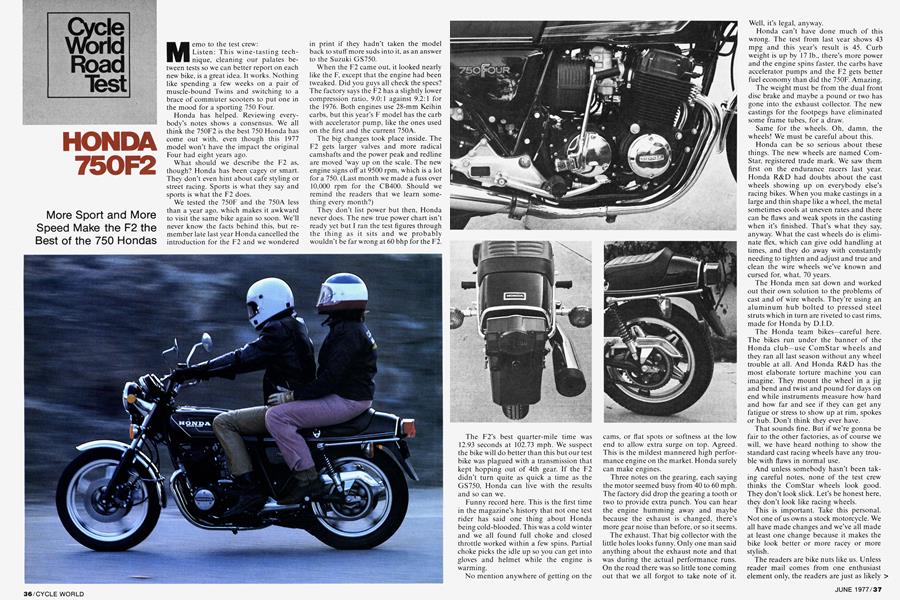
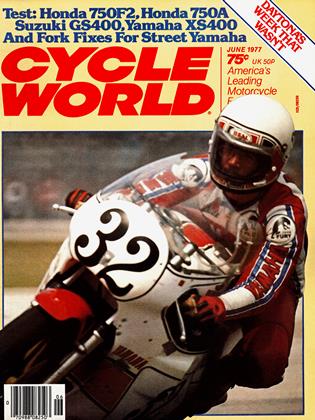
HONDA 750F2
Cycle World Road Test
More Sport and More Speed Make the F2 the Best of the 750 Hondas
Memo to the test crew: Listen: This wine-tasting technique, cleaning our palates between tests so we can better report on each new bike, is a great idea. It works. Nothing like spending a few weeks on a pair of muscle-bound Twins and switching to a brace of commuter scooters to put one in the mood for a sporting 750 Four.
Honda has helped. Reviewing everybody’s notes shows a consensus. We all think the 750F2 is the best 750 Honda has come out with, even though this 1977 model won’t have the impact the original Four had eight years ago.
What should we describe the F2 as, though? Honda has been cagey or smart. They don’t even hint about cafe styling or street racing. Sports is what they say and sports is what the F2 does.
We tested the 750F and the 750A less than a year ago, which makes it awkward to visit the same bike again so soon. We’ll never know the facts behind this, but remember late last year Honda cancelled the introduction for the F2 and we wondered in print if they hadn’t taken the model back to stuff more suds into it, as an answer to the Suzuki GS750.
When the F2 came out, it looked nearly like the F, except that the engine had been tweaked. Did you guys all check the specs? The factory says the F2 has a slightly lower compression ratio, 9.0:1 against 9.2:1 for the 1976. Both engines use 28-mm Keihin carbs, but this year’s F model has the carb with accelerator pump, like the ones used on the first and the current 750A.
The big changes took place inside. The F2 gets larger valves and more radical camshafts and the power peak and redline are moved ’way up on the scale. The new engine signs off at 9500 rpm, which is a lot for a 750. (Last month we made a fuss over 10,000 rpm for the CB400. Should we remind the readers that we learn something every month?)
They don’t list power but then, Honda never does. The new true power chart isn’t ready yet but I ran the test figures through the thing as it sits and we probably wouldn’t be far wrong at 60 bhp for the F2.
The F2’s best quarter-mile time was 12.93 seconds at 102.73 mph. We suspect the bike will do better than this but our test bike was plagued with a transmission that kept hopping out of 4th gear. If the F2 didn’t turn quite as quick a time as the GS750, Honda can live with the results and so can we.
Funny record here. This is the first time in the magazine’s history that not one test rider has said one thing about Honda being cold-blooded. This was a cold winter and we all found full choke and closed throttle worked within a few spins. Partial choke picks the idle up so you can get into gloves and helmet while the engine is warming.
No mention anywhere of getting on the cams, or flat spots or softness at the low end to allow extra surge on top. Agreed. This is the mildest mannered high performance engine on the market. Honda surely can make engines.
Three notes on the gearing, each saying the motor seemed busy from 40 to 60 mph. The factory did drop the gearing a tooth or two to provide extra punch. You can hear the engine humming away and maybe because the exhaust is changed, there’s more gear noise than before, or so it seems.
The exhaust. That big collector with the little holes looks funny. Only one man said anything about the exhaust note and that was during the actual performance runs. On the road there was so little tone coming out that we all forgot to take note of it. Well, it’s legal, anyway.
Honda can’t have done much of this wrong. The test from last year shows 43 mpg and this year’s result is 45. Curb weight is up by 17 lb., there’s more power and the engine spins faster, the carbs have accelerator pumps and the F2 gets better fuel economy than did the 750F. Amazing.
The weight must be from the dual front disc brake and maybe a pound or two has gone into the exhaust collector. The new castings for the footpegs have eliminated some frame tubes, for a draw.
Same for the wheels. Oh, damn, the wheels! We must be careful about this.
Honda can be so serious about these things. The new wheels are named ComStar, registered trade mark. We saw them first on the endurance racers last year. Honda R&D had doubts about the cast wheels showing up on everybody else’s racing bikes. When you make castings in a large and thin shape like a wheel, the metal sometimes cools at uneven rates and there can be flaws and weak spots in the casting when it’s finished. That’s what they say, anyway. What the cast wheels do is eliminate flex, which can give odd handling at times, and they do away with constantly needing to tighten and adjust and true and clean the wire wheels we’ve known and cursed for, what, 70 years.
The Honda men sat down and worked out their own solution to the problems of cast and of wire wheels. They’re using an aluminum hub bolted to pressed steel struts which in turn are riveted to cast rims, made for Honda by D.I.D.
The Honda team bikes—careful here. The bikes run under the banner of the Honda club—use ComStar wheels and they ran all last season without any wheel trouble at all. And Honda R&D has the most elaborate torture machine you can imagine. They mount the wheel in a jig and bend and twist and pound for days on end while instruments measure how hard and how far and see if they can get any fatigue or stress to show up at rim, spokes or hub. Don’t think they ever have.
That sounds fine. But if we’re gonna be fair to the other factories, as of course we will, we have heard nothing to show the standard cast racing wheels have any trouble with flaws in normal use.
And unless somebody hasn’t been taking careful notes, none of the test crew thinks the ComStar wheels look good. They don’t look slick. Let’s be honest here, they don’t look like racing wheels.
This is important. Take this personal. Not one of us owns a stock motorcycle. We all have made changes and we’ve all made at least one change because it makes the bike look better or more racey or more stylish.
The readers are bike nuts like us. Unless reader mail comes from one enthusiast element only, the readers are just as likely to go for looks as for anything else. If this guess is right, few' buyers are going to come into the Honda showroom with money at the ready because of these wheels.
SUSPENSION DYNO TEST
FRONT FORKS
Description: Shows fork HD 315 oil Fork travel, in.: 5.1 Engagement, in.: 6.2 Spring rate, lb./in.: 47 Compression damping force, Ib.: 9 Rebound damping force, Ib.: 37 Static seal friction, lb.: 10
The F2’s forks are much improved over last year’s F models. Damping rates are appropriate, and static seal friction has been reduced. The front end is very compliant, but some road irregularities are transmitted because of the stiff (47 lb.) spring. A lighter spring would give the bike a much smoother ride if desired.
REAR SHOCKS
Description: Showa shock, gas/oil mix, non-rebuildable Shock travel, in.: 3.25 Wheel travel, in.: 4.0 Spring rate, lb./in.: 100 Compression damping force, lb.: 0 Rebound damping force, lb.: 125
Remarks: Spring rate is the same as previous F models, but preload and damping rates have been altered to provide an excellent balance between comfort and control. Pavement-racer types may opt for a shock with higher damping, but others should be happy with the rear end as is. Tests performed at Number One Products
All this engineering by Honda and all they’ll get for it is the pleasure of knowing they did their scientific best. Do you suppose they’ll be as keen to build motorcycles for Americans when they understand us?
Honda may not be all that interested. Running down the list of items new and items unchanged on the F2, compared with our collective notes, turns up some bits where factory and press don’t see eye to eye.
The F2 has big horns sticking right out front. No sign from us that they actually do more of what horns do. They may make more decibels, but just as always, the twit who chops you on the freeway goes creeping on his fogged way no matter how long you lean on the horn button.
Still those distinctive shields for the brake discs. Honda engineering has the idea that the shields keep spray from flying off the wheel and all over the rider. Right. But the spray that doesn’t fly off the wheel keeps churning around there on the disc, getting between rotor and pad and making wet-weather braking less effective than when things are dry. Braking in the wet was one of the reasons everybody switched to discs, eh?
No problem with starts even though the headlight is permanently on. The charging circuit on the big motor must have been arranged with this in mind.
No approving mention of the grips, alledged by the factory to have been redone in softer material. This may be because there are still complaints about heavy throttle springs. Our palate cleaning again. Nothing like riding for a while on a small Twin with two-finger throttle to remind you where the ache-in your right wrist aboard the F2 comes from.
The beepers wired into the turn signals were intact when the F2 had made the complete rounds. That comes under the heading of restraint under adverse conditions. Let’s give us a gold star.
Nothing in the records about the larger chain, from #530 to #630. Things like that don't show up anywhere unless it’s by omission: The chain hasn’t needed adjustment yet, despite all the hard miles we’ve put on the bike. These endless permanently lubricated chains are nice when the machine is new, although it’s too bad we can't do some sort of long range test, the better to report on whether the extra cost of replacement is equaled by longer life.
Have we mentioned Honda’s early warning system? The label on the swing arm telling the owner when the chain has stretched to the replacement point? Nice touch, even if it’s a bit of overkill for those who know to replace the chain when it’s at the rear of the slot.
Taking the passengers along for the long road ride was another good idea. Short jaunts are fine and getting reactions from various wives and ladies is fine, too, but the first doesn’t reflect real life and the second is colored by personal preference. Like rider impressions, which is why we use these collected notes. Having passengers we’re not used to, and having them be people who don’t usually go on long rides, turned up new impressions, for us and them.
They didn’t know which bike was supposed to be good at what, right? Not surprising that they vastly preferred the big Fours to the mid-range Twins. But none of us expected they’d like the 750F better than the 750A. Unanimous. You’d think that the touring saddle shape of the 750A’s seat would work better on a long haul, but no. Or maybe this is another sign that the F2 is supposed to be a sports bike for long runs; two people are more fun. All the riders liked the F2 seat better as well. We can say this is the best seat Honda’s put on a road bike. (Don’t forget to mention this in the 750A test.)
Handlebars sure are personal. The road racers don’t like the F2 bars and the dirt guys feel right at home. Makes sense. The new bars are high and they are wide. Nobody actually complained, though. The height does help with two up, as you can’t lean forward too far with somebody riding behind. And the leverage pays off in town. The notes don't show any complaints about close work at low speeds, except one> comment about the F2 being overly willing to fall into a turn at a crawl. The bars do help overcome this.
HONDA 750F2
$2148
Suspension is normal Honda. Anybody have any ideas why Honda hasn’t become interested in reducing initial fork friction? The suspension tests still show lots of initial resistance to little jogs. The F2 isn’t bad, but there are other big bikes a bunch better.
Highway ride didn’t bother us, except for one man who cranked the rear shocks onto full pre-load for carrying a passenger and didn’t back the adjustment down when he rode solo. The ride does suffer with the rear on full hard. Nobody encountered dreaded wobble and the only guy who touched ground—we can all guess, so no name—somehow always manages to drag a pipe or the sidestand or something on any road bike we’ve ever had. The rest of us didn’t, so we can say the fast road rider will have no trouble with the F2 unless he’s a full Boulevard Berserko.
Let’s begin working on our handling vocabulary. One sheet talks about understeer and oversteer and says the F2 has neither. Goes where you point it. All testers vote aye on that.
Oversteer and understeer are car terms, fellow bikers, and unless the readers know that oversteer is when the rear lets go and understeer is where the front lets loose first, we’d better take it slow. On a motorcycle, understeer would be a bike that is reluctant to . turn, one you have to wrestle down and around, and oversteer would be a twitch, the kind where the bike darts whichever way you shift your weight.
If we can make this part of the normal vocabulary, it might be useful. But if we don’t explain, we could give the impression that normal motorcycle riding involves sliding the tires on the pavement. If anybody is doing that, don’t get caught at it.
Too bad criticism is easier than praise. Honda has done such a good job building an improved 750 Four, the gearing matches the completely smooth and powerful engine, the gear train snatch is reduced with every model, the seat is more comfortable and the controls better suited to human beings, they keep right on persuading the engine to make more power on less fuel and they truly do feed racing stuff like the composite wheels into the top of their model line. Finding new phrases becomes work
One man’s comment after the mountain ride is as much as needs to be said about the 750F2: A very nice motorcycle.
Everything else will be comments on details.
Meanwhile, one of you guys put some more miles on the 750A this weekend. The F2 has been reserved. That’s one of the best parts of being ...
The Chief.
CYCLE WORLD SUMMARY