Penton 250 Hare Scrambler
PENTON 250 HARE SCRAMBLER
Cycle World Road Test
An Enduro Bike For Motocross; Or Is It A Motocross Bike For Enduros? It's Both....
LOOKING FOR a good 250? If so, ask yourself this series of questions. Would you rather buy one expensive machine that is more versatile than one would normally deem possible? Or, would you rather buy one equally expensive, highly specialized machine for say motocross or enduros, but not both? Or, would you rather buy two or three less expensive bikes to cover all the bases?
If you're a serious competitor, discount the 3rd choice. If you aren't pro motocross oriented and never intend to be, discount choice two as being impractical. That leaves choice one, and John Penton's 250cc Hare Scrambler is one of the first bikes you should consider. Here's why.
Earning a berth for the International Six Days Trials is a rather remote possibility for the average biker, but it is definitely not out of reach for the 250 Penton. All that needs to be done for Six Days work is to install the optional enduro kit, consisting of a VDO speedometer, psuedo legal lights, and a small rack to hold the leather tool pouch.
Several Penton 250s qualified this year and more than a couple survived the test on gold time. Some people don't think it takes much to earn a gold medal in the Six Days, because riders aren't penalized for early arrivals at checkpoints. But daily special tests make those individuals wrong and these tests require an element most enduro bikes don't have enough of. Speed.
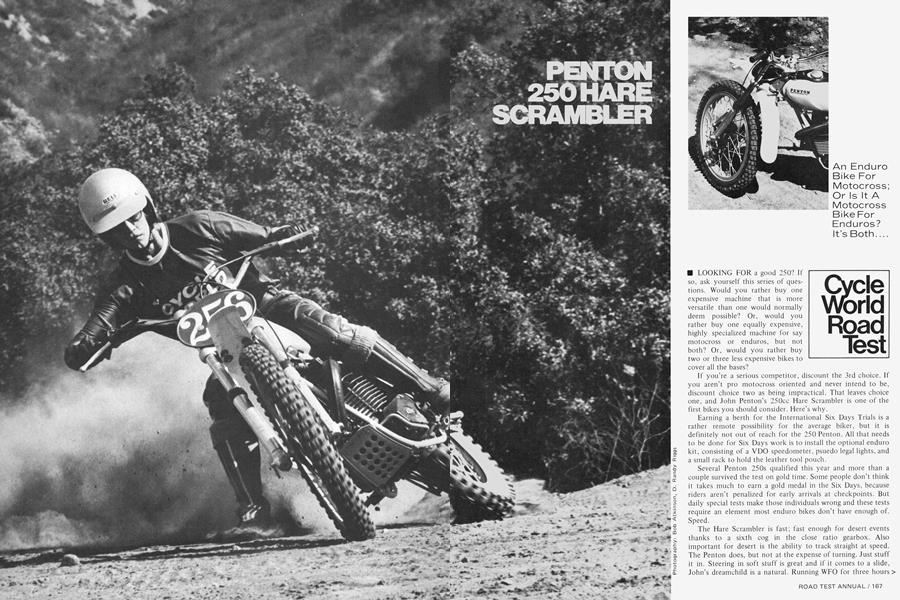
The Hare Scrambler is fast; fast enough for desert events thanks to a sixth cog in the close ratio gearbox. Also important for desert is the ability to track straight at speed. The Penton does, but not at the expense of turning. Just stuff it in. Steering in soft stuff is great and if it comes to a slide, John's dreamchild is a natural. Running WFO for three hours also won’t hurt anything as the giant cylinder and head fins keep things cool. And that frame. Forget it. It’s chrome moly and shouldn’t break...at least not before you do.
Now for motocross, the use to which most Hare Scramblers will be put. First gear is all but useless. It’s just too low. Proof is the fact that European G.P. versions under the KTM logo are raced as five-speeds. Low is removed because it isn’t needed and why carry that extra weight around?
Back to the start. Dump the hammer in second and the bike comes out hard with the front wheel on the ground. It’s best to slide back a bit for maximum traction as soon as the clutch is out. While on the subject of things to do, it’s also best to short shift once the thing is wound out. Revs build quickly and there’s enough power to pull the changes.
At the top of Saddleback’s start hill, there is an off camber left that must be taken fast if you like to run in front. Here’s where the Penton is neat. Steering is great. It goes where you point it so you don’t need a berm in every turn as on the CR Honda.
Upshift down the G.P. hill, slide around the right at the bottom if the berm hasn’t built up yet and power up a short straight with whoop-de-doos. Here the new Ceriani forks with 7.1-in. of usable travel get a workout because the Hare Scrambler can’t keep the front end up long enough to miss most of the bumps.
Take the left at the top of the hill and brake hard for some downhill whoops. At this point you’ve gotta grin and bear it because if the Penton pogoed front to back any harder, it would pitch you off.
This is why you gotta stop and ask yourself how come a $1595 racing machine is behaving like an $800 Japanese compromise. There is always a reason and this time it’s rear shocks and springs. While Girlings don’t have a revolutionary amount of travel, they usually work fine so we looked at the springs. They were sacked, although near new and didn’t have enough pre-load. Consequently, even when adjusted all the way up, there was only an inch of effective travel remaining with a 160-lb. rider!
Replacing the springs with, say, S&Ws would normally cure this, but on the Penton it doesn’t quite work out. The Hare Scrambler, you see, is a quality machine and has a needlebearing swinging arm pivot. As a result, there is virtually no drag at all. Most swinging arms do not move this freely. Some types of bushing setups even act as a weak torsion bar and apparently manufacturers have taken that into consideration.
So, to make the Penton work properly, you need a shock absorber with more damping on the upstroke than usual. Curnutt builds units for the Penton along this line of thought, and they work quite well. In fact, with the 3.7-in. travel Curnutts installed, the pogo effect all but disappears.
Back to the Saddleback course. A couple of more turns and the main straightaway looms up. Accelerate hard, hook it slightly to the left and then grab the binders for all they’re worth. The front brake requires a fair amount of pull, but action is progressive and there is enough stopping power to lock the wheel on all but deep cushion tracks. Rear brake action is similar, but the pedal is located too high for convenience. A rubber bumper between the rear portion of the pedal and the frame and subsequent readjustment of the brake will cure this.
Brakes, incidentally, are single leading shoe and are housed in magnesium alloy hubs to keep unsprung weight down. Rims are also light, yet strong, but because they are the Akronts with ridges, they are prone to collecting mud and mud is very heavy, indeed.
It’s safe to say that the Hare Scrambler is a good handler for motocross but there is a limiting factor. Weight. Dry, the bike weighs 227 lb. Add 6 lb. for a half tank of fuel and you come up with 233 lb., which is a good 10 lb. off the pace if you’re being kind. The Penton, then, horsepower for horsepower, handling characteristic for handling characteristic, is giving away a little acceleration and a little rider endurance to a couple of others in the class. Those others, of course, are the Honda CR and the Yamaha YZ.
Still, John Penton did not opt for a single-purpose bike and because of that, he and his staff must be given a lot of credit for ending up with one of the better ones around. And that’s an opinion just based on performance, soundness of design aside.
Soundness of design is one area you don't have to worry about on this one. As mentioned earlier, the chassis is chrome moly and there are numerous gussets for additional strength. Design is full cradle with an unusual pressed steel backbone which doubles as the air intake. If you follow the backbone down the chassis, it turns into a plate welded practicall>^pil length to the top frame rails. Besides adding strength, this plate forms the top of a still air box which is connected to the backbone by a rubber hose.
A bash plate is provided, but it doesn't continue very far under the engine and it isn’t wide enough to save the magnesium alloy engine cases from rock damage, a concern for enduro riders. Another minor shortcoming are the footpegs which are too smooth on top for safety and are not spring loaded to force their return when knocked upward by a rock.
The engine is mounted solidly to the chassis and is really quite a piece of work. The cylinder barrel is aluminum alloy with a pressed in liner. Porting is interesting in that there are four transfer ports (the rear pair are smaller) instead of the normal two. Also, there is a slot in the rear of the piston to allow additional intake through a pair of booster ports at the rear. Completing the system are a conventional intake and exhaust port.
The piston is forged aluminum, not cast, and there are two rings. The top or compression ring is a Dykes type and are surfaced with cast iron for long wear.
Three ball type main bearings support the crankshaft. The left end bearing is standard. The remaining two are conical race ball bearings. These differ in that they separate into two pieces; the outer race and the inner race, balls, and retainers.
Straight-cut primary gears transmit a claimed 35 bhp (no way does this machine have that much) to an unusual clutch with steel and sintered bronze plates, rather than plates lined with neoprene or a cork material. Shifting is accomplished via a rotating drum mechanism that is flawless regarding every change except the one from first to second. If you ignore the first cog for motocross, there’s really no problem. Otherwise, it’s best to hold the lever up until the clutch is fully released.
One thing that impressed us was the 36mm Bing concentric carburetor that is manufactured specially for KTM. Throttle response is excellent from mid rpm on up and there is absolutely no tendency for the engine to load up, even during prolonged periods of slow running or idling.
Even more impressive is the exhaust system. Sure, it’s big. But, it doesn’t get in the rider’s way and it’s the quj^^st machine in motocross trim CYCLE WORLD has ever tested! Here’s how the system works. Inside that bulky enclosure is a set of reversed cones and a stinger in true expansion chamber fashion. The dead area between the stinger and the outer wall of the system is stuffed with fiberglass packing to deaden noise. From there, exhaust gases pass through a perforated stinger section surrounded by fiberglass packing and finally through a baffled end unit. Are you listening industry?
The remaining parts are first rate, too. The seat has a fiberglass base and is really light. A leather strap allows removal of the fuel tank in less than two minutes (it wouldn’t even take that long if you didn’t have to remove the seat first). Fuel taps have click stops to avoid confusion. Fenders are flexible plastic. Handlebars are chrome moly without a crossbar. If you bend them, they straighten without cracking, as do the Magura levers.
What all this adds up to is one expensive motorcycle, but like we said in the beginning, its versatility makes it worth considering. But, is it worth buying? Let’s add one additional qualifier: winning. If you’re the kind of guy that wants td^pn but can’t resolve himself to a single variety of off-road sport, the Penton Hare Scrambler is the best compromise going. g
PENTON
250
$1595