Maico 250 Gp
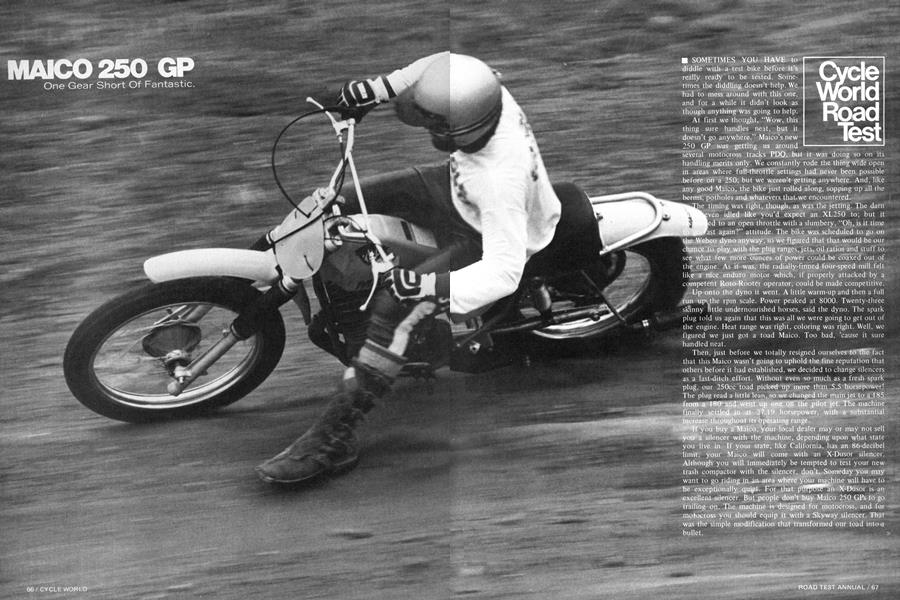
MAICO 250 GP
One Gear Short Of Fantastic.
Cycle World Road Test
SOMETIMES YOU HAVE to diddle with a test bike before it's really ready to be tested Sometimes the diddling doesn't help. We had to mess around with this one, and for a while it didn't look as though anything was going to help. At first we thought, "Wow, this thing sure handles neat, but it doesn't go anywhere." Maico's new 250 GP was getting us around
several motocross tracks PDQ, but it was doing so on its handling merits only. We constantly rode the thing wide open in areas where full-throttle settings had never been possible before on a 250; but we weren’t getting anywhere. And, like any good Maico, the bike just rolled along, sopping up all the berms, potholes and whatevers that,we encountered.
Íhe ■teven .Bed timing idled to an was like open right, you’d throttle though, expect witli as a was an slumbery, the XL250 jetting. to; “Oh, The but is it darn time it Brast again?” attitude. The bike was scheduled to go on the Webco dyno anyway, so we figured that that would be our chance to play with the plug ranges, jets, oil ratios and stuff to see vyhat few mófe "ounces of power could be coaxed out of the engine. As it was, the radially-finned four-speed mill felt like a nice enduro motor which, if properly attacked by a competent Roto-Rooter operator, could be made competitive.
Up onto the dyno it went. A little warm-up and then a full run upythe rpm scale. Power peaked at 8000. Twenty-three skinny nttie undernourished horses, said the dyno. The spark plug told us again that this was all we were going to get out of the engine. Heat range was right, coloring was right. Well, we figured we just got a toad Maico. Too bad, ’cause it sure handled neat.
Then, just before we totally resigned ourselves to the fact that this Maico wasn’t going to uphold the fine reputation that others before it had established, we decided to change silencers as a last-ditch effort. Without even so much as a fresh spark plug, our 250cc toad picked up more than 5.5 horsepower!
The plug read a little lean, so we changed the main jet to a 185 from a 180 and went up one on the pilot jet. The machine finally settled in at 27,.19 horsepower, with a substantial Me throughout its operating range. ou buy a Maico. your local dealer may or may not sell you a silencer with the machine, depending upon what state you live in. If your state, like California, has an 86-decibel limit, your Maico will come with an X-Dusor silencer. Although you will immediately be tempted to test your new trash compactor with the silencer, dqn’G Someday you may want i" go riding in an area where your machine will have to be exceptionally quiet. For that ptifflRe lan X-l)usor is an excellent silencer. But people don't buy Maico 250 GPs to go trailing on. The machine is designed for motocross, and for motocross you should equip it with a Skyway silencer. That was the simple modification that transformed our toad into a bullet.
Back to the track with our rejuvenated rocket and what a difference! Not only was the acceleration improved (as would be expected when encountering a 20-percent increase in power), but the handling didn’t deteriorate one iota, even though the frame and suspension components were being put through much more strain than before.
With the engine now performing up to par, it was much more fun to ride the Maico. Low-end performance is about equal to that of most current-day 250 MXers. It pulls if you force it to, but it really doesn’t like to. The Maico does not stand out when it comes to mid-range power, either. It isn’t the leader, but it doesn’t lack very much. Top end is the same way. Not phenomenal, just good. Very good. What, then, is it that makes the Maico fast? At least as fast as anything in its class except maybe the Ossa Phantom. The silver and yellow German streak puts its power to the ground. All of its power.
The machine is tremendously efficient. What it produces, it delivers. There is very little waste. This means that wheelie freaks and those who live their lives just for that elusive moment when they can roost a pursuer with 4.00x18 inches worth of Metzeler-aided loam had better look elsewhere to satisfy their fetishes. The Maico neither looks nor feels like it’s going fast when by itself. But just put it in the middle of a pack of 250 MXers of varying origins and it won’t take it long to find its way into the top three.
The transmission is very slick in operation. Shift throw is very short and the clutch can be ignored once underway. But the trans is only a four-speed and first gear is very tall. Some hairpin corners will require clutch slipping in order to exit swiftly. Lower the overall gearing and you lose top speed. Quite a dilemma.
It seems almost redundant to fill you in on how neat Maico forks are, after spending a good deal of time last month doing the same thing with regard to the forks on the 450 GP we tested. Let’s just say that everything you’ve ever heard CYCLE WORLD say about good forks can be applied to Maico forks. Now couple all of this to the equally famous steering geometry and you can see why it’s easy to pass people just about anywhere you want—inside or outside—with little regard for the smoothest line.
Power comes from a conventionally-ported cylinder fed through a Twin-Air-filtered 32mm Bing carburetor. A duplex chain primary drive then delivers the power to Maico’s traditional four-speed transmission. From there it’s to the rear wheel, which is kept in consistent contact with terra firma, thanks to the Koni shocks that are standard on all GP designated Maicos.
It is interesting to note that the Konis that are supplied on these Maicos differ from convent onal Konis in that they possess a single-ringed piston instead of the non-ringed piston found in regular Konis and other shocks. The ring on the piston is what creates the seal inside the shock’s cylinder. Before, the piston was the only form of sealing. Because of the new method, there is less friction area because piston/cylinder tolerances have been increased. Less friction means less heat. And the less heat, the longer the shocks will last. Maico claims that the average rider can expect several months of service from his shocks before he needs to worry about rebuilding them. In fact, about the time you feel that the 100-lb. springs are beginning to sack, is just about the time that the shocks will need attention.
Back-end behavior is, along with the steering geometry, one of the Maico’s strongest assets. The neat thing about it is that it works superbly under racing conditions, yet will not beat you to a pulp if you try to ride it at anything but wide open.
In this respect, it is a much better system than Yamaha’s monoshock. However, the Maico’s suspension can occasionally be bottomed out. Jacking up the preload on the springs helped quite a bit, but it could still be used up completely. This was
• thing that we could not do on the monoshocker. It ldn’t bottom. We hit some incredible stuff wide open on the Yamaha and came out of it better than we would have on the Maico. However, if you look at a suspension system as a whole packaged unit, the Maico’s offers a better ride.
This month’s 250 does not differ much from last month’s 450 when it comes to stuff motocrossers gripe about! Rotten grips, a Bing that floods the engine, levers that require extremely large hands, slippery footpegs, fiberglass fenders, a measly 1.5-gal. fiberglass fuel tank and, of course, good old Maico steel rims. But the distributor says to fret not. Maicos will soon be coming in with plastic instead of fiberglass and maybe—wait, first find a nice soft place to sit down—maybe with ridgeless alloy rims!
There may be some of you out there who really want to buy a Maico but are waiting for the factory to do something about the brakes. But that’s all over. You’ll find that the binders on these machines function with as much stopping power as the best Japanese units, while not being as overly-sensitive to pressure as the others are. In essence, the
• co has a superb set of anchors. But when wet, they duce a flat zero in the stopping department. Also, wet sand will cause the brake pedal pivot to jam up. Be sure to keep it well doused in WD-40 or some other lubricant.
Even though the GP versions sport heavier swinging arms than regularly suspended Maicos, GPs don’t weigh any more than their more traditional counterparts. The extra weight of the swinging arm is made up for by liberal use of alloy in the brake pedal and on both brake anchor arms.
The overall weight of the Maico is deceptive. It is heavy by present-day standards, yet it will not tire you out as quickly as other machines weighing the same. This is one benefit ol the superior suspension. The other is that it lets you use the power that the engine produces. Forget about what the “experts” have said about the dire necessity of staying on your chosen lines. If you find that you’ve slipped off the groove you wanted to stay on, don’t try to get back on it right away. Just gas it. You’ll go just as fast and you won’t have to waste time getting back on line.
Maicos have never had a tendency to high-side; a low CG i^^good weight distribution are why. With the GP set-up, you feel even more confident that the machine is not going to spit you off if you do something dumb. Nor does the bike want to slide out. But it does like to slide. It’s not the Dave Aldana type of rear-wheel-first slide (the Maico not only won't slide in this manner, but can't because of limited steering lock), but it likes to let the rear wheel drift out about a foot or two and hold it there. The rear suspension allows you to keep the throttle WFO even if you have to cross washboard-like surfaces while sliding.
Because of the innate tight-line geometry, riding a berm all the way through a corner is a waste of time on this machine. If you’re going to touch the berm at all, use it like a billiard cushion. . .CZ in the corner pocket.
When put into its proper place in the 250 MX line-up, the Maico 250 GP has few peers. The Yamaha YZM is one of them. The Maico has better forks than the Yamaha, but the Yamaha has a slightly better rear end. Acceleration is nearly identical, although the Yamaha would get the nod as being slightly quicker. The Maico will outsteer its competitors, t^Ägh. And it will get you around a track in fast fashion. In racing that’s the name of the game.
Now if it only had a five-speed.
MAICO
250 GP
SPEC I FICATIONS
$1578
DYNAMOMETER TEST HORSEPOWER AND TORQUE