Kawasaki 400 Mach Ii
KAWASAKI 400 MACH II
Cycle World Road Test
Smoother, More Refined... Without A Doubt The Company's Best Triple
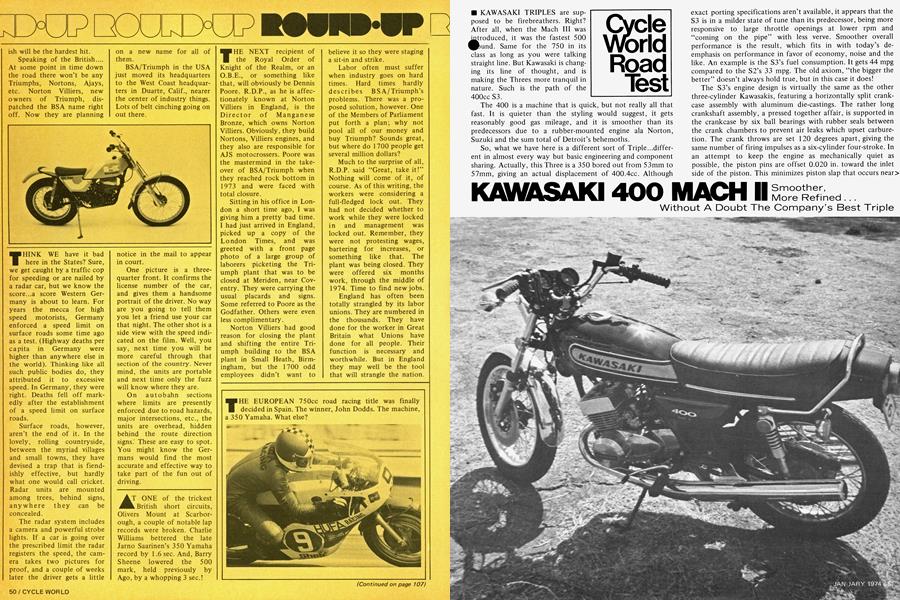
■ KAWASAKI TRIPLES are supposed to be firebreathers. Right? After all, when the Mach III was introduced, it was the fastest 500 round. Same for the 750 in its class as long as you were talking straight line. But Kawasaki is changing its line of thought, and is making the Threes more tranquil in nature. Such is the path of the 400cc S3.
The 400 is a machine that is quick, but not really all that fast. It is quieter than the styling would suggest, it gets reasonably good gas mileage, and it is smoother than its predecessors due to a rubber-mounted engine ala Norton, Suzuki and the sum total of Detroit’s behemoths.
So, what we have here is a different sort of Triple...different in almost every way but basic engineering and component sharing. Actually, this Three is a 350 bored out from 53mm to 57mm, giving an actual displacement of 400.4cc. Although exact porting specifications aren’t available, it appears that the S3 is in a milder state of tune than its predecessor, being more responsive to large throttle openings at lower rpm and “coming on the pipe” with less verve. Smoother overall performance is the result, which fits in with today’s deemphasis on performance in favor of economy, noise and the like. An example is the S3’s fuel consumption. It gets 44 mpg compared to the S2’s 33 mpg. The old axiom, “the bigger the better” doesn’t always hold true, but in this case it does!
The S3’s engine design is virtually the same as the other three-cylinder Kawasakis, featuring a horizontally split crankcase assembly with aluminum die-castings. The rather long crankshaft assembly, a pressed together affair, is supported in the crankcase by six ball bearings with rubber seals between the crank chambers to prevent air leaks which upset carburetion. The crank throws are set 120 degrees apart, giving the same number of firing impulses as a six-cylinder four-stroke. In an attempt to keep the engine as mechanically quiet as possible, the piston pins are offset 0.020 in. toward the inlet side of the piston. This minimizes piston slap that occurs near> bottom dead center of the combustion cycle.
The connecting rods are supported by roller bearings at the big ends of the crankshaft and the pistons are supported by caged needle bearings. Oil for lubricating the engine’s internals is supplied by a plunger-type pump whose delivery rate is controlled by the amount of throttle opening and the engine rpm. This oil under pressure from the pump is delivered through check valves into the cylinder intake ports where it mixes with the incoming fuel/air mixture to lubricate the connecting rods and piston pin bearings.
Each piston is a two-ring affair which rides in a cast iron sleeve joined to the aluminum alloy cylinder by a cast-in-bond process, assuring maximum heat transfer from the sleeve to the cylinder, and hence to the cooling airflow.
With three cylinders arranged transversely across the frame, one might be led to believe that the center cylinder would receive inadequate cooling because it is behind the front wh^J and forks. Kawasaki also anticipated this and spent much time in the wind tunnel developing and perfecting a front fender design which would not seriously impede airflow to the center cylinder.
Twenty-six millimeter carburetors have replaced the 24mm units found on the 350, indicating that the inlet port area is somewhat larger. In one way we can see where this size increase has helped, in conjunction with the increase in engine size. The S3 turned the standing start quarter-mile in 14.10 sec. with a terminal speed of 91.27 mph, while the S2 only managed a 15.10-sec. quarter-mile with a terminal speed of 83.79 mph. And, as we said earlier, the S3 is more economical operate and is a more tractable performer.
Also an improvement in the S3 is the use of cast-in bridges between the cylinder fins which helps stifle the piston rattle which is so common in two-stroke motorcycles. Mechanically, the S3 is very quiet, the transmission hardly whines in the intermediate gears and delivers practically noiseless shifts every time. Our only complaint was from the exhaust system, which sounded as though the muffler walls are made of a very thin steel which has a tendency to resonate at low engine speeds and creates a curious “tapping” sound. With a helmet on, the rider isn’t aware of this noise, but the person in the car next to the S3 at a stoplight might think something was about to fall off the machine. Heavier gauge steel used for the muffler bodies would probably cure this annoying racket. The exhaust note, however, is not at all loud or unpleasant.
But the intake roar at large throttle openings is still there and could stand some quieting by the use of better baffling at the air cleaner intake. It’s a low-pitched drone which can become annoying during long periods in the saddle.
Straight-cut gears are used to transmit the power from the crankshaft to the clutch, and although this type of gear is usually associated with a whining sound, especially when accelerating, the S3 proved to be very quiet.
The clutch is one of the better features of the motorcycle. Six neoprene-faced drive plates and six plain steel driven plates are pushed together by five springs and create clutch action which is nearly ideal. Some initial adjustment was required at the drag strip, but after that the clutch held up well. This is unusual in that if they require adjustment at all, it is frequently constant. The drive is taken up smoothly and gear changing is always effortless and positive.
The transmission is bitchin’! Relatively closely spaced ratios allow the engine to be kept in its power band while accelerating or when blasting down a curvy road.
The drive and output shafts are supported by ball and needle bearings and shifting the constant mesh transmission is accomplished by a shifting drum which controls the movement of the three shifting forks. Even though the gear selector detent springs are a little on the firm side, missed shifts are rare.
One thing we did miss was the lack of primary kickstarting, which allows the engine to be started in any gear. With the S3 you have to select neutral before depressing the kickstarter pedal.
One of the best features of the new S3 is rubber mounting of the engine. At low rpm, as when sitting at a stop light, you can see the engine moving around a little, but practically no vibration is felt through the footpegs at any speed. The handlebars, which are also rubber mounted, transmitted an almost imperceptible “tingle” at freeway speeds, but this was made annoying because of the ridiculously uncomfortable handlebar grips. Still, it’s quite a change from the early His, which would often vibrate so badly your eyes would tend to rotate in their sockets!
It seems strange that Kawasaki has stuck to the battery and coil ignition system with its three sets of points, until one considers the prohibitive price of the GDI unit. Also, it’s not particularly difficult to adjust the ignition timing exactly with the aid of a strobe light. Besides, many of the 500cc HI models with CDI ignition gave trouble with their “magic black boxes,” which were expensive to replace.
Power for charging the battery and operating the lights is supplied by an AC generator, which is small, light in weight and has few parts which might fail. The three-phase current developed by the generator is rectified to DC by a full-wave rectifier, providing more than enough current to handle the motorcycle’s needs.
The first 350cc S2s had a rather short 52.5-in. wheelbase which made them prone to lifting the front wheel when accelerating hard and gave them a less than “rock steady” feeling when cornering to the limit. The S3, on the other hand, sports a 54.5-in. wheelbase, a front fork angle of 28 degrees from the vertical and a trail measurement of 4.4 in. It’s still possible to pull wheelies, but now the rider has more to say> about it. A more neutral weight bias of 45 percent front and 55 percent rear also aids in the good handling qualities, which are some of the most assuring we’ve found recently. The exhaust pipes and stands are tucked up and out of the way far enough to allow a generous lean angle without grounding them, and when they do ground, it’s after a portion of your boots have been worn away from dragging them (and the footpegs) on the blacktop. Also, the rather “taut“ suspension allows adequate wheel travel without the dreaded pogo effect setting in.
This is one Kawasaki that can be stuffed into a corner with lots of confidence. It can be flicked from side to side, power on, except in the first two gears. In that situation you have to ease the power on to keep the front wheel down. If it had a little more power, production racing the 400 could be lucrative.
Much of the credit for the excellent handling qualities must be given to the frame, which is a double cradle affair. Twin tubes run from the top of the steering head downward and curve beneath the engine, eventually curving upward and terminating at the rear suspension top mounting position. Two additional horizontal tubes run from the bottom of the steering head and continue rearward to form a mounting position for the seat and the rear fender. A third, single lube runs from the top of the steering head to a cross tube located above the engine between the two horizontal top tubes, making an extremely rigid assembly.
As mentioned earlier, the suspension is a trifle stiff riders under 170 lb. or so, but because the machine was st^^ relatively new when we returned it, it may loosen up slightly as miles build up.
Braking is a facet of motorcycle performance which is very important to us at CYCLE WORLD. A motorcycle that is capable of a good turn of speed should also be able to stop well, and in that respect the Kawasaki S3 left us with mixed emotions. Stopping power of the disc front brake was excellent until the third of our panic stops in quick succession. The brake seemed to stop as well as the first time, but the lever pressure increased significantly. The excellent action of the front brake almost made up for the poor action of the rear one, which required an inordinate amount of pedal pressure to get a satisfactory amount of retardation. You could slide the rear wheel, but you had to practically stand on the pedal to do it! A nice feature of the rear brake is the pointer connected to the operating cam spindle which shows how much effective brake lining is remaining.
Control layout on the S3 is very good. The turn signal switch, headlight high/low beam switch, horn button and the choke control are located on the left hand handlebar while the headlight on/off switch and an off/on/off kill switch are on the right hand side. An area between the speedometer and tachometer contains the ignition switch and just above it are warning lights for the neutral gear position, the headlight high beam and the turn signal light. The ignition key, incidentally, unlocks the seat, under which is the battery, the tool kit, a compartment for three spare spark plugs and a helmet holder.
Electrical equipment on the S3 is first-rate. High quality wiring and electrical components are neatly concealed under the seat and beneath the left hand side cover. The headlight is nicely shaped and illuminates the road well at night, and the large taillight provides warning to following motorists. The only complaint we had here was that the taillight lens cracked and eventually fell off because of insufficient material where the screws attach it to the license plate bracket.
In our mind, the 400 is Kawasaki’s best three-cylinder buy. It handles much better than the 750—in fact there is no comparison. It’s more economical than the 500 by a wide margin and still has enough performance to get you excited in the mountains.
Enough performance to get you excited, however, shouldn’t be confused with being a leader in its class. That honor belongs to the Yamaha 350 Twin, which is marginally faster in the quarter-mile and on the top end as well. |§]
KAWASAKI
400 MACH II
$935
ACCELERATION / ENGINE AND ROAD SPEEDS / RPM X 100
TIME IN SECONDS