Report From Italy
REPORT FROM ITALY
CARLO PERELLI
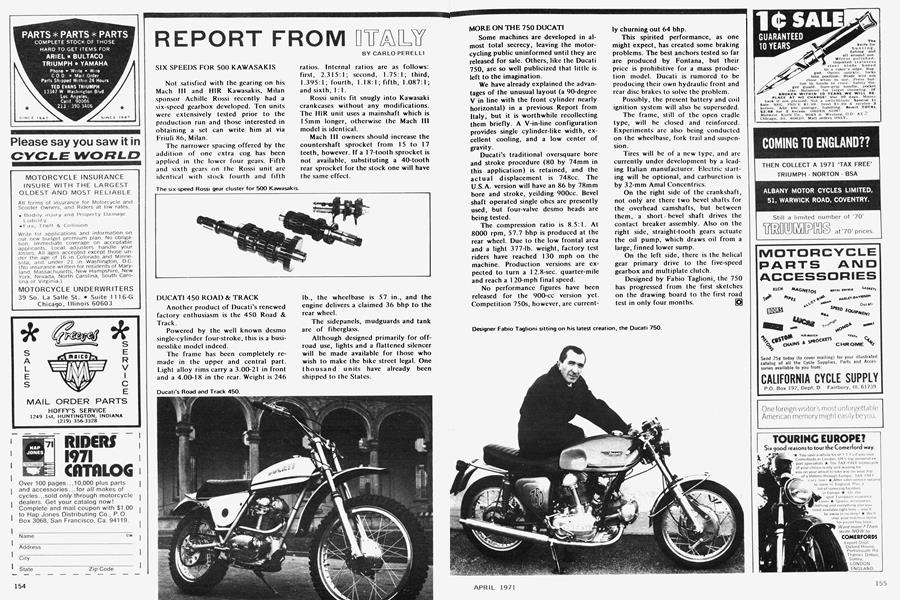
SIX SPEEDS FOR 500 KAWASAKIS
Not satisfied with the gearing on his Mach III and HIR Kawasakis, Milan sponsor Achille Rossi recently had a six-speed gearbox developed. Ten units were extensively tested prior to the production run and those interested in obtaining a set can write him at via Friuli 86, Milan.
The narrower spacing offered by the addition of one extra cog has been applied in the lower four gears. Fifth and sixth gears on the Rossi unit are identical with stock fourth and fifth
ratios. Internal ratios are as follows: first, 2.31 5: l; second, 1.75:1; third, 1.395:1; fourth, 1.18:1; fifth, 1.087:1; and sixth, 1:1.
Rossi units fit snugly into Kawasaki crankcases without any modifications. The HIR unit uses a mainshaft which is 15mm longer, otherwise the Mach III model is identical.
Mach HI owners should increase the countershaft sprocket from 15 to 17 teeth, however. If a 17-tooth sprocket is not available, substituting a 40-tooth rear sprocket for the stock one will have the same effect.
DUCATI 450 ROAD & TRACK
Another product of Ducati’s renewed factory enthusiasm is the 450 Road & Frack.
Powered by the well known desmo single-cylinder four-stroke, this is a businesslike model indeed.
The frame has been completely remade in the upper and central part. Light alloy rims carry a 3.00-21 in front and a 4.00-18 in the rear. Weight is 246
lb., the wheelbase is 57 in., and the engine delivers a claimed 36 bhp to the rear wheel.
The sidepanels, mudguards and tank are of fiberglass.
Although designed primarily for offroad use, lights and a flattened silencer will be made available for those who wish to make the bike street legal. One thousand units have already been shipped to the States.
MORE ON THE 750 DUCATI
Some machines are developed in almost total secrecy, leaving the motorcycling public uninformed until they are released for sale. Others, like the Ducati 750, are so well publicized that little is left to the imagination.
We have already explained the advantages of the unusual layout (a 90-degree V in line with the front cylinder nearly horizontal) in a previous Report from Italy, but it is worthwhile recollecting them briefly. A V-in-line configuration provides single cylinder-like width, excellent cooling, and a low center of gravity.
Ducati’s traditional oversquare bore and stroke procedure (80 by 74mm in this application) is retained, and the actual displacement is 748cc. The U.S.A. version will have an 86 by 78mm bore and stroke, yeilding 900cc. Bevel shaft operated single ohes are presently used, but four-valve desmo heads are being tested.
The compression ratio is 8.5:1. At 8000 rpm, 57.7 bhp is produced at the rear wheel. Due to the low frontal area and a light 377-lb. weight, factory test riders have reached 130 mph on the machine. Production versions are expected to turn a 12.8-sec. quarter-mile and reach a 1 20-mph final speed.
No performance figures have been released for the 900-cc version yet. Competition 750s, however, are current-
ly churning out 64 bhp.
This spirited performance, as one might expect, has created some braking problems. The best anchors tested so far are produced by Fontana, but their price is prohibitive for a mass production model. Ducati is rumored to be producing their own hydraulic front and rear disc brakes to solve the problem.
Possibly, the present battery and coil ignition system will also be superseded.
The frame, still of the open cradle type, will be closed and reinforced. Experiments are also being conducted on the wheelbase, fork trail and suspension.
Tires will be of a new type, and are currently under development by a leading Italian manufacturer. Electric starting will be optional, and carburetion is by 32-mm Amal Concentrics.
On the right side of the crankshaft, not only are there two bevel shafts for the overhead camshafts, but between them, a short • bevel shaft drives the contact breaker assembly. Also on the right side, straight-tooth gears actuate the oil pump, which draws oil from a large, finned lower sump.
On the left side, there is the helical gear primary drive to the five-speed gearbox and multiplate clutch.
Designed by Fabio Taglioni, the 750 has progressed from the first sketches on the drawing board to the first road test in only four months.