The Hill
THE HILL
Hillclimbing Is Hairy, And The Mt.Garfield Championship Is The Hairiest Of Them All
WARREN HALL
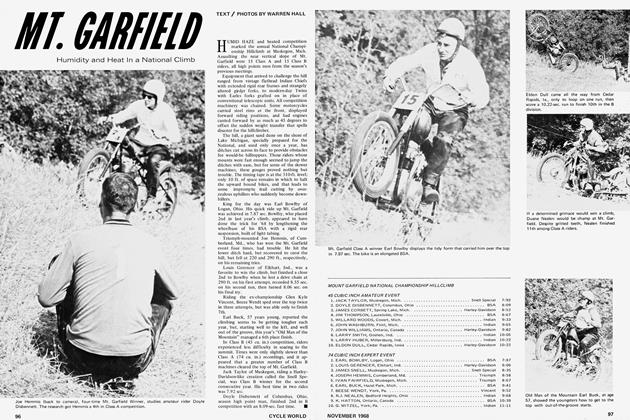
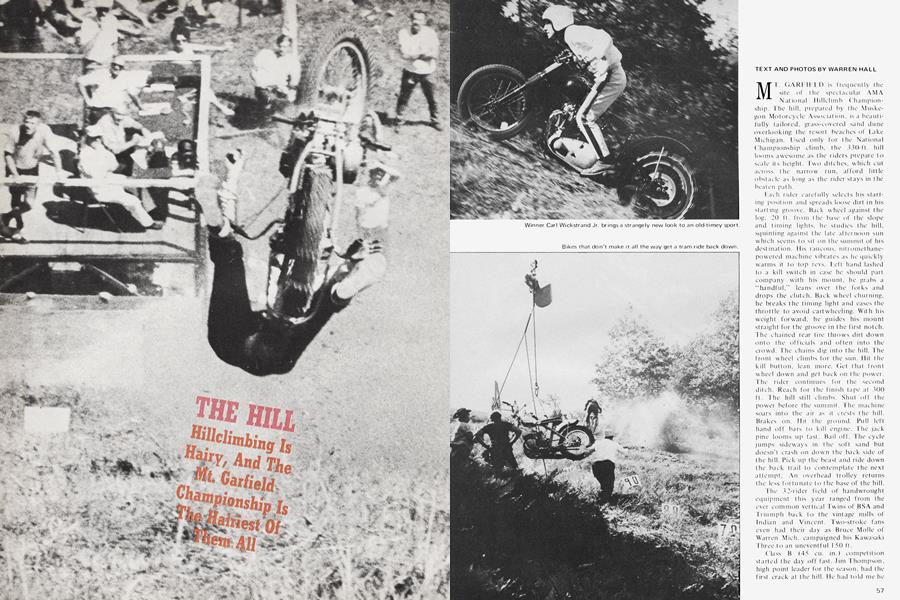
MT.GARFIELD is frequently the site of the spectacular AMA National Hillclimb Championship. The hill, prepared by the Muskegon Motorcycle Association, is a beautifully tailored, grass-covered sand dune overlooking the resort beaches of Lake Michigan. Used only for the National Championship climb, the 330-ft. hill looms awesome as the riders prepare to scale its height. Two ditches, which cut across the narrow run, afford little obstacle as long as the rider stays in the beaten path.
bach rider carefully selects his starling position and spreads loose dirt in his starting groove. Back wheel against the log. 20 ft. from the base of the slope and timing lights, he studies the hill, squinting against the late afternoon sun which seems to sit on the summit of his destination. His raucous, nitromethanepowered machine vibrates as he quickly warms it to top revs, l eft hand lashed to a kill switch in case he should part company with his mount, he grabs a “handful," leans over the forks and drops the clutch. Back wheel churning, he breaks the timing light and eases the throttle to avoid cartwheeling. With his weight forward, he guides his mount straight for the groove in the first notch. The chained rear tire throws dirt down onto the officials and often into the crowd. The chains dig into the hill. The front wheel climbs for the sun. Hit the kill button, lean more, ('.et that front wheel down and get back on the power. The rider continues for the second ditch. Reach for the finish tape at 300 ft. The hill still climbs. Shut oil the power before the summit. The machine soars into the air as it crests the hill. Brakes on. Hit the ground. Bull lelt hand off bars to kill engine. The jack pine looms up fast. Bail off. The cycle jumps sideways in the soft sand but doesn't crash on down the back side of the hill. Bick up the beast and ride down the back trail to contemplate the next attempt. An overhead trolley returns the less fortunate to the base of the hill.
The 3 2-rider field of handwrought equipment this year ranged from the ever common vertical Twins of BSA and Triumph back to the vintage mills of Indian and Vincent. Two-stroke fans even had their day as Bruce Molle of Warren Mich, campaigned his Kawasaki Three to an uneventful I 50 ft.
('lass B (45 eu. in.) competition started the day off fast. Jim Thompson, high point leader for the season, had the first crack at the hill. He had told me he was nervous about this climb for a week. He couldn't sit back and study how the others would do it: he was first. St rad tiling his clean BSA at the line early, he studied the hill. He had climbed Mt. (iarfield before but that was 1968 when he took 4th place. In 1 969 he was 2nd in points standing; this year he was tops in points, but to gain the crown as “B” champ, he had to be fastest. l ittle wonder he was anxious. His ride was f lawless. He broke the tape
at a record 6.40 sec., but he didn't stop there. Over the top and down through the pines he parted company with his machine. Jim suffered some bad bruises and facial cuts which had to be stitched. His mount was damaged too much fora second ride, so Jim watched as the rest of the "B" division tried to better his time. No one seemed able to muster up the right combination, or maybe they feared the other side of the hill. Jim only made his one fantastic ride, and I know he was glad that he didn’t have to do it again.
Second place went to Doyle Disbennett riding a 1962 Gold Star BSA Single. Doyle has been the Canadian national hillciimb champ for three years running and seems to have a consistent hold on 2nd place in the U.S. competition, having captured three 2nd places in three national championships here.
Larry Smith, an engineer for Robert Shaw Controls, brought his conglomerate Indian into 3rd position. Mis machine, typical of the vintage stormers, is basically a 45 cu. in. Indian with a 1940 crankcase, Harley Sportster lower end, and 3 4-mm Vincent straightthrough earbs and cams that he has ground himself in the shop where he works. Burning 90 percent nitromethane, he figures his 270-lb. mount sports 90-100 blip. The original standard Indian frame cradles the engine, and it is complemented by Harley Sprint forks and the rigid rear extended in Larry’s own design.
Class “A" rider Carl Wickstrand, Yalesville, Conn., set a record on his first attempt to win No. 1 plate with a time of 6.12 sec., breaking the record held by Joe Hemmis of 6.7, set before the ditches were put into the hill. Carl has been four times the New England c h a m pion in sports m a n events (1966-69). His mount, sponsored by Nash Bros, of New Haven, Conn, is a stock Triumph with the 750 kit and rigid rear extension. It weighs in at 285 lb. Carl cleared the hill his first attempt but gave the crowd of 15.000 another chance to see how he did it. However, he couldn't better his own time.
Second place in the “A" division went to Earl Bowlby (6.33), a BSA dealer from Logan, Ohio. His first attempt was his quickest on his bored and stroked Rocket. Carl uses 40 percent nitro mix for dependability. He claims he only has to tear down once a season this way and feels the reliability to be an important factor. He also maintains the machines of Jim Thompson and Doyle Disbennett.
Jack Taylor, twice “B" champ, took 3rd place money on a fuel-injected H-D with a decent time of 6.39.
Beeze Wendt, on the Vincent Black Shadow first campaigned by Glen Kyle to many victories, took 4th in the 74 cu. in. class. Brother Dale pulled 9.87 on an Indian his first time on Mt. Garfield in the “B" class.
Harley Davidson dealer Louis Gerencer from Elkhart, Ind., brought a stable of eight various H-D’s. Riding with Gerencer and flying the H-D orange, black and white checked colors were L. Huber, C. Hunter, W. Cher, A.J. Smith, J. T. Smith, E. Bradley and John Williams from Ontario, Canada. Gerencer had three ohv's and five flatheads in the lineup. Louis is also experimenting with Yet man frames and Paul Gommi fuel injectes on at least two ot his machines. Riding one of the injected models himself, he explains that he still has mix problems. He fuels with a 60-80 percent nitro mix. Louis himself didn’t fare well on the hill. On his first attempt he tore the sprocket right off the splines. On the second attempt, he got off the track and fumbled in the rough stuff by the right side markers. The front wheel kept coming up on the third try to keep him from getting higher than 7th place.
Matt Kroel, factory racing representative from H-D, spent the day taking notes on frame configurations and comparing fuel injection with the carburated models. Does Harley plan on climbing? Matt tells me he has scrambled but never attempted hill pursuits.
Wearing the familiar Snell green shirt, Glen Kyle showed up with an exotic piece of equipment, a 750 American Eagle (Laverda). It sounded very healthy but Glen couldn’t pull quicker than 6.77, which any other year could have stolen the event. Glen quit climbing a while back to take up flying as a professional pilot. He found this tot) time consuming and, returning to work in a small machine shop, he built up his own mount. He constructed the entire trame from high carbon steel, and is using old BSA forks. Glen says that 1 lying was a challenge, but riding and work-
ing on Dikes is pure pleasure. [O;