Continental Report
CONTINENTAL REPORT
B. R. NICHOLLS
TRIAL TRAIL
How long will it be before someone can stop SuperSam from winning all major trials events? Certainly he is beaten occasionally, but when the chips are really down, as in the British Experts’ Trial, then Samuel Hamilton Miller, the quiet-spoken Ulsterman, is supreme.
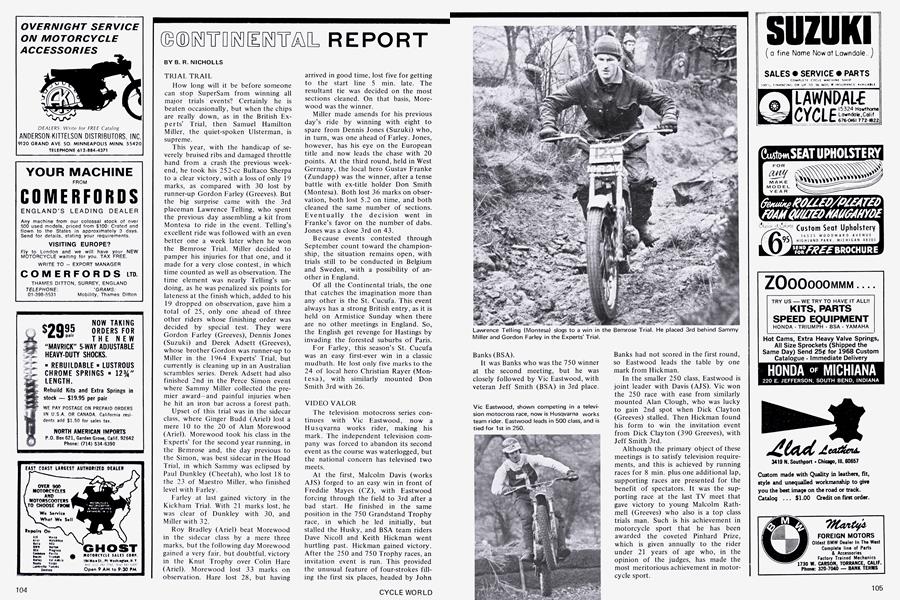
This year, with the handicap of severely bruised ribs and damaged throttle hand from a crash the previous weekend, he took his 252-cc Bultaco Sherpa to a clear victory, with a loss of only 19 marks, as compared with 30 lost by runner-up Gordon Farley (Greeves). But the big surprise came with the 3rd placeman Lawrence Telling, who spent the previous day assembling a kit from Montesa to ride in the event. Telling’s excellent ride was followed with an even better one a week later when he won the Bemrose Trial. Miller decided to pamper his injuries for that one, and it made for a very close contest, in which time counted as well as observation. The time element was nearly Telling’s undoing, as he was penalized six points for lateness at the finish which, added to his 19 dropped on observation, gave him a total of 25, only one ahead of three other riders whose finishing order was decided by special test. They were Gordon Farley (Greeves), Dennis Jones (Suzuki) and Derek Adsett (Greeves), whose brother Gordon was runner-up to Miller in the 1964 Experts’ Trial, but currently is cleaning up in an Australian scrambles series. Derek Adsett had also finished 2nd in the Perce Simon event where Sammy Miller collected the premier award—and painful injuries when he hit an iron bar across a forest path.
Upset of this trial was in the sidecar class, where Ginger Budd (Ariel) lost a mere 10 to the 20 of Alan Morewood (Ariel). Morewood took his class in the Experts’ for the second year running, in the Bemrose and, the day previous to the Simon, was best sidecar in the Hoad Trial, in which Sammy was eclipsed by Paul Dunkley (Cheetah), who lost 18 to the 23 of Maestro Miller, who finished level with Farley.
Farley at last gained victory in the Kickham Trial. With 21 marks lost, he was clear of Dunkley with 30, and Miller with 32.
Roy Bradley (Ariel) beat Morewood in the sidecar class by a mere three marks, but the following day Morewood gained a very fair, but doubtful, victory in the Knut Trophy over Colin Hare (Ariel). Morewood lost 33 marks on observation. Hare lost 28, but having arrived in good time, lost five for getting to the start line 5 min. late. The resultant tie was decided on the most sections cleaned. On that basis, Morewood was the winner.
Miller made amends for his previous day’s ride by winning with eight to spare from Dennis Jones (Suzuki) who, in turn, was one ahead of Farley. Jones, however, has his eye on the European title and now leads the chase with 20 points. At the third round, held in West Germany, the local hero Gustav Franke (Zundapp) was the winner, after a tense battle with ex-title holder Don Smith (Montesa). Both lost 36 marks on observation, both lost 5.2 on time, and both cleaned the same number of sections. Eventually the decision went in Franke’s favor on the number of dabs. Jones was a close 3rd on 43.
Because events contested through September count toward the championship, the situation remains open, with trials still to be conducted in Belgium and Sweden, with a possibility of another in England.
Of all the Continental trials, the one that catches the imagination more than any other is the St. Cucufa. This event always has a strong British entry, as it is held on Armistice Sunday when there are no other meetings in England. So, the English get revenge for Hastings by invading the forested suburbs of Paris.
For Farley, this season’s St. Cucufa was an easy first-ever win in a classic mudbath. He lost only five marks to the 24 of local hero Christian Rayer (Montesa), with similarly mounted Don Smith 3rd with 26.
VIDEO VALOR
The television motocross series continues with Vic Eastwood, now a Husqvarna works rider, making his mark. The independent television company was forced to abandon its second event as the course was waterlogged, but the national concern has televised two meets.
At the first, Malcolm Davis (works AJS) forged to an easy win in front of Freddie Mayes (CZ), with Eastwood forcing through the field to 3rd after a bad start. He finished in the same position in the 750 Grandstand Trophy race, in which he led initially, but stalled the Husky, and BSA team riders Dave Nicoll and Keith Hickman went hurtling past. Hickman gained victory. After the 250 and 750 Trophy races, an invitation event is run. This provided the unusual feature of four-strokes filling the first six places, headed by John Banks (BSA).
It was Banks who was the 750 winner at the second meeting, but he was closely followed by Vic Eastwood, with veteran Jeff Smith (BSA) in 3rd place.
Banks had not scored in the first round, so Eastwood leads the table by one mark from Hickman.
In the smaller 250 class, Eastwood is joint leader with Davis (AJS). Vic won the 250 race with ease from similarly mounted Alan Clough, who was lucky to gain 2nd spot when Dick Clayton (Greeves) stalled. Then Hickman found his form to win the invitation event from Dick Clayton (390 Greeves), with Jeff Smith 3rd.
Although the primary object of these meetings is to satisfy television requirements, and this is achieved by running races for 8 min. plus one additional lap, supporting races are presented for the benefit of spectators. It was the supporting race at the last TV meet that gave victory to young Malcolm Rathmell (Greeves) who also is a top class trials man. Such is his achievement in motorcycle sport that he has been awarded the coveted Pinhard Prize, which is given annually to the rider under 21 years of age who, in the opinion of the judges, has made the most meritorious achievement in motorcycle sport.
RECORD RUNS
About this time each year, when the last exhaust note has faded on the road race circuits, Stanley Schofield brings memories flooding back with CYCLE WORLD lp recordings of the Isle of Man TT. Commentary is by Peter Arnold, whose voice was taped while racing was in progress. Also on the two records are interviews with stars, and a superb symphony of machines changing down for corners, then up through the gears and accelerating away.
FIM-F LAM
It is not often necessary to refer to the deliberations of the FIM in this column, but in the recent congress held, the main item of interest to American readers is that in 1969 a U.S. motocross grand prix can be contested—not counting toward the world championship.
The points scoring system for both road racing and motocross have been changed. In the future, riders down to 10th place will score. The points system will be 15 for a win, descending as follows: 12, 10, 8, 6, 5, 4, 3, 2, 1. It is a pity there is no reward for fastest lap, as this would add spice to close contests such as Read vs. Ivy battles of 1968.
Following the FIM decision, the British championships also will adopt that scoring system, and the road racing series has been cleaned up considerably so that a rider now can plan an attack on the championships at the beginning of the season, knowing that only eight meetings will count, and that, of the eight, only his best five performances will score.
In order to give all courses a fair crack of the whip, the championship has
been divided into two sections, the first for 125, 250 and sidecar classes and the other for 350 and 500s. No sponsor has been found for the series, but the new system will mean that the public can follow the battle for championship points from the outset, and not wonder whether a meeting is counting toward the championship.
From 1969 onward, there will be no more mixed racing for sidecars and three-wheelers at international events. This has raised a storm of protest from the handful of enthusiasts who race the cyclecars as they are officially designated. The majority of sidecar competitors are, however, adamant that they are a danger, though in some cases it would seem the danger is loss of prize money. One leading competitor has expressed the view that racing leftand righthanded outfits together is dangerous, so the next move should be interesting!
Talking of the chair brigade, Terry Vinnicombe has quit the sponsorship of Tom Kirby, so Tom will concentrate his road racing efforts on Alan Barnett equipment next season in a handful of classic meetings on the Continent, and in an attempt to gain both 350 and 500 British titles.
In the meantime, Tom has built a very neat 250 BSA-powered Kirby Métissé motocross machine to join his 500 for young Brian Atkinson to ride.
TT TIME
Coming to the Isle of Man TT in 1969? If so, the new-look races should appeal to all enthusiasts. The 50-cc event has been dropped, so there now will be two separate sidecar races, as well as the production event and all other world championship classes. Practice week has been condensed into six days, starting on Monday, June 2. [o]