Baja And Back
BAJA AND BACK
MARVIN FOSTER
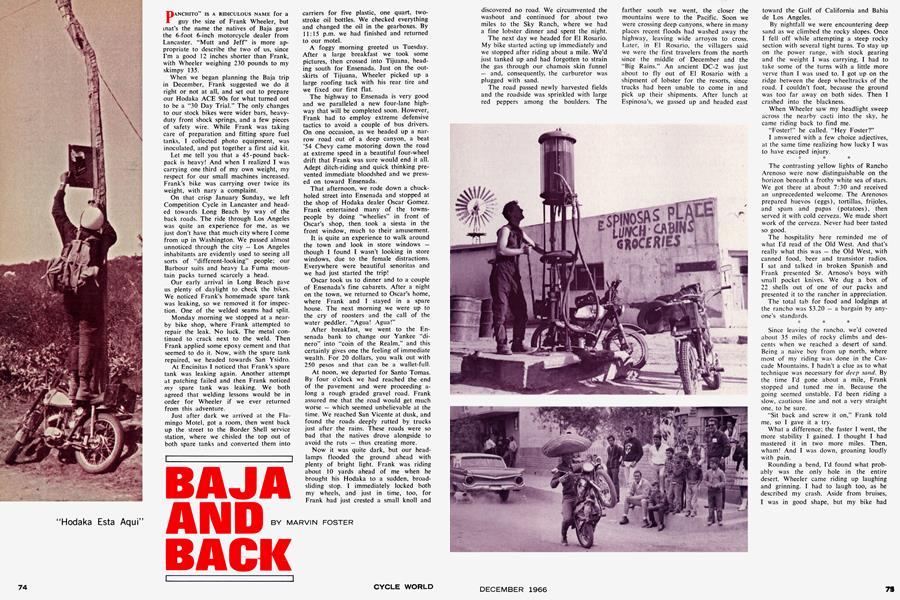
"Hodaka Esta Aqui"
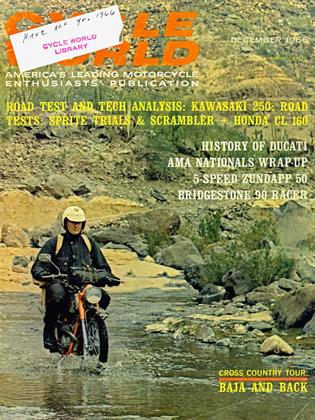
PANCHITO" IS A RIDICULOUS NAME for a guy the size of Frank Wheeler, but mat’s the name the natives of Baja gave the 6-foot 6-inch motorcycle dealer from Lancaster. “Mutt and Jeff” is more appropriate to describe the two of us, since I’m a good 12 inches shorter than Frank, with Wheeler weighing 230 pounds to my skimpy 135.
When we began planning the Baja trip in December, Frank suggested we do it right or not at all, and set out to prepare our Hodaka ACE 90s for what turned out to be a “30 Day Trial.” The only changes to our stock bikes were wider bars, heavyduty front shock springs, and a few pieces of safety wire. While Frank was taking care of preparation and fitting spare fuel tanks, I collected photo equipment, was inoculated, and put together a first aid kit.
Let me tell you that a 45-pound backpack is heavy! And when I realized I was carrying one third of my own weight, my respect for our small machines increased. Frank’s bike was carrying over twice its weight, with nary a complaint.
On that crisp January Sunday, we left Competition Cycle in Lancaster and headed towards Long Beach by way of the back roads. The ride through Los Angeles was quite an experience for me, as we just don’t have that much city where I come from up in Washington. We passed almost unnoticed through the city — Los Angeles inhabitants are evidently used to seeing all sorts of “different-looking” people; our Barbour suits and heavy La Fuma mountain packs turned scarcely a head.
Our early arrival in Long Beach gave us plenty of daylight to check the bikes. We noticed Frank’s homemade spare tank was leaking, so we removed it for inspection. One of the welded seams had split.
Monday morning we stopped at a nearby bike shop, where Frank attempted to repair the leak. No luck. The metal continued to crack next to the weld. Then Frank applied some epoxy cement and that seemed to do it. Now, with the spare tank repaired, we headed towards San Ysidro.
At Encinitas I noticed that Frank’s spare tank was leaking again. Another attempt at patching failed and then Frank noticed my spare tank was leaking. We both agreed that welding lessons would be in order for Wheeler if we ever returned from this adventure.
Just after dark we arrived at the Flamingo Motel, got a room, then went back up the street to the Border Shell service station, where we chisled the top out of both spare tanks and converted them into carriers for five plastic, one quart, twostroke oil bottles. We checked everything and changed the oil in the gearboxes. By 11:15 p.m. we had finished and returned to our motel.
A foggy morning greeted us Tuesday. After a large breakfast we took some pictures, then crossed into Tijuana, heading south for Ensenada. Just on the outskirts of Tijuana, Wheeler picked up a large roofing tack with his rear tire and we fixed our first flat.
The highway to Ensenada is very good and we paralleled a new four-lane highway that will be completed soon. However, Frank had to employ extreme defensive tactics to avoid a couple of bus drivers. On one occasion, as we headed up a narrow road out of a deep canyon, a beat ’54 Chevy came motoring down the road at extreme speed in a beautiful four-wheel drift that Frank was sure would end it all. Adept ditch-riding and quick thinking prevented immediate bloodshed and we pressed on toward Ensenada.
That afternoon, we rode down a chuckholed street into Ensenada and stopped at the shop of Hodaka dealer Oscar Gomez. Frank entertained many of the townspeople by doing “wheelies” in front of Oscar’s shop, then took a siesta in the front window, much to their amusement.
It is quite an experience to walk around the town and look in store windows — though I found I wasn’t looking in store windows, due to the female distractions. Everywhere were beautiful señoritas and we had just started the trip!
Oscar took us to dinner and to a couple of Ensenada’s fine cabarets. After a night on the town, we returned to Oscar’s home, where Frank and I stayed in a spare house. The next morning we were up to the cry of roosters and the call of the water peddler. “Agua! Agua!”
After breakfast, we went to the Ensenada bank to change our Yankee “dinero” into “coin of the Realm,” and this certainly gives one the feeling of immediate wealth. For 20 dollars, you walk out with 250 pesos and that can be a wallet-full.
At noon, we departed for Santo Tomas. By four o’clock we had reached the end of the pavement and were proceeding along a rough graded gravel road. Frank assured me that the road would get much worse — which seemed unbelievable at the time. We reached San Vicente at dusk, and found the roads deeply rutted by trucks just after the rains. These roads were so bad that the natives drove alongside to avoid the ruts — thus creating more.
Now it was quite dark, but our headlamps flooded the ground ahead with plenty of bright light. Frank was riding about 10 yards ahead of me when he brought his Hodaka to a sudden, broadsliding stop. I immediately locked both my wheels, and just in time, too, for Frank had just crested a small knoll and discovered no road. We circumvented the washout and continued for about two miles to the Sky Ranch, where we had a fine lobster dinner and spent the night.
The next day we headed for El Rosario. My bike started acting up immediately and we stopped after riding about a mile. We’d just tanked up and had forgotten to strain the gas through our chamois skin funnel — and, consequently, the carburetor was plugged with sand.
The road passed newly harvested fields and the roadside was sprinkled with large red peppers among the boulders. The farther south we went, the closer the mountains were to the Pacific. Soon we were crossing deep canyons, where in many places recent floods had washed away the highway, leaving wide arroyos to cross. Later, in El Rosario, the villagers said we were the first travelers from the north since the middle of December and the “Big Rains.” An ancient DC-2 was just about to fly out of El Rosario with a shipment of lobster for the resorts, since trucks had been unable to come in and pick up their shipments. After lunch at Espinosa’s, we gassed up and headed east toward the Gulf of California and Bahia de Los Angeles.
By nightfall we were encountering deep sand as we climbed the rocky slopes. Once I fell off while attempting a steep rocky section with several tight turns. To stay up on the power range, with stock gearing and the weight I was carrying, I had to take some of the turns with a little more verve than I was used to. I got up on the ridge between the deep wheeltracks of the road. I couldn’t foot, because the ground was too far away on both sides. Then I crashed into the blackness.
When Wheeler saw my headlight sweep across the nearby cacti into the sky, he came riding back to find me.
“Foster!” he called. “Hey Foster?”
I answered with a few choice adjectives, at the same time realizing how lucky I was to have escaped injury.
H< Hi *
The contrasting yellow lights of Rancho Arenoso were now distinguishable on the horizon beneath a frothy white sea of stars. We got there at about 7:30 and received an unprecedented welcome. The Arenosos prepared huevos (eggs), tortillas, frijoles, and spam and papas (potatoes), then served it with cold cerveza. We made short work of the cerveza. Never had beer tasted so good.
The hospitality here reminded me of what I’d read of the Old West. And that’s really what this was — the Old West, with canned food, beer and transistor radios. I sat and talked in broken Spanish and Frank presented Sr. Arnoso’s boys with small pocket knives. We dug a box of 22 shells out of one of our packs and presented it to the rancher in appreciation.
The total tab for food and lodgings at the rancho was $3.20 — a bargain by anyone's standards.
HJ H« H<
Since leaving the rancho, we’d covered about 35 miles of rocky climbs and descents when we reached a desert of sand. Being a naive boy from up north, where most of my riding was done in the Cascade Mountains, I hadn’t a clue as to what technique was necessary for deep sand. By the time I’d gone about a mile, Frank stopped and tuned me in. Because the going seemed unstable, I’d been riding a slow, cautious line and not a very straight one, to be sure.
“Sit back and screw it on,” Frank told me, so I gave it a try.
What a difference; the faster I went, the more stability I gained. I thought I had mastered it in two more miles. Then, wham! And I was down, groaning loudly with pain.
Rounding a bend, I’d found what probably was the only hole in the entire desert. Wheeler came riding up laughing and grinning. I had to laugh too, as he described my crash. Aside from bruises, I was in good shape, but my bike had been less fortunate. The front forks had moved back to the extent that the tire was up against the header pipe and frame. It was then that we reached an agreement. The man with the most falls was to buy the other guy a steak dinner in La Paz. I was leading by three.
My bike started easily and Frank rode it to see what the extent of the damage was. He dumped it about ten yards down the trail when he tried to turn sharper than the exhaust header-pipe would allow.
A mile down the trail we came to San Agustín, where my limited Spanish got us the loan of a sledge hammer and a piece of railroad track. In a little over an hour we had my forks straightened out. We put everything back together, had a bottle of soda, then headed south.
Near dusk we reached piles of large boulders, scattered in pyramids about the desert. In the twilight we passed an oasis in the edge of the mountains and decided to return before sunrise to photograph the palm-covered canyon. The next few miles were a real up and down affair — up over rocks, down onto boulders, and then through deep sand.
Half a mile later, we reached Rancho Santa Ines, where an old woman answered the door of a palm frond and adobe house. She invited us in, then busied herself cooking us spam, frijoles and tortillas. When we had eaten, Frank went out to inspect our sleeping quarters, which appeared to be a goat pen adjacent to the house, while I negotiated for a blanket.
Later, in full riding dress and covered with an old quilt, Frank and I lay on the ground in the goat pen, looking up at the stars through the thatched palm roof. Frank put his helmet on for a pillow.
We were up well before the sun and anxious to move about because of the cold night. “Adioses” were exchanged and we headed back to the oasis we’d seen in the night. I set up my cameras and waited for daybreak. Frank rode down into the canyon, ready to ride across for the pictures. While we waited, a boy came down the canyon herding a group of eight or nine burros. The sound of the lead burro’s bell rang clear through the cold morning air. The sun came up on schedule, I took my pictures, then we headed our bikes for Rancho Chappala.
Thirty-five miles and several hours later we reached the rancho, a group of buildings and a house on the northern side of a dry lake. We had breakfast at noon, talked with the patron of the ranch, and asked him how far it was to Bahia de Los Angeles. He told us it was about 45 minutes away. In this land, you measure distance in time, rather than miles or kilometers. A rain or sand storm can change only the time, not the distance.
We gassed up and departed. After a couple of hours passed we saw water ahead and surmised that the old man either flew or knew a much shorter road. The water turned out to be an off-season dry lake. By dusk we hadn’t reached the bay, but since we were headed east, knew we’d come to it sooner or later. As the sun was going down I stopped to photograph the first trees I’d seen in Baja. We went on and my headlight wouldn't work, so I rode by the light of Frank’s headlamp. This was great sport — zinging through the deep-rutted sand between the cacti by the light from another bike. Frank fouled a plug, and there was I doing a cool 35 mph in the dark; I stopped scarcely more than immediately, and he cleaned the plug. We could smell the food and hear the light plant as we neared Bahia de Los Angeles, and after a couple of wrang-way rides down ill chosen river beds, reached Casa Diaz at 6:30 p.m. (about six hours from Rancho Chappala).
Dinner was well received by Frank and me and we talked with several Americans who had flown in for the fishing. After the meal we headed for our cabana and a bath. Fooled by the modern atmosphere. I’d sort of expected a hot shower. I was in for a surprise!
I’d like to digress a moment to tell you about cold showers. I’m not yet sure that they’re any better than no shower at all. The technique involved is truly comical. The “showeree” stands at arms length from the just dribbling tap (no unnecessary splashing desired) and fills the cupped hand with ice cold water. Showeree then allows his body temperature to heat this water, exhales, throws water on self, inhales, and repeats until sufficiently wet to make soap suds. Showeree sudses with great haste, grits teeth and repeats dampening process to rinse off suds. An experience not to be accepted vicariously.
The bath done, we returned to Casa Diaz. Some of the Mexicanos were interested in our Hodakas, so we talked with them while I connected the loose headlight wire, and tried to answer all the questions we could understand. By nine we were ready to turn in, and the giant cot-type beds, heaped high with blankets, were very welcome after the previous cold night.
We were on our way west by 11 a.m., headed back to the other side of the peninsula; back up the sandy road we’d travelled the evening before, but much faster now. For 40 miles, we averaged over 20 mph, and then took a road to the south. Almost immediately the road disappeared into an arroyo full of rocks and washed-out elephant trees. We proceeded through this devastated terrain for another 20 miles, and after several rest stops, reached some rolling hills of red volcanic cinders about the size of softballs. Whoever built the road had moved the uneven stones to the sides of the road and constructed a sort of fence.
There’s a sign pointing up the road to Mission San Borjas in the Sierra De Calmalli, now sporting one of our “Hodaka Esta Aqui” stickers that we liberally distributed in Baja California.
* * *
We were on our way to Guerrero Negro now, and as we rode into looser sand, it was difficult to stay in the groove. Exhausted, I tried riding off to the side of the road; but picking a path through the cacti at night was risky business, and I returned to the road. By 8:00 p.m. hunger had the best of me. “Where the hell is Guerrero Negro?”
Frank seemed unconcerned.
Finally, we spotted lights on the horizon, a set to the west and a set to the south. Frank decided the ones to the south were Guerrero Negro, so off we headed. The road got wider and smooth and hardpacked with dampness. Suddenly, the road was a lake and we went to the left and right to get around. We kept riding on and on toward the lights, and I imagined a palm-studded, beach-front boulevard, sprinkled liberally with hotels and restaurants. Now I could notice buildings among the lights, and my mouth watered for the big steak Frank had promised to buy when we got there.
The road was 40-feet wide, hard as a brick and smooth. We were making it for town at over 50 mph. At 11 p.m. we passed the army barracks on the edge of Guerrero Negro and proceeded down the main street of the town.
What a disappointment! No palm-studded, beach-front boulevard. No restaurants . . . We stopped the first hombre we saw and asked directions. He informed us that the restaurant opened at 6 a.m. He told us, too, that there was no hotel. What a topper to a wonderful day! A twelve-hour ride with no food and now this.
Perhaps “Los Federales” could put us up for the night, and so we headed back to the army quartel. The soldier on guard could understand no English and hardly any of my Spanish, but he led us around the barracks to the modem trailer-house quarters of “El Sargente.” We woke him and he asked to see our tourist cards. He said if the men in the barracks could find a place for us, we were welcome to stay.
Santos Monteverde, the guard and Abraham Sausedo, another solider who had gotten up to see what was going on, led us to a hut and proceeded to find beds for us. No mattresses or blankets were available, so our hosts improvised with corrugated cardboard.
It was incredibly cold that night and we woke up very early the next morning. Just before we left, I took a picture of my friend, Abraham with his puppies, which were evidently the company mascots.
After half an hour of riding on Bonneville Salt Flat-type roads we came to Nursery Inlet where whales are bom. Unfortunately, all the whales were a good 300 yards off shore — too far for me to photograph. We watched for awhile, then returned to Guerrero Negro.
Guerrero Negro is one of the largest producers of salt in the world. Large settling basins or “vasos” surround the city. The sea water evaporates and the remaining salt is bladed into rows by large road graders, then loaded into monstrous truck and trailer combinations for delivery to the refinery.
Breakfast done, and tanks topped up, we headed east toward El Arco for lunch and San Ignacio for dinner. Six miles out of town we came to “Bombas,” a town affectionately regarded by the soldiers with a chuckle. Bombas is at the very end of another splendidly wide and flat road. The town’s sole inhabitants are prostitutes, 139 by actual count. All roads in this region lead to Bombas and are the best maintained in the area.
It was a tough ride to El Arco, the final ten miles being a climb up from the sandy coastal plain to a 980 ft. elevation. In 1882, gold was discovered near the town. By 1920, an American company was developing the mines and employing 160 people. I bought some Mexican cigarettes and we pushed off for San Ignacio, 76 miles away.
From El Arco the road descended to a plateau of sand, endless sand ... In deep sand you must ride as fast as possible to maintain headway. One mistake and you’re into the cacti that lines the road. This kind of riding is my idea of a motorcyclist’s hell. Before dark we had a few drops of rain and by 6 p.m. the sand was getting wet. We finally came to a wild road that was of hard-packed sand and rocks. As I rode on, I imagined myself Dave Bickers riding a fantastic motocross. The beam from my headlight lit the road better than day, and I kept “hooking” it on . . . After half an hour of this exaggerated riding. I realized what I was doing and stopped. Wheeler came riding up a few minutes later and asked me if I was trying to destroy my Hodaka. I told about my experience and he agreed that it was a good thing I’d stopped.
We had expected to be in San Ignacio by about 8:30 and it was 9:30 and still no town, but after half an hour’s ride, in and out of rocky arroyos, we spotted a row of lights off to the right and knew we had reached our destination.
San Ignacio is a very old settlement dating back to at least 1716, when it was visited by Jesuit padres. A mission was established around 1730 and is standing today; also a magnificent stone church built in 1785.
We checked into the hotel, a large oneroom adobe building with canvas dividers for semi-privacy. Then I went into town to get acquainted. The friendly people of San Ignacio number about 800. The town is picturesque, unspoiled by tourists, and in my estimation, a wonderful place to retire from most of the things that plague today’s urban society. We returned to our room at 9:30. What luxury — feather mattresses and many blankets and only eight pesos (64c) each, per night.
At sunrise, we were awakened by the sound of church bells. As we drifted into consciousness we were aware of a beautiful voice singing in Spanish, roosters crowing, and other sounds of a small village welcoming the new day. So relaxing to lie there with the crisp air all about, warm under the quilts, with not a thing planned.
Rather than see the whole day slip by, we got up and walked a block to the house that served as the restaurant.
After we had eaten I got my cameras and we met with two of the sons of a local storekeeper and walked to some Indian paintings on the rocks above the town. Ignacio, one of the boys and I exchanged jokes, clowned around and referred to each other as “Cantinflas,” the famous Mexican comic. Ignacio really deserves the title, though, with his broad, white smile, handsome features, and prim military pill-box cap.
The climb finished, and paintings photographed, we all took a tour of the town, then did a little dove hunting in the outer groves. Ignacio proved to be as good a shot as he was a comic and downed a bird with his .22 rifle.
Later, I went to the post office and bought some postcards before the place closed for siesta. Frank sacked out and I wrote to the folks back home. “Dear Folks back home . . .” How can you explain on a card all the fun and enjoyment you’re having? Well, I couldn’t, so I wrote the usual cliche, “Having a good time. Wish you were here.”
With the - required correspondence off my back, I decided to walk around the town while everyone else was on siesta. Up and down the narrow dusty streets I walked, seeing few people, soaking up the architecture and surroundings. If you've ever fallen in love with a place, you'll know how I felt. The people and the town will always come to mind whenever I think or ask myself if our way of life is really "the best of all possible worlds." I returned to the main block of shops and found Ignacio seated with some of his friends enjoying siesta time. I sat with them and asked about the town and local farming. My interest in viticulture summoned forth some local wine, which was quite good, and we sat there in the warm afternoon enjoying the grape, the day and Old Mexico.
(Continued on page 96)
continued
Ignacio joined me for dinner at the Oasis and was quite thrilled by the ride on the back of my Hodaka. “Andale! Muy rapido!” he shouted in my ear as we bounced down the dusty road to town. Mexico is the land for motorcycles.
Thursday morning arrived with its early church bells, roosters crowing and women singing as they did the wash. A beautiful greeting from an unwanted day. I was not anxious to leave this atmosphere of welcome and relaxation, but with Frank’s “press on” urging. I shoved my belongings
into my packsack and prepared to depart.
* * *
From the top of the mountains east of San Ignacio, we could almost see across the lava-edged desert and the next range of mountains to the Gulf of California. To the north were “Las Tres Virgenes,” a quite spectacular 6,550 foot trio of inactive volcanoes. The road that crossed the plain to the foot of the mountains was like a 12-mile washboard covered with loose sand. About half way across I noticed oil on my left boot and looked around to find my front shock tube bolts were loose. The left one had fallen out and was lost. Evidently I hadn’t tightened those bolts securely when putting the front end back together after my crash. Luckily, we were carrying a spare rear shock bolt and could replace the lost one. But no sooner were we underway, before Frank’s rear tire went flat . . . again . . . and another half hour was lost.
Finally, we got going to Santa Rosalia. We reached the second range of mountains where we discovered a picturesque switch-back road leading to the floor of another desert. I shot many feet of film there, as Frank descended the three miles of curves to become a tiny dot on the white ribbon of road below.
Across the plains we rode, and into another range of mountains that ran into the Gulf. Old mines could be seen everywhere and the road showed signs of daily use. By 4 p.m. we were in Santa Rosalia, a mining town of 4,000 people, founded in 1876 when copper was discovered. A few years later a French company took over operations and even brought in prefabricated buildings from Europe, many of which are in use today.
Frank and I went to the Office of Port Authority and found Capitan Rafael — Captain for the port. We made plans with the hospitable capitan to call Southern California on his ham radio rig later that evening.
Up town, we got a room at the Hotel Central, where we met an old friend of Frank’s, Dr. McKinnon, a Barry Fitzgerald type of gentleman that brought me to my knees with a real handshake. Dr. McKinnon, Frank and I talked about Santa Rosalia and the surrounding country as we ate dinner. Dr. McKinnon is a 65year-old dentist who has chosen this area as his permanent home.
At 7 p.m. we rode up to the Capitan’s radio shack. Inside, it was literally papered with QSL cards and certificates verifying that he had “worked all countries” on several occasions. Capitan XE20K swung into action and contacted three stations in the Los Angeles area. Atmospheric conditions were against us that night and our contacts were short, but we let the folks back home know where we were. We thanked Capitan Rafael for his hospitality and efforts and returned to Hotel Central.
The next morning, after packing, we spent a little extra time and checked everything over on our Hodakas, especially after the vibrating trip the day before. Everything was in order, and to celebrate, Frank had his boots shined. This evidently fascinated the local children and a group of about 50 gathered to watch. The shine finished, Wheeler decided that called for a “wheelie” demonstration and delighted the children by riding clear around the plaza with the front wheel up in the air.
I got on my bike and the kids all turned to me. “Arriba! Arriba!” they shouted. “Up! Up!” •
But since I can’t do it without falling off, I answered, “Hombre alto, solamente,” which to me meant “only the tall guy.” But whether or not it was right, they all ran up the street after Frank, laughing and shouting delightedly.
The expression on the face of the gas station attendant was beyond description, when he saw that motorcycle and rider pull up to the pump, wheel in the air, followed by close to 70 yelling kids. He waved his arms at the niños, trying in vain to disperse the crowd. But they just swarmed around Frank, who responded to their emulation with a big Pepsodent smile.
Next stop was down at the Office of the Port Authority to ask the best directions to Mulege, some 40 miles away.
On our way out of town we made a side trip past the airport, which overlooks Santa Rosalia from a plateau just south of the city. It was a fine vantage point for pictures and while I set up my cameras, Frank rode back down to the field where he met a real estate promoter who had just landed in one of those sleek “center line thrust” Cessna twins. The flyer invited us to see the latest development in the area, Punta Chivato, where an ultra-modern flying resort is under construction.
Our route altered slightly, we headed south by east for the remote vacation spot. After seeing some fantastically beautiful coast line, we headed across a cape for the point. The road was unbelievably bad, with dust nearly a foot deep in places and after that, bottomless sand. That heavy trucks had encountered difficulty was evident, as brush had been cut and placed across the ruts for added traction.
We arrived at the construction sight at 4 p.m., and were astonished to see such a gigantic undertaking going on in such a remote place. Two long airstrips were almost completed and landing barges were carrying supplies and materials ashore from a ship in the harbor. Massive stone arches of the hacienda were almost completed and workers were busy everywhere.
The crescent beach was flat and smooth and we knew that just about 20 miles around that arc was Mulege. Some of the people there told us that the beach would not be passable for motorcycles, but that an ancient trail, once used by Franciscan missionaries, ran parallel to the beach and that it possibly was passable. It seemed like an easy challenge to Frank and me, so we headed off down the beach. For six or seven miles we rode on the beach; we crossed an estuary of some unnamed river and the sand turned to small pebbles. A few miles farther and the beach was composed of stones the size of baseballs. The sun was out of sight beyond the mountains to the west, as the rocks became even larger and the beach steeper. Near dark, we decided to head inland up an arroyo. We knew that the main road ran parallel to the shore and knew it would have to cross the arroyo. By the time we’d gone two miles inland, looking for the road with no results, it was pitch dark.
We rode back down to the bay and headed on south over the gigantic rocks. It was getting quite nasty and the tide was coming in. I was hungry and tired and the rocks were so large it was difficult to walk alongside the machines. The shore was terraced by high tides, making it almost impossible to ride in the off-camber rocks. We were running out of places to go and finally could not pass around a cliff that came right down into the Gulf. We pushed the bikes a little way up a wash, safe from any tide, and with the smell of hot clutches in our nostrils, the sound of rocks rolling under the push of the surf, we started a long starry walk to Mulege.
It’s sort of demoralizing to me to have to get off and walk, and in this case brought the realization closer to me of just where we were . . . the tortuous terrain, the isolation from civilization. But by 11 p.m. we had reached the long estuary of the Arroyo de Santa Rosalia and in 20 minutes more were on the doorstep of “La Casistas” in Mulege.
* * *
The next morning I bounced out of bed — ready to go. I built a fire, then stood in front of the fireplace, soaking up the heat. Soon breakfast was ready and Frank and I ate exceptionally large portions. Our meal finished, Frank reverted to his old self and “pitched” Hodakas to all the tourists he could locate. I rode around town and shot some movie footage including shots of Mulege’s famous prison. Inmates are released during the day to work in town, but return to their cells at sundown.
By 1:30, Frank and I were on our way to Bahia Conception.
The coast line was broken by many coves and white sand beaches. The shallow water was an inviting turquoise — a skin-diver’s paradise. We saw porpoise and many fish as we rode along next to the gulf. The road we chose turned inland at Bahia Coyote and climbed up into the mountains.
By dusk we were nearing the Canyon La Purísima and decided to find a place to stay so that we could photograph the canyon in the morning. Dogs barked and children looked through the stick fence of the first ranch we came to. We really frightened these people, but who could blame them. Two bright headlights snarling
in out of the dark, stopping at their door. Two black-clad figures, certainly foreign, with white helmets and goggles. I dismounted and asked if we could have dim ner and a place to stay. They said they had no food and no place to stay and suggested a place farther on.
We rode on, and after four or five kilometers, came to a small group of palm frond huts. This time we stopped our engines immediately and removed our helmets and goggles. The reception was much improved.
The following day we arrived at the town of La Purisma at 11 a.m. and ate a meal to make up for the missed dinner and breakfast. At noon we mounted up and began the 230 mile ride to La Paz. After an hour and a half, of winding around, the road straightened out and went south. The highway became two-lane and flat, except for a bad washboard surface. From 1:30 to 5:30, we rode, stopping only for gasoline and cookies at Colonia Federal de la Toba. We pressed on through rich cotton and rice country for two and a half hours more and hit pavement — real pavement.
It was 10:30 when we reached La Paz and the Hotel Perla. Both of us, nearly frozen from the cold night air, hurried to our room for hot showers . . . but forget it . . . there was no hot water at that hour. We were both too tired to go find a restaurant, and so sacked out.
We spent most of the next day like other tourists. A visit to the Paulamar gift shop netted me a beautiful Swiss army knife with 16 blades for only 21.50 pesos. We walked around town and stopped off at the steamship office to book passage for the mainland. Tourist class was 50 pesos per person and 50 pesos per bike, about eight dollars for each of us.
At siesta time, the streets became deserted and it was very odd to see a city of about 20,000 with empty streets and closed shops in the middle of the day, but by 3:30 La Paz stirred to life again, and we took the bikes to a service station and washed out the air cleaners in gasoline. Then we went to a friendly little bar, where we sipped “Carona Cervezas” and listened to mariachi music. The day well done, we went to our room and were serenaded to sleep by the singing Mexican band in the bar just below.
In addition to La Paz, our Hodakas took us to such places as San Jose del Cabo, Cabo San Lucas and Todos Santos — all of them supplying us with their unique brand of Mexican hospitality.
Then, eventually it was over and we were back at La Paz. The sun was warm and the palms along El Malecón bent with the crisp breeze from Bahia de La Paz, as it combed the beach and churned the windmills along the waterfront. And it was with real reluctance that we rode our Hodakas onto the ferry at Pichilingue for the 16-hour crossing to the mainland. The return trip north, over the paved Pan American Highway was a comparative “breeze;” we averaged 300 miles a day.
Our trip to Baja and back took a month, during which time we’d met a lot of wonderful people and covered 3,700 miles of country we’ll never forget. Each of us had spent $185. It would have been a bargain at ten times the amount. ■